


Let's get one thing straight right off the bat: there's no such thing as truly "bulletproof" film. The correct term is bullet-resistant. It’s a crucial distinction. Think of it less like a solid steel plate and more like a sophisticated safety net for your glass. Its real job is to absorb a bullet's immense energy and tenaciously hold the shattered glass together, stopping deadly shards from flying and, most importantly, slowing down anyone trying to get in.
Turning Your Weakest Point Into a Formidable Barrier
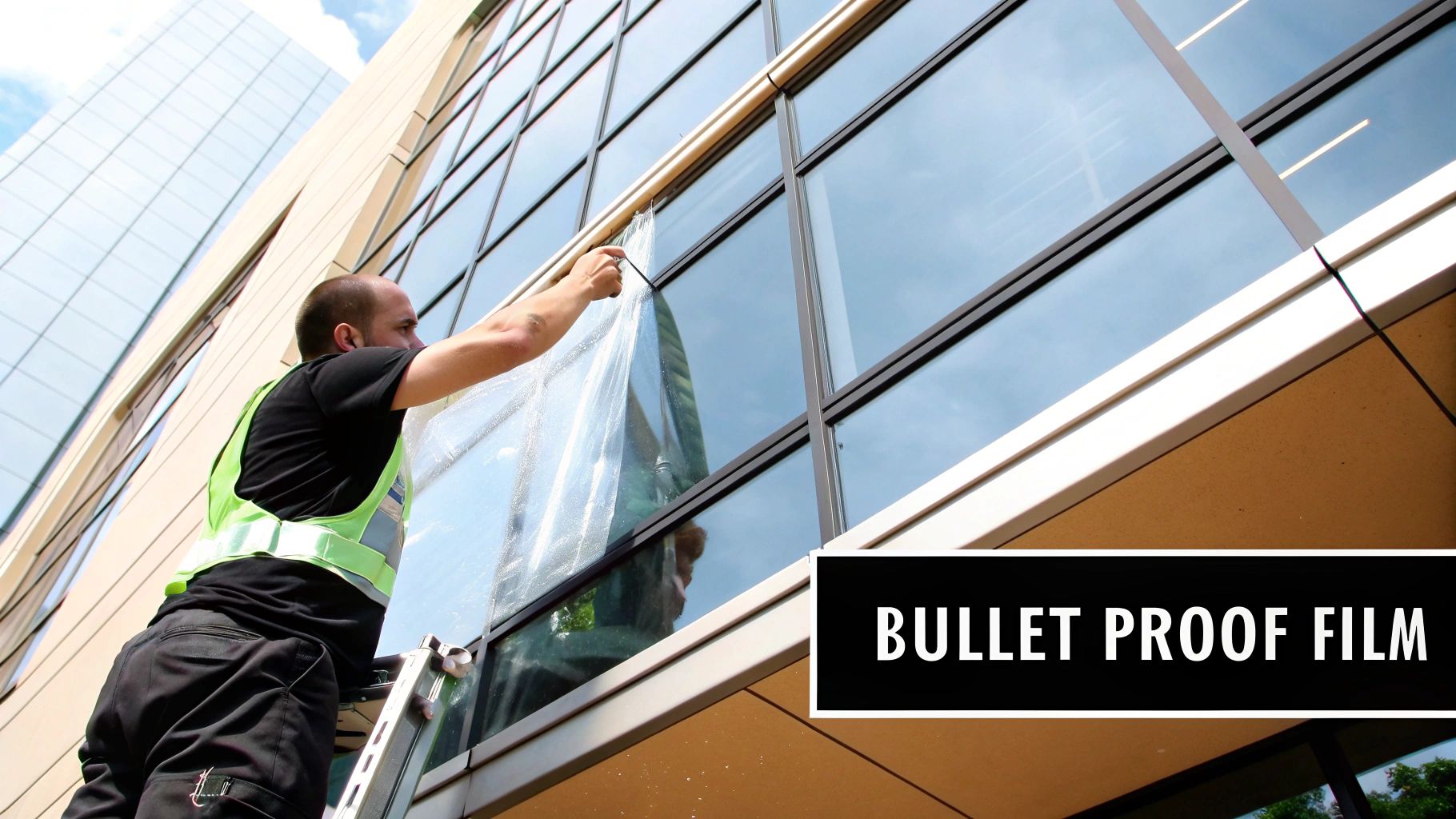
Look at any building, and you'll quickly spot its most vulnerable points: the windows. Standard glass offers almost no resistance. It shatters on impact, creating an open invitation for forced entry, an easy target during an active threat, or a major hazard in a storm. This is where bullet-resistant films completely change the game. They aren't designed to stop a bullet in its tracks, but to expertly manage the violent aftermath.
The magic is in how the film disperses energy. When a projectile hits the treated glass, the film's powerful adhesive and tough, multi-layered construction absorb the initial shock and spread it across the entire pane. The glass will still crack and spiderweb—that's expected—but the film holds it all together, locked firmly in the window frame.
Delaying Threats and Buying Precious Time
This ability to contain the shattered glass is the film's superpower. By keeping the window intact, it accomplishes several critical security goals all at once:
- Denies Immediate Entry: An intruder can't just break the glass and climb in. They're now faced with a stubborn barrier that requires a lot more time and effort to defeat.
- Mitigates Projectile Hazards: In an explosion or impact, glass fragments become lethal shrapnel. The film keeps those dangerous shards safely contained.
- Creates a Time Buffer: The delay created gives people inside invaluable seconds to escape, hide, or trigger an alarm. It gives law enforcement a bigger window to respond.
In a crisis, time is your most valuable asset. Bullet-resistant films are engineered to give you more of it. They transform a window from an instant point of failure into a resilient obstacle that buys you the seconds that matter most.
The Growing Market for Enhanced Protection
The core material behind these films, typically thermoplastic polyurethane (TPU), is incredibly effective, and its demand is soaring. The global market for TPU bulletproof film was valued at around USD 1.5 billion in 2023 and is on a steep upward trajectory. This growth isn't surprising, as more and more industries—from construction to automotive—are seeking out lightweight, high-strength materials for protection. You can dig into more data on the TPU film market's growth to see the trends driving this demand.
Ultimately, to really grasp what bullet-resistant films do, you have to shift your thinking from "stopping" a threat to "managing" it. These films fortify the glass you already have, turning a building’s weakest link into a robust part of your security plan. It's a simple, powerful retrofit that dramatically enhances safety without ever changing the look of your property.
How Bullet Resistant Films Are Made
The incredible strength of these security films isn't magic; it's a brilliant feat of material science and clever engineering. The star of the show is a material called thermoplastic polyurethane (TPU). This is an advanced polymer prized for its unique combination of elasticity, sheer toughness, and incredible tear resistance. Think of TPU as the film’s flexible, shock-absorbing backbone.
But one layer of TPU, no matter how tough, isn't enough. The real secret lies in a multi-layered construction. It's a simple concept, really. Tearing a single piece of paper is effortless. Now, try tearing a thick phone book—the combined strength of all those individual pages makes it nearly impossible. Bullet resistant films work on the very same principle.
They are meticulously built from dozens of micro-thin layers of polyester and polyurethane. These layers are fused together with a special pressure-sensitive adhesive that's both incredibly strong and flexible, creating a single, unified sheet that is far tougher than any of its individual components.
The Science of Absorbing the Hit
So, what happens when a bullet, a brick, or a hammer strikes glass treated with this film? Two critical things happen in a fraction of a second. First, the powerful adhesive tenaciously grips the glass, preventing shards from flying inward and becoming dangerous projectiles.
At the same time, the film’s multi-layered structure kicks into action. It absorbs the raw kinetic energy of the impact, stretching and distributing the force across the entire surface of the window. This process turns a brittle, fragile pane of glass into a resilient, energy-absorbing shield. The glass itself will likely still crack under a severe blow, but the film holds everything together, maintaining a formidable barrier.
The image below breaks down this simple but highly effective layered defense system.
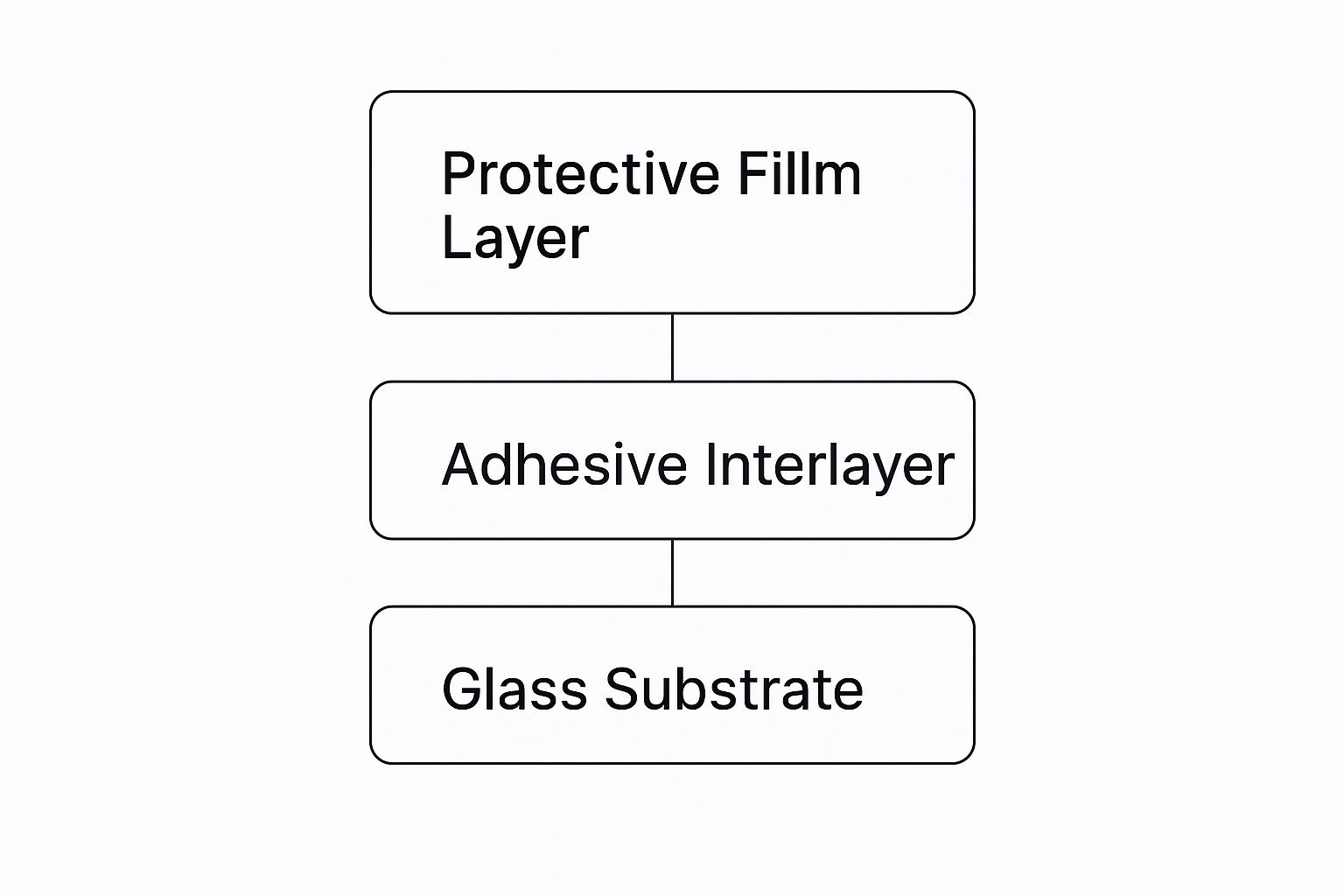
You can see how the film, adhesive, and glass all work together as a single unit to manage and neutralize impact forces.
Measuring Strength: It's All in the Mils
A security film's protective capability boils down to its thickness, which we measure in mils (one one-thousandth of an inch). For context, a standard solar control film might only be 2 mils thick. Security films, on the other hand, start at 4 mils and can go all the way up to 15 mils or even thicker.
The thickness of the film directly corresponds to the level of threat it's designed to handle. A thicker film simply has more layers to absorb and dissipate energy.
The table below provides a quick reference for matching film thickness to common security needs.
Comparing Security Film Thickness to Threat Levels
| Film Thickness (Mils) | Primary Protection Level | Common Applications |
|---|---|---|
| 4-7 Mils | Safety, smash-and-grab deterrence, storm/seismic protection. | Residential homes, storefronts, ground-floor office windows. |
| 8-14 Mils | Enhanced forced entry resistance, anti-intrusion. | High-value retail, government buildings, schools, high-risk locations. |
| 15+ Mils | High-level forced entry and ballistic resistance (in systems). | Embassies, critical infrastructure, panic rooms, military facilities. |
Ultimately, choosing the right thickness is about matching the film’s capability to the specific threat you need to mitigate.
This technology's effectiveness hasn't gone unnoticed. By 2025, the market for TPU bulletproof film is expected to hit around USD 500 million, with a projected annual growth rate of 8% through 2033. This surge is driven by demand from law enforcement, military, and even automotive sectors looking for lightweight protection. You can dive deeper into the market trends by exploring the latest TPU bulletproof film research.
The Anchoring System: The Unsung Hero
Finally, it’s crucial to understand that the film is only one part of a complete security system. To be truly effective against serious threats, the film must be bonded to the window frame itself. This is done with an anchoring system.
This system uses either a structural silicone adhesive or a mechanical batten system to lock the edges of the film to the frame. Without this anchor, a powerful blow could just pop the entire sheet of glass and film out of the frame in one piece.
The anchoring system ensures the glass, film, and frame act as a single, unified barrier, dramatically increasing its ability to withstand immense force. For any serious security application, it’s not an option—it’s a necessity.
Making Sense of NIJ Ratings and Protection Levels
When you start looking into security solutions, you're going to run into a lot of technical terms. How do you actually measure "bullet resistance"? The industry benchmark comes from a set of strict standards created by the National Institute of Justice (NIJ). Think of it as the gold standard for ballistic protection here in the U.S.
But here’s the single most important thing to get straight from the start: bullet proof films alone do not get an NIJ rating. That's a huge misconception. The NIJ doesn't test just one part; it certifies the entire system working together—the glass, the film, the anchoring system, and the frame. The film is just one piece of a much larger puzzle.
It's All About the System
Think of it like building a race car. You wouldn't say the tires alone make the car fast, would you? Their performance depends entirely on the engine, the suspension, and the chassis. It's the same idea here. A security film’s real-world ability to stop a threat is completely tied to the kind of glass it’s on and how securely it’s all locked into the frame.
This system-based approach is what makes the rating meaningful. A thick, multi-layer film will behave one way on a standard piece of glass and completely differently on stronger laminated glass, especially when paired with a heavy-duty anchoring system.
The NIJ rating applies to the complete glazing assembly, not just the film. This holistic testing guarantees that the entire window system can withstand the specified threat, from the impact on the glass to the stress on the frame.
NIJ Levels in Plain English
The NIJ standard is broken down into different levels, kind of like weight classes in boxing. Each level is tested and certified to stop a specific type of bullet from a specific type of firearm. Knowing these levels helps you match the right solution to your actual needs, so you don't end up with too little protection or paying for too much.
Here’s a simple breakdown of the levels you'll most often see for window security:
- NIJ Level I: This is your baseline. It's designed to stop lower-velocity handgun rounds like a .22 Long Rifle and .380 ACP.
- NIJ Level IIA: A step up, this level protects against more common, higher-velocity handgun threats, including 9mm and .40 S&W rounds.
- NIJ Level II: This level offers solid protection against a wider range of handguns, capable of stopping more powerful 9mm rounds and the .357 Magnum.
- NIJ Level IIIA: This is one of the most common and practical ratings for public buildings and businesses. It's rated to stop heavy-hitting handgun rounds like the .357 SIG and .44 Magnum, covering the vast majority of threats you're likely to face.
While NIJ ratings go all the way up to Level IV (which can stop armor-piercing rifle rounds), those are typically for military or high-risk government facilities, not your average window retrofit.
So, Which Level Do You Need?
The best approach is to be realistic about your situation. A downtown jewelry store worried about smash-and-grabs has very different security needs than a federal building. For most schools, businesses, and even homes, a system rated at NIJ Level IIIA offers a powerful defense against the most common firearm threats.
At the end of the day, these NIJ standards give us a clear, reliable way to measure performance. They cut through the marketing noise and provide objective proof of what a system can do. By understanding what these ratings actually mean, you can make a smart investment in a certified bullet proof film system that gives you the exact security you need.
Where Security Film Makes a Real-World Difference
The science behind bullet proof film is impressive, but its true value comes to life when you see it in action. This isn't just a theoretical defense—it's a practical tool that protects people and property every single day, in more places than you might think.
The magic is in turning a building's weakest link, its glass, into a surprising source of strength. By holding shattered glass together even under extreme force, these films stop intruders in their tracks, prevent deadly glass shards from flying, and—most importantly—buy precious time. That delay is everything. It's the window of opportunity for people to get to safety and for help to arrive.
Protecting Your Home and Family
For any homeowner, peace of mind is the ultimate goal. Unfortunately, windows and glass doors are the go-to entry points for burglars because a standard pane of glass can be broken in a single second. It’s quick, quiet, and effective.
Security film completely flips that script.
An intruder expecting an easy smash-and-grab is suddenly faced with a frustratingly resilient barrier. The glass will spiderweb, but it won't give way. The repeated, noisy effort needed to even try to get through draws immediate attention and ruins their element of surprise, usually sending them running.
It’s a simple upgrade that hardens your home's defenses without changing its look. While these films are a fantastic layer of protection for your windows, they work best as part of a complete security plan. To see how different measures can work together, it's worth exploring comprehensive home security strategies.
Beyond break-ins, these films are also a powerful shield against Mother Nature. During hurricanes, tornadoes, or earthquakes, flying debris can instantly shatter windows. Security film keeps that glass in the frame, maintaining the protective envelope of your home and protecting everyone inside from dangerous projectiles.
Securing Businesses and Retail Stores
Walk down any main street, and you’ll see businesses that are prime targets for smash-and-grab robberies. These crimes are over in seconds. Thieves shatter a window, snatch high-value goods, and are gone before anyone can react. In 2023, one major retailer blamed organized retail crime for a staggering $500 million drop in profits.
This is where bullet proof films become a business owner's best friend. By stopping storefront windows and display cases from shattering instantly, they dismantle the entire smash-and-grab playbook. When criminals can't get in and out in a flash, the target loses all its appeal.
For businesses in higher-risk areas, the film also offers a degree of blast mitigation. In the event of a nearby explosion, it dramatically reduces the hazard from flying glass. The growing need for this kind of protection is clear, with the global bulletproof glass market seeing huge growth as security threats rise.
Fortifying Schools and Public Buildings
Protecting our schools and government facilities has, unfortunately, become a top priority. Security films are one of the most effective and accessible tools for creating safer spaces for students, teachers, and public servants. Here, their job is all about access denial and threat delay.
In an active threat scenario, every second counts. By reinforcing windows and glass entryways, security films can delay an intruder’s progress by several crucial minutes. That’s invaluable time for lockdown procedures to start and for law enforcement to arrive.
It’s also one of the most cost-effective security upgrades a school or public building can make. It hardens the entire perimeter without making the building look like a fortress, so you get enhanced safety while maintaining a welcoming environment.
Enhancing Automotive Security
The same principles apply to our vehicles. Bullet proof films are being used more and more in cars to protect against threats like carjackings and smash-and-grab thefts. We've all seen the aftermath—a shattered side window and valuables gone.
By reinforcing a car's glass, security films make it incredibly difficult for an attacker to break a window to get to you or your belongings. This alone can deter a carjacking attempt or make an opportunistic thief move on to an easier target. For executives or anyone needing a higher level of protection, these films add a discreet but powerful layer of security, turning vulnerable glass into a protective shield.
Security Film Use Case Comparison
To put it all into perspective, let's look at how these applications compare across different sectors. While the film is the same, the primary goals and benefits are tailored to the specific threats each environment faces.
| Sector | Primary Security Goal | Key Benefits |
|---|---|---|
| Residential | Intrusion Deterrence | Delays break-ins, protects against storm damage, provides family safety and peace of mind. |
| Commercial | Asset Protection | Prevents smash-and-grab theft, mitigates blast damage, protects inventory and employees. |
| Educational | Access Denial & Delay | Buys critical time in active threat situations, hardens building perimeter, protects students/staff. |
| Automotive | Occupant Safety | Deters carjacking and theft, protects against violent entry, secures personal property. |
As you can see, the core function of delaying and deterring threats translates into unique, vital advantages no matter where the film is installed. It's a versatile solution for a world full of unpredictable risks.
Why Professional Installation Is Non-Negotiable
You can buy the best-rated bullet proof film on the market, but until it's installed, it's just a roll of high-tech material. Its ability to stop a threat is only activated through a flawless, professional installation. This is absolutely not a weekend DIY project—the gap between a pro job and an amateur attempt can be the difference between total security and a catastrophic failure.
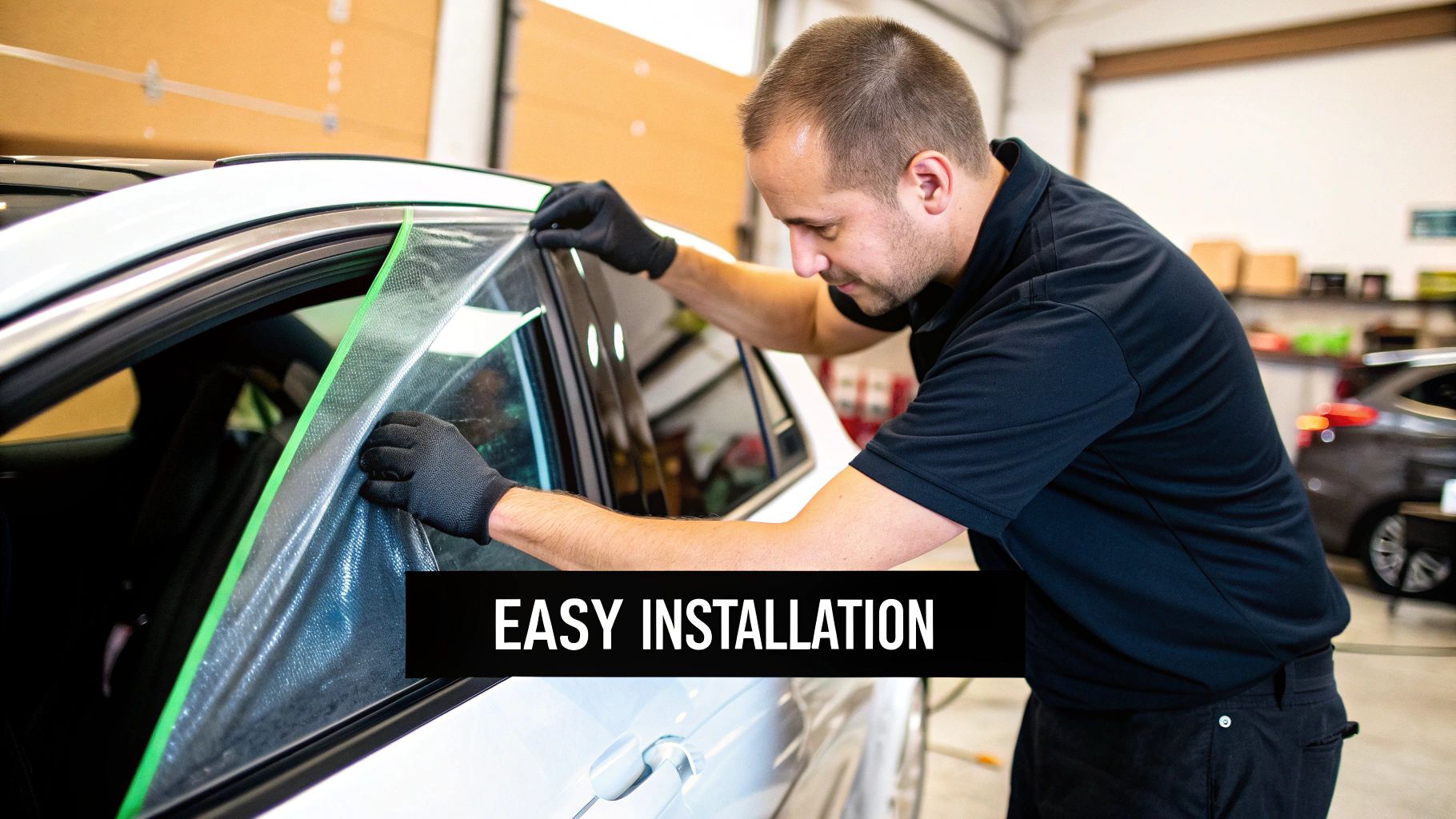
Think of it like this: a world-class race car engine sitting on a pallet is just a piece of metal. It only becomes a powerhouse when installed by a master mechanic who understands every connection, every tolerance, and every nuance.
A professional film installer works with that same level of precision. Even a single speck of dust trapped under the film, a tiny air bubble, or an edge that isn't perfectly sealed creates a weak point. Under impact, that's exactly where the system will fail. The goal is to create such a seamless bond that the film and glass effectively become a single, laminated unit.
The Anchoring System: Where the Real Strength Lies
The installation is far more than just squeegeeing a film onto glass. The real magic happens with the anchoring system. This is the critical step where the edges of the film are mechanically or chemically bonded directly to the window frame.
Without this step, a powerful blow could just push the entire pane of filmed glass out of its frame, completely defeating the purpose of the film. A properly installed anchoring system turns the film, glass, and frame into one unified, resilient barrier. It’s designed to transfer the immense shock of an impact away from the glass and into the surrounding structure of the building.
A bullet proof film without an anchoring system is like a seatbelt that isn't buckled. The material is strong, but it can't protect you if it isn't secured to the frame.
How to Vet Your Installer
Choosing the right installer is just as critical as choosing the right film. A true expert will be able to answer your questions clearly and confidently, so don't be afraid to dig in.
Here’s a quick checklist of questions to ask any potential installer:
- "Are you certified by the film manufacturer?" This is a big one. It proves they've been specifically trained to install the product you're buying.
- "What kind of anchoring system do you recommend for my frames, and why?" Their answer should be tailored to your specific windows—whether they're wood, vinyl, or aluminum—and the security level you need.
- "Can I see a portfolio of similar projects?" Looking at their past work, especially on buildings like yours, is a great indicator of their experience and quality.
- "What, exactly, does your warranty cover?" A solid warranty will cover both the film itself (against defects like bubbling or peeling) and the labor.
Long-Term Care for Lasting Protection
Once your security film is installed, keeping it in top condition is surprisingly simple. For cleaning, just use a soft cloth or a rubber squeegee with a gentle, ammonia-free cleaning solution. You'll want to avoid any abrasive scrubbers or harsh chemicals that could scratch the film's outer coating.
It’s also a good idea to periodically check the edges of the film, right where it meets the frame and anchoring system, for any signs of lifting. This is very rare with a quality installation, but catching it early makes for an easy fix. With just a little care, your investment will remain an invisible guardian, ready to perform when you need it most.
More Than Just a Shield: The Everyday Perks of Security Films
People install security films for one main reason: protection. But what most don't realize is that these films pull double-duty, delivering a host of practical benefits that improve comfort, protect your property, and even trim your energy bills. It's this combination of safety and everyday value that makes them such a savvy upgrade for any building.
One of the most impressive behind-the-scenes features is their ability to fight off the sun's damaging radiation. Think of it like a powerful, transparent sunscreen for your entire interior. These films can block up to 99% of harmful UV rays.
Keeping Your Interiors Looking New
That constant stream of sunlight streaming through your windows might seem harmless, but over time, it's brutal on your belongings. Hardwood floors warp and discolor, custom upholstery fades, and cherished artwork can be permanently ruined. Security film puts a stop to that slow-motion damage, preserving the value and beauty of your interiors for the long haul.
But the benefits don't stop at UV protection. These films are also serious energy savers. Windows are notorious weak points when it comes to insulation, letting heat pour in during the summer and escape during the winter.
Security films act as an invisible barrier, reflecting solar heat to keep things cool when it's hot and helping trap warmth inside when it's cold. This makes a real difference to your bottom line.
By cutting down on solar heat gain, your air conditioner doesn't have to work nearly as hard, which means lower electricity bills. In the winter, that same film provides an extra insulating layer, keeping the heat you've paid for right where it belongs. The result is a more comfortable, stable indoor climate all year round, and a smaller carbon footprint to boot.
Building a Complete Safety Net
The peace of mind that comes with this level of protection is huge. You’re not just reinforcing a weak point; you're also making daily life more comfortable and protecting your investments.
Of course, windows are just one part of the equation. For total security, a layered strategy is always best. Exploring a comprehensive guide to home security systems can show you how alarms, cameras, and physical deterrents can work together with your fortified windows. It’s these hidden, everyday advantages that truly round out the value of security films, making them a cornerstone of any smart safety plan.
Your Questions, Answered
Making a big decision about security always comes with questions. It's smart to have them. Here are some of the most common things people ask about bullet resistant film, with straightforward answers to help you get a clear picture.
Can I Just Install This Film Myself?
For basic, thin safety films, a DIY approach might be tempting. But when we're talking about true bullet resistant film, the answer is a firm no. Professional installation is non-negotiable.
The film's strength doesn't just come from the material itself; its real power lies in a flawless application and, crucially, a robust anchoring system that chemically fuses the film to the window frame. Think of it like a chain: an amateur installation creates weak links that are guaranteed to fail under impact. You’re not just paying for the film; you’re investing in an expertly installed system that will actually work when you need it most.
What's the Ballpark Cost for Bullet Resistant Film?
You can expect professionally installed security film to run anywhere from $15 to over $30 per square foot. That's a pretty wide range, and the final price tag really depends on a few key things:
- Film Thickness: The tougher the film, the higher the cost. Films built to stop higher-level threats have more layers and are at the top end of that price range.
- Anchoring System: The specific type of anchor needed for your window frames is a big factor in the overall cost.
- Window Complexity: A large, flat, easy-to-access window is simpler than a series of small, custom-shaped panes on the third floor. Labor costs will reflect that.
My best advice? Get a few detailed quotes from certified installers. It’s the only way to know you’re getting a fair price for the protection you're after.
Will This Film Make My Windows Look Weird?
Not at all. One of the best things about modern security films is that they are designed to be optically clear. Once installed, the film is virtually invisible. Your view won't be distorted, and your glass will look exactly the same as it did before.
That said, if you want to change the look or add other features, you can. Many security films come in combination versions. You could choose a tinted film for privacy and to cut down on solar heat, or even a frosted one for a more decorative touch. It all comes down to what you need the film to do.
How Long Does This Stuff Actually Last?
When you have a high-quality bullet resistant film installed by a pro, you can expect it to last a long time. Most top-tier manufacturers back their products with a warranty of 10 to 15 years, but it's not uncommon for the film to perform well beyond that.
Of course, its lifespan depends on factors like the local climate, how much direct sun it gets, and how well you take care of it. A little common-sense maintenance—just cleaning it with non-abrasive materials as recommended—will go a long way in making sure your investment remains a reliable barrier for years.
Ready to turn your most vulnerable entry points into a source of strength? The experts at Fortress Security Films provide certified installations of advanced security film systems for residential, commercial, and automotive applications.
Secure your property with a professional consultation today.
