


First things first, let's get a common misconception out of the way. While everyone calls it "bulletproof film," the industry term is actually ballistic-resistant film. The distinction is important. This isn't some magic shield that makes glass invincible; it's a multi-layered material engineered to absorb and disperse the raw energy of an impact, holding the dangerous mess of glass shards together.
Its real job? To stop an intruder or a projectile from getting through immediately and to create one tough barrier against forced entry.
Decoding the Strength of Ballistic Resistant Film
When people hear "bulletproof film," they often imagine an invisible force field that can stop a cannonball. The reality is a lot more nuanced and, frankly, more practical. Think of it less like a solid steel plate and more like a high-tech catcher's mitt for your windows. Its primary goal isn't to be completely unbreakable, but to manage the incredible kinetic energy that comes with a high-velocity impact.
When a bullet or a hammer strikes glass treated with this film, the layers work together instantly. They flex and stretch, absorbing the shock and spreading the force across the entire pane of glass. This is what keeps the glass from exploding into a hail of deadly, flying shards—which, by the way, are often the main cause of injury during a blast or break-in.
The core function of ballistic film is to maintain the integrity of the glass envelope. By holding the shattered pane together, it creates a tough, flexible barrier that significantly delays—and often deters—forced entry or ballistic threats.
What Is It Made Of
The secret to its remarkable strength is all in the construction. This isn't just a simple sheet of plastic; it's a sophisticated composite material. We're talking about multiple layers of high-tensile polyester film, all meticulously bonded together with powerful, pressure-sensitive adhesives.
The film's thickness, which we measure in mils (one-thousandth of an inch), is directly tied to its strength. A standard solar film might be just 2 mils thick. Security films, on the other hand, start around 4 mils and can go all the way up to 15 mils or more for serious protection. For true ballistic resistance, these thicker films are almost always paired with a special anchoring system that physically secures the film and glass to the window frame itself.
This multi-layered design gives the film its impressive physical properties:
- Tensile Strength: Its ability to resist being pulled apart.
- Break Strength: The sheer amount of force needed to tear the film.
- Puncture Resistance: Its capacity to withstand being pierced by a sharp object.
A Practical Security Upgrade
Let me be crystal clear: no film alone can make standard glass truly "bulletproof" to the level of military specifications. A complete ballistic-resistant system involves applying a thick, multi-layered film to specialized glass and then anchoring that entire unit securely into the window frame. It's this combination that transforms a building's weakest points into a formidable line of defense.
The real-world value of this film is that it buys you time. In an active threat or a smash-and-grab scenario, those precious few seconds can be the difference between safety and tragedy. They give people inside a chance to get to cover and give law enforcement a window to respond. It acts as a powerful deterrent, turning what would have been an easy entry point into a loud, frustrating, and time-consuming obstacle for any would-be attacker.
How Ballistic Resistant Film Actually Works
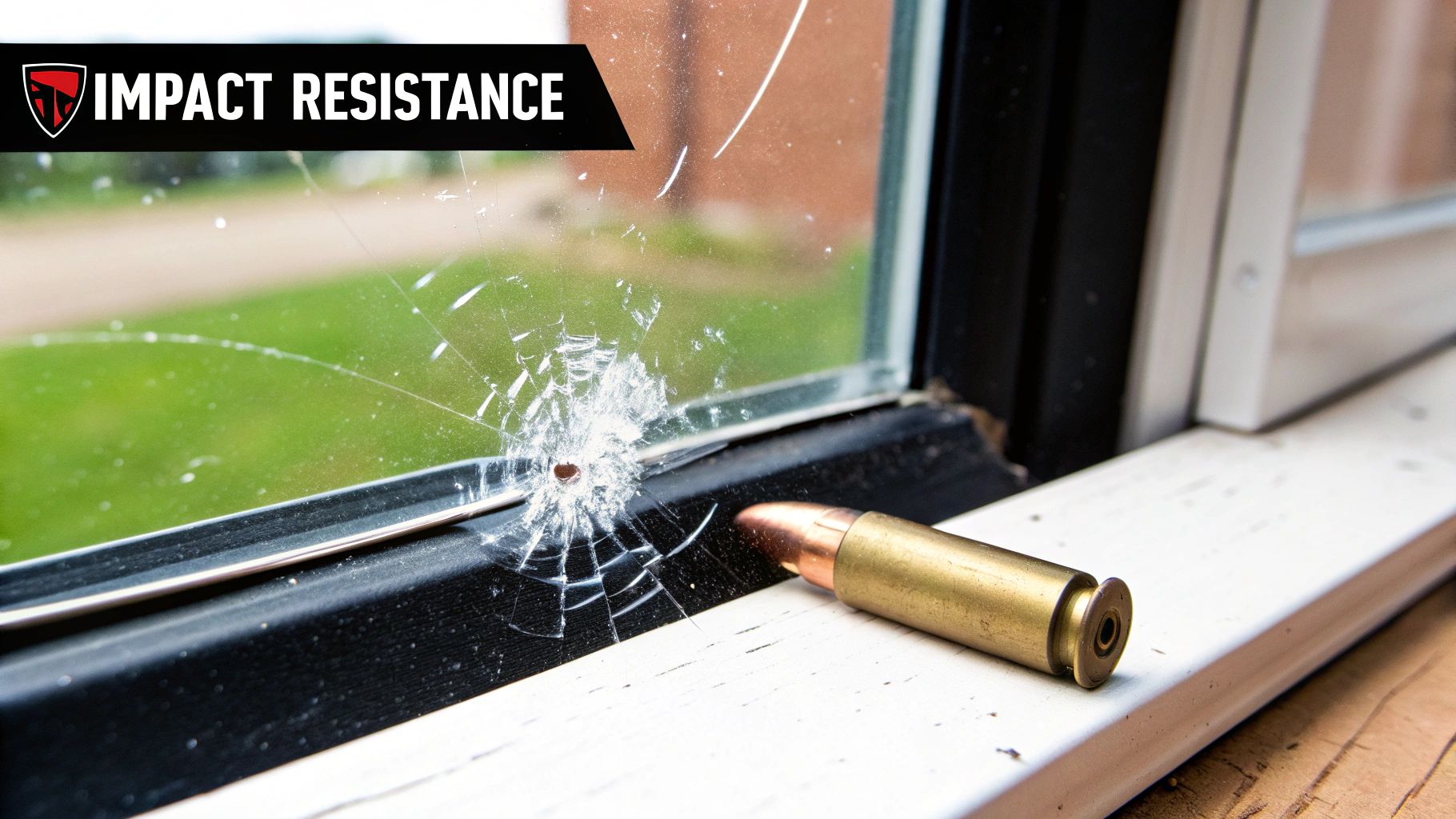
It’s hard to imagine how a thin, clear film could possibly hold up against the incredible force of a bullet. The secret isn't about creating an unbreakable barrier; it's about the clever physics of dispersing energy. The whole process unfolds in a split second, turning a weak point like a window into a flexible, resilient shield.
Think about a gymnast landing a high-flying routine on a trampoline. The surface doesn’t just stop her cold. It gives, stretches, and absorbs the impact, bringing her to a safe stop. A bullet proof film works in a remarkably similar way, just on a much more violent and instantaneous scale.
When a bullet hits glass treated with this film, a chain reaction kicks off. Instead of the glass instantly exploding, the film’s multiple, micro-thin layers of high-tensile polyester immediately start to stretch and deform.
Absorbing and Dispersing Kinetic Energy
This stretching is the heart of the technology. The kinetic energy from the bullet, which would normally punch right through a single point, is spread out across the entire surface of the window. By distributing the force, the film prevents the glass from failing at the point of impact and dramatically reduces the bullet's power to penetrate.
It's like the difference between throwing a rock into a pond versus into a spiderweb. The water barely resists as the rock sinks. But the spiderweb? It catches the rock, as every interconnected thread stretches to absorb the force and hold the object in place.
The real unsung hero here is the powerful, pressure-sensitive adhesive that bonds the film to the glass. This bond is what turns two separate materials into a single, unified laminate, allowing the impact energy to transfer seamlessly from the rigid glass to the flexible film. Without that bond, the glass would simply shatter behind the film, offering no real protection. If you want to dive deeper into these systems, you can learn more about how https://fortresssecurityfilms.com/ballistic-window-film/ functions across different applications.
The primary goal of ballistic resistant film is to manage the impact. By absorbing and redistributing energy, it prevents immediate penetration and holds shattered glass together, turning a critical vulnerability into a robust defensive layer.
Preventing Spalling and Delayed Entry
One of the biggest dangers when a bullet hits standard glass is something called spalling. This is when fragments from the inside of the glass are blasted into the room at high speeds, becoming lethal projectiles themselves. These shards can cause horrific injuries, even if the bullet never enters the space.
Ballistic resistant film all but eliminates this threat. The powerful adhesive grips the fractured glass, keeping it together and preventing those deadly fragments from flying inward. It keeps the danger on the outside.
Holding the glass together also achieves another vital security goal: delayed entry.
- Forced Entry: An intruder trying to smash their way in will be met with serious resistance. The film keeps the broken glass locked in the frame, forcing them to make a lot of noise and waste a lot of time to create even a small opening.
- Ballistic Threat: Even if a powerful round pierces the glass, the film and the spiderweb of cracks it's holding together can often slow or even trap the projectile, preventing it from continuing its path.
This delay is everything. It robs an attacker of the element of surprise and buys precious seconds—or even minutes—for people inside to take cover, initiate a lockdown, or call for help. In any active threat situation, time is your most valuable asset, and that's exactly what a professionally installed security film system gives you.
The Real Benefits of Security Window Film

While the main job of a bullet proof film system is to stop or slow down an attacker, that’s really just scratching the surface. When you install this kind of advanced film on your windows, you unlock a whole range of benefits that boost safety, security, and even day-to-day comfort in ways most people don't expect. It’s about turning your building's weakest points into multi-functional assets.
It's these all-encompassing advantages that are fueling some serious market growth. The bulletproof security glass market is expected to hit around $11.56 billion in 2025 and is on track to more than double to $30.38 billion by 2032. This incredible growth is a direct response to rising security concerns worldwide and the real need for better protective solutions. If you want to dig deeper, you can discover more insights about this growing market and its key drivers.
Protection Beyond Ballistics
In the real world, the threats you’re most likely to face are far more common than gunfire. From violent storms to a brick through the window, security film provides a tough, reliable shield that protects people and property when it counts.
Think about what happens during a hurricane or an earthquake—the biggest danger is often flying shards of glass. Security film is designed to hold the pane together, even after it shatters. This keeps the glass from turning into deadly projectiles and maintains a barrier against the wind and rain trying to get inside.
The same principle makes it a fantastic deterrent against forced entry.
- Smash-and-Grab Deterrence: For a retail business, the film transforms a quick smash-and-grab attempt into a loud, difficult, and time-consuming mess. More often than not, thieves will just give up and run.
- Vandalism Prevention: It also acts as a sacrificial layer, protecting the glass itself from scratches, acid etching, and graffiti.
- Blast Mitigation: For high-risk buildings, the film is critical for containing glass fragments during an explosion, which dramatically reduces injuries from flying debris.
Unseen Advantages for Comfort and Preservation
Beyond the obvious security perks, a high-quality window film brings some powerful secondary benefits that improve the indoor environment and protect your interior finishes. These are the advantages that work quietly in the background, adding value to your investment every single day.
One of the best is its ability to block harmful ultraviolet radiation. Most security films filter out up to 99% of UV rays, which are the number one cause of fading. This keeps your furniture, flooring, artwork, and merchandise from losing their color, extending their life and preserving their value.
A common misconception is that security film is only for extreme threats. In reality, its daily benefits—like UV protection and energy savings—provide consistent value long before an emergency ever occurs.
On top of that, many security films have solar control properties built right in. By rejecting a good chunk of the sun's heat, the film helps keep your indoor temperatures much more stable and comfortable, especially on those scorching summer days.
This leads directly to another huge win: energy efficiency.
- Reduced Heat Gain: Less solar heat pouring through the windows means your air conditioning system doesn't have to work nearly as hard.
- Lower Energy Bills: Easing the load on your HVAC system translates directly into noticeable savings on your monthly energy costs.
- Improved Comfort: The film helps get rid of those annoying hot spots near windows, creating a more pleasant and consistent environment for everyone inside.
Understanding Film Types and Protection Levels
Trying to make sense of security films can be confusing, since not all products are created equal. When it comes to choosing the right bulletproof film, the secret is to look past the marketing hype and focus on what really matters: the film's physical properties and how they stand up to real-world threats.
The single most important factor is the film's thickness, which is measured in mils. A mil is simply one-thousandth of an inch. To put that in perspective, a basic solar control film is usually just 2 mils thick. Real security films, however, start at 4 mils and can go all the way up to 21 mils or even more for serious protection.
It’s pretty straightforward: the thicker the film, the more punishment it can take. A thicker film has greater tensile strength, making it much harder to tear or puncture. This is what allows it to absorb and spread out the force from an impact, whether that’s from a burglar’s crowbar, a bomb blast, or a bullet.
Decoding Industry Protection Ratings
To bring some order to the chaos, independent organizations have created strict testing standards. The two big names you'll see are Underwriters Laboratories (UL) and the National Institute of Justice (NIJ). Their ratings are the best way to cut through the noise and see what a film system can actually do.
The rating you’ll hear about most often is UL 752, which is the gold standard for testing the ballistic resistance of materials. For a window system to earn this rating, it has to stop a specific number of shots from a particular firearm without the bullet passing through or sending dangerous shards of glass flying on the inside (a phenomenon called "spalling").
- Level 1: Must stop three shots from a 9mm handgun.
- Level 2: Has to withstand three shots from a powerful .357 Magnum.
- Level 3: Is tested against three shots from an even more potent .44 Magnum.
One crucial point to remember: these ratings are for the entire system. That means the film, the glass it’s on, and the special anchoring system that bonds it all to the window frame. A film by itself on a standard piece of glass won’t get you a ballistic rating.
Matching Film Thickness To Your Needs
So, how thick does your film need to be? It all comes down to what you’re trying to protect against. A homeowner who wants to stop a quick smash-and-grab doesn’t need the same level of protection as a government facility worried about a planned attack.
This is where the distinction between a DIY job and a professional installation becomes critical, especially when security is on the line.
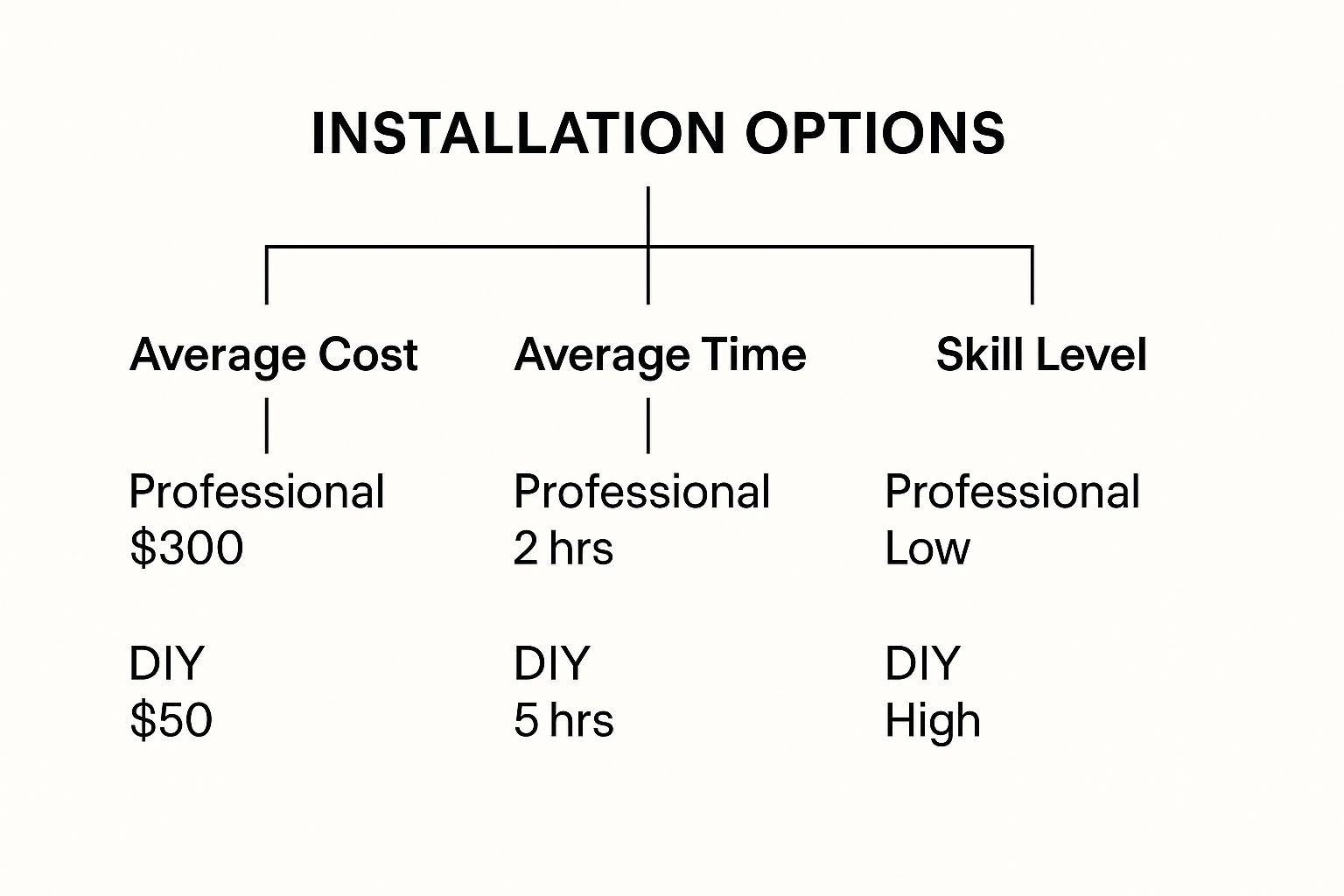
As the data shows, you might save some money upfront with a DIY kit, but a professional installation guarantees the system is installed correctly and will actually perform when you need it most. For security applications, that peace of mind is everything.
It's worth pointing out that "bulletproof" is a bit of a misnomer—no material is truly invincible. The real goal of a ballistic-resistant system is to delay, deter, and absorb damage. It's about buying precious time for people inside to react and for help to arrive.
This need for reliable protection is fueling massive growth in the industry. The market for bullet-resistant systems, including security films, was valued at $5.02 billion in 2024 and is expected to more than double, reaching $11.25 billion by 2032. This surge is driven by a growing demand for better security in vehicles, public buildings, and businesses. You can [explore the full research on this expanding market](https://www.fortunebusinessinsights.com/bulletproof-glass-market-102 Bulletproof Glass Market) to see what’s behind the trend.
Security Film Thickness and Protection Levels
To help you get a clearer picture of what you might need, this table breaks down common film thicknesses and what they're designed for.
| Film Thickness (Mils) | Primary Protection Level | Typical Applications | Ballistic Resistance Rating (If Applicable) |
|---|---|---|---|
| 4-7 Mils | Safety & Smash-and-Grab Deterrence | Residential homes, storefronts, and ground-floor offices. | None |
| 8-14 Mils | Enhanced Security & Blast Mitigation | Schools, commercial buildings, government offices, and high-value retail. | Low-level resistance when part of an approved system. |
| 15+ Mils | High-Level Ballistic & Forced Entry Resistance | High-risk government facilities, police stations, and critical infrastructure. | Higher UL & NIJ levels when part of an approved system. |
Ultimately, choosing the right thickness is about matching the film’s capabilities to your specific threat assessment. A thinner film is great for basic safety and deterrence, while the thickest multi-layer films are reserved for situations where the stakes are highest.
Where Does Bullet Proof Film Make Sense?
The science behind ballistic resistance is one thing, but seeing where bullet proof film is actually put to work is where its value really clicks. This isn't just a high-tech solution for government motorcades or embassies. It’s a practical security layer that solves real-world problems in all sorts of places, from your local electronics store to the neighborhood middle school.
Think about it: a building's weakest points are almost always its windows and glass doors. By transforming this vulnerability into a source of strength, the film offers a powerful defense against a host of modern threats. It’s all about delaying entry and keeping shattered glass contained, which can make all the difference when it comes to protecting people and property.
Safeguarding Commercial and Retail Spaces
Glass-front retail stores are practically an invitation for smash-and-grab robberies. An unprotected window can be broken in a split second, giving a thief just enough time to snatch merchandise and disappear. This is precisely the scenario where security film completely changes the game.
When a criminal tries to break a window treated with ballistic-resistant film, the glass will crack and spiderweb, but it won't collapse. The tough, adhesive film holds all those dangerous shards firmly in place, creating a surprisingly resilient barrier that’s a nightmare to get through.
The real magic here is delay. Forcing a way through the filmed glass takes time and makes a ton of noise. That robs thieves of the one thing they count on: speed. Often, the frustration is enough to make them give up and run.
This gives law enforcement a much-needed window to respond and protects a store’s valuable inventory. For many business owners, it's a smarter investment than bulky roll-down shutters, allowing them to maintain an open, welcoming look without compromising on security.
Reinforcing Educational and Government Facilities
Schools, courthouses, and other public buildings have a massive responsibility to keep people safe. Installing bullet proof film on windows and glass entryways is a proactive step that dramatically strengthens a building’s first line of defense.
During an active threat, the film’s ability to stop an intruder from simply shooting or smashing their way through a glass door can be a lifesaver. It buys precious, irreplaceable time for people inside to follow lockdown protocols, find shelter, and for first responders to get to the scene.
You’ll often see it applied in these key areas:
- Entryway Doors and Sidelites: Hardening the most obvious points of entry.
- Ground-Floor Classroom Windows: Securing rooms that are easily accessible from the outside.
- Administrative Office Windows: Protecting staff in vulnerable, public-facing offices.
- Library and Cafeteria Windows: Securing large common areas with lots of glass.
The need for effective, lightweight security solutions like this is booming. In fact, the global market for this type of film (specifically TPU, or Thermoplastic Polyurethane) is expected to leap from $800 million in 2025 to nearly $2.5 billion by 2033.
Protecting Homes and Valued Assets
The film is also finding a place in residential security. For homeowners, it offers incredible peace of mind against everything from burglaries to severe weather. A would-be intruder expecting to quietly break a window or sliding glass door will be met with a loud, frustrating obstacle that draws unwanted attention. If you're looking into this for your own property, understanding the specific benefits of security window film for home windows is a great next step.
This same principle applies to protecting high-value assets, whether it’s a private art collection, a company’s server room, or a sensitive R&D lab. By reinforcing the glass, the film adds a crucial layer of defense against both targeted attacks and opportunistic crime, ensuring that what matters most stays safe and sound.
Why Professional Installation Is a Must
You can buy the best bulletproof film on the market, but its true strength is unlocked by one thing: a perfect installation. This isn't a job for a weekend warrior with a squeegee. The film's incredible ability to stop a threat depends entirely on a flawless application, and that’s something only a seasoned pro can deliver.
Think of it this way: even a tiny speck of dust or a microscopic air bubble trapped between the film and the glass creates a weak spot. Under a high-impact event, that’s exactly where the system will fail. Professional installers have a meticulous process, from deep-cleaning the glass to using specialized tools, to create a bond so seamless it's practically at a molecular level.
It's Not Just About the Film, It's About the Frame
But simply sticking the film to the glass is only half the battle. The real game-changer, and what truly separates a professional job from an amateur attempt, is the anchoring system. This is what turns a strong piece of film into a legitimate security barrier.
Without a proper anchor, an attacker could still shatter the glass and just push the entire filmed pane right out of the window frame. The film does its job holding the glass together, but the whole unit fails. Anchoring is how you stop that from happening.
An anchoring system is what mechanically fastens the film and the glass to the window frame itself. It forces the entire structure—glass, film, and frame—to work as a single, unified system to resist an attack.
Wet Glazing: The Secret to a Strong Bond
So how do the pros anchor the film? The most trusted and effective technique is called wet glazing.
Installers use a high-strength structural silicone, like the industry-standard Dow Corning 995, to create a powerful yet flexible bond between the edge of the film and the window frame. When an impact occurs, this bead of silicone allows the energy to transfer from the glass, through the film, and into the building's structure.
In some cases, a mechanical attachment system—like a bolted metal batten system—might be used to clamp the film's edges to the frame. The goal is always the same: make sure the window holds its ground under extreme force.
Getting the installation right is everything. To learn more about what this process involves, it’s worth understanding the specifics of a professional security window film installation. A certified technician can evaluate your specific windows and determine the exact anchoring method needed to give you the protection you're paying for.
Common Questions About Bullet-Resistant Film
Even with all the details, you probably still have a few practical questions. That’s completely normal. When you’re thinking about a security upgrade this important, you want to be sure. Let's walk through some of the most common things property owners ask us.
Is Window Film Actually Bulletproof?
This is the big one, and the straight answer is no, the film itself is not bulletproof. It's a common industry term, but "ballistic-resistant" is a much more accurate description.
Think of it this way: a thick, multi-layered security film, when installed by a pro with a proper attachment system, creates a powerful barrier. It’s designed to absorb the massive energy from a bullet's impact and hold the glass together, preventing it from shattering inward. This dramatically slows down an attacker, but it doesn't stop the bullet cold like a steel plate would. To get an official UL 752 ballistic rating, the film must be part of a full system, which usually includes specialized glass or multiple layers of film on laminated glass.
How Long Does Security Film Last?
You can expect a high-quality, professionally installed security film to last for a very long time. It’s a serious investment in your building's safety. Most top-tier films are backed by a manufacturer's warranty for 10 to 15 years in commercial settings, and many even offer a lifetime warranty for homes.
These warranties are there to give you peace of mind and typically cover issues like:
- Bubbling and peeling
- Cracking or crazing
- Discoloring or turning purple
As long as you clean it properly (just use soft cloths and non-abrasive cleaners), your security film will keep doing its job for decades.
Will the Film Change the Look of My Windows?
Not at all. One of the best things about modern security films is their incredible optical clarity. The vast majority are engineered to be completely invisible once they're applied. You won’t see any dark tinting, weird "funhouse" distortions, or anything that changes the architectural beauty of your building.
A professional installation is so seamless that you'll forget it's even there. From the inside looking out or the outside looking in, the glass looks exactly the same—until the moment it's needed most.
Now, if you do want extra benefits, you can opt for a hybrid film. Some security films come combined with solar control properties, which add a slight tint to cut down on heat and glare. But that’s a choice, not the standard.
What Goes Into the Cost of an Installation?
The final price for a bullet-resistant film project really depends on a few key things. The biggest factor is, of course, the film itself—thicker films designed to handle higher levels of threat cost more than thinner films meant for basic smash-and-grab prevention.
Beyond the film, the cost is shaped by:
- Total square footage: How much glass are we covering?
- Window accessibility: High-up or hard-to-reach windows can add to the labor time.
- Attachment system: The type of anchoring needed to secure the film to the frame for your desired level of protection.
- Frame and glass condition: We need to make sure the existing frames and glass are in good shape for a proper bond.
The only real way to get a firm number is with a professional consultation. That way, you get a quote that’s built specifically for your property and your security goals.
Ready to turn your property’s weakest points into a powerful line of defense? Contact Fortress Security Films today for a comprehensive security assessment. Let us show you how our advanced window film solutions can bring you true peace of mind. Learn more at https://fortresssecurityfilms.com.
