


A breaking glass alarm is a security sensor with a very specific, very important job: it listens for the exact sound of glass being shattered. It’s not like a standard motion detector that waits for someone to walk by. Instead, this device acts as an early warning system, sounding the alarm the very instant a window or glass door is broken—often before a burglar has even set foot inside.
Why a Breaking glass Alarm is a Security Essential
Think of your home security system as a team of specialists. You've got your door and window contacts standing guard at the main entry points, and motion sensors patrolling the hallways inside. But what about the most fragile points of entry—your windows? That’s where a breaking glass alarm comes in, acting as a dedicated sentinel whose only mission is to listen.
This clever sensor is engineered to recognize the unique, two-part acoustic signature of a break-in. It first picks up the low-frequency thud of an object hitting the glass, immediately followed by the high-frequency shatter as the pane breaks. This dual-verification method is what makes it so reliable and helps prevent false alarms from a dropped plate or a loud TV.
A Proactive Layer of Perimeter Defense
A breaking glass alarm gives you a serious advantage by beefing up your perimeter protection. It creates a defensive line that triggers an alert at the very first sign of a forced entry, which is a huge step up from a motion sensor that only goes off after an intruder is already moving around your space.
That early warning is priceless for a few key reasons:
- Faster Response Time: You and your monitoring service get an alert seconds before someone can actually get inside.
- Active Deterrence: The sound of a blaring siren triggered by the glass breaking is often enough to send a would-be burglar running.
- Enhanced Peace of Mind: You can keep perimeter sensors like these armed even when you’re home, letting you move around freely while still being protected.
The real power of a breaking glass alarm is how it shifts your security from reactive to proactive. It doesn’t wait for movement; it reacts to the breach itself, buying you and the authorities critical time.
A Growing Role in Modern Security
It’s no surprise that these devices are becoming more popular. The global market for glass alarms is expected to hit USD 1.5 billion by 2033, a clear sign that people want smarter, more effective security for their homes and businesses. Considering there are roughly 2.5 million burglaries in the U.S. each year, the need for this kind of specialized sensor is obvious.
When you add a breaking glass alarm, you're not just installing another piece of equipment; you're shoring up the most common weak spots in your property's defenses. It works hand-in-hand with your other sensors to build a tougher, more complete security network. To get a better sense of the bigger picture, you can learn more about how enhancing security with personalized technology is crucial for stopping intruders today.
How Glass Break Sensor Technology Actually Works
To really get why a breaking glass alarm is so effective, it helps to pull back the curtain on the tech that makes it tick. These sensors aren't just simple microphones. They’re highly specialized devices designed to listen for a very specific sound signature, cutting through the noise of daily life to avoid false alarms.
Most of these sensors work in one of two ways: they either hear the break (acoustic detection) or feel it (shock and vibration sensing).
Think of an acoustic glass break sensor as a security guard with superhuman hearing, trained to listen for a specific one-two punch of sound. This is the most common type you'll find, and it basically acts like a smart microphone that’s always monitoring the room.
It’s not just listening for any loud bang, though. It’s tuned to a unique acoustic fingerprint. When glass gets hit hard, it first makes a low-frequency sound—a dull thud. A split-second later, the glass shatters, creating a spray of high-frequency sound. An acoustic sensor only triggers an alarm when it hears both of those sounds in that exact sequence. This clever dual-check system is what keeps it from being fooled by a barking dog, a slamming door, or a loud movie.
Feeling the Force with Shock Sensors
While acoustic sensors listen, shock sensors feel. Imagine a tiny seismograph stuck right onto your windowpane. This type of sensor doesn't have a microphone at all. Instead, it uses a component called an accelerometer to detect the physical shockwaves that vibrate through the glass when it’s struck.
These sensors are calibrated to ignore minor vibrations from things like heavy rain, strong winds, or even a bird hitting the window. They are set to go off only when they feel the distinct, high-frequency vibrations that come from a forceful impact meant to break the glass. Because they rely on direct contact, you generally need to place one shock sensor on each pane of glass you want to protect.
The key difference is simple: Acoustic sensors protect a space by hearing the break from a distance, while shock sensors protect a specific surface by feeling the impact directly.
The push for smarter, more reliable security has led to some major improvements in this tech, especially on the acoustic side. The market for acoustic glass break detectors was valued at USD 1.2 billion in 2024 and is expected to more than double, hitting a projected USD 2.5 billion by 2033. This growth shows just how much people are looking for more precise security for their homes and businesses. You can dive deeper into this trend in the market analysis about the growth of acoustic glass break detectors.
Comparing Sensor Technologies
So, which type of sensor is right for you? The choice between an acoustic and a shock sensor really comes down to your specific situation—your budget, the layout of your space, and what you’re trying to protect. Each has its own strengths and weaknesses.
To make it easier, let's break down the key differences.
Acoustic vs. Shock Sensor Technology
| Feature | Acoustic Sensor | Shock Sensor |
|---|---|---|
| Coverage Area | Covers multiple windows in one room (up to ~25 ft radius) | Covers only the specific glass pane it's attached to |
| Installation | Typically one device mounted on a wall or ceiling | Requires one device installed directly on each window |
| False Alarm Risk | Low, due to dual-frequency sound analysis | Very low, as it only detects direct, forceful impact |
| Ideal Use Case | Large rooms with many windows or glass sliding doors | Protecting specific, high-risk windows or small glass panels |
| Cost | More cost-effective for covering multiple windows | Can become expensive if you need to protect many windows |
Ultimately, if you have a large room with several windows, a single acoustic sensor is often the most practical and budget-friendly choice. But if you're focused on securing a few specific, high-risk entry points, the pinpoint accuracy of shock sensors might be the better fit.
Choosing the Right Breaking Glass Alarm
Picking the right breaking glass alarm isn't a simple off-the-shelf purchase. It’s all about matching the technology to the unique layout of your home or business. You wouldn't use a hammer to turn a screw, and the same logic applies here—the right sensor depends entirely on the space you're trying to protect.
The first step is to take a hard look at your coverage needs. Are you dealing with a big, open living room with a whole wall of windows? Or is your primary concern a single, isolated window in a back room? Getting clear on this will point you toward the right type of sensor.
Acoustic vs. Shock Sensors for Your Space
If you’re trying to cover a large area with several windows, an acoustic sensor is usually your best bet. Think of it like a sentry with superhuman hearing, strategically placed to monitor an entire room. A single sensor can often cover a radius of up to 25 feet, listening for that distinct, two-part sound of glass shattering. This makes it an incredibly efficient way to protect multiple entry points at once.
Shock sensors, on the other hand, are the specialists. They work by detecting the physical vibration of an impact, which means they have to be mounted directly onto each pane of glass. This makes them perfect for protecting a specific, high-risk window, like the one next to your front door or a vulnerable ground-floor window where pinpoint detection is key.
This infographic can help you visualize which path makes the most sense for your layout.
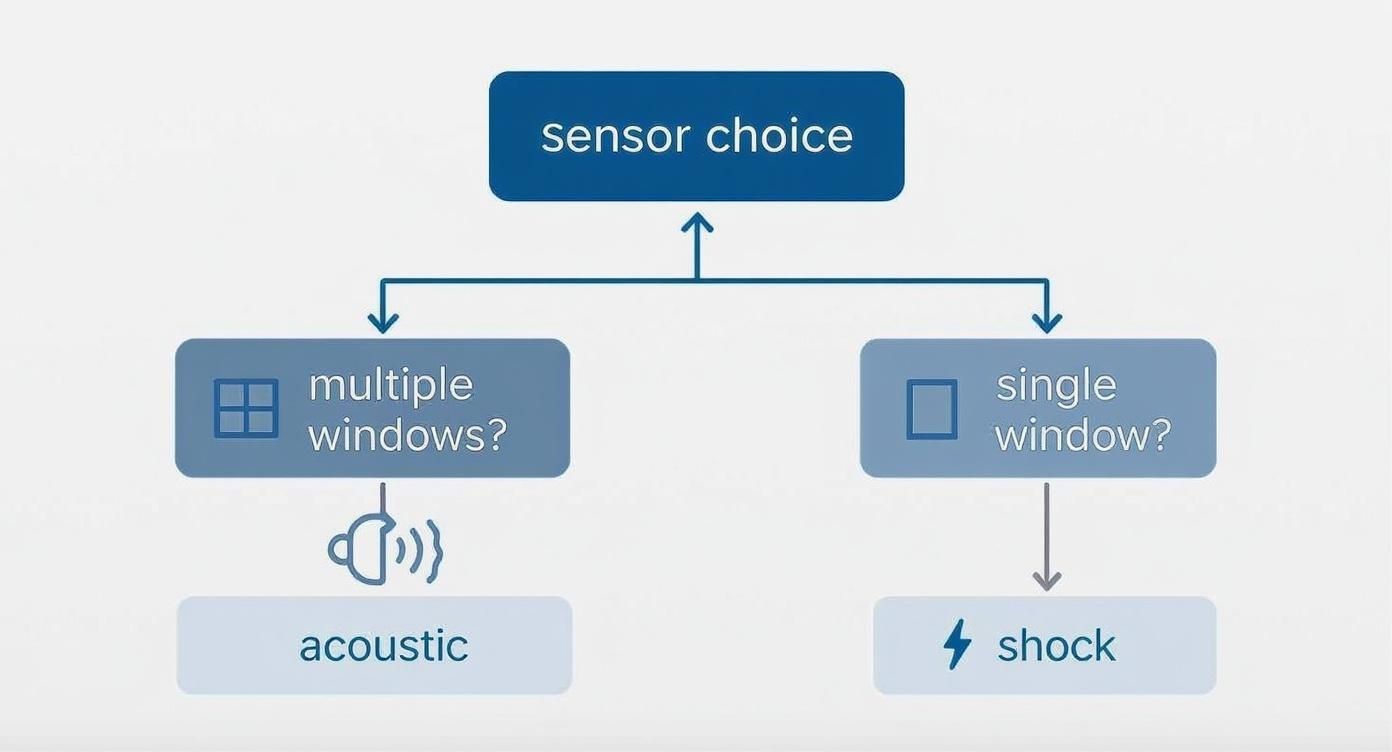
As you can see, the number and arrangement of your windows really drive the decision. It's all about getting the most effective coverage without overcomplicating things.
Wired vs. Wireless Systems
Next up is the installation. Do you go with a traditional wired system or a modern wireless one? This choice affects everything from the setup process to long-term maintenance.
- Wired Systems: These sensors are physically connected to your main security panel. They're rock-solid reliable since you never have to worry about batteries dying. The trade-off is that installation is a bigger job, often requiring a professional to run wires through your walls.
- Wireless Systems: Powered by batteries, these sensors are a breeze to install—many just use a strong adhesive backing. This gives you tons of flexibility on where you can place them and makes them ideal for renters or anyone who prefers a DIY approach.
The trend toward easy, smart-home-friendly security has made wireless options explode in popularity. The wireless glass break detector market was valued at around $960 million in 2025 and is only expected to grow. If you're curious about the industry trends, you can read the full research about wireless security trends for a deeper dive.
Key Takeaway: For a big room with lots of glass, an acoustic sensor is your workhorse. For protecting one or two specific windows, go with shock sensors. Your choice between wired and wireless really comes down to balancing reliability with ease of installation.
Getting the Installation Right for Maximum Protection
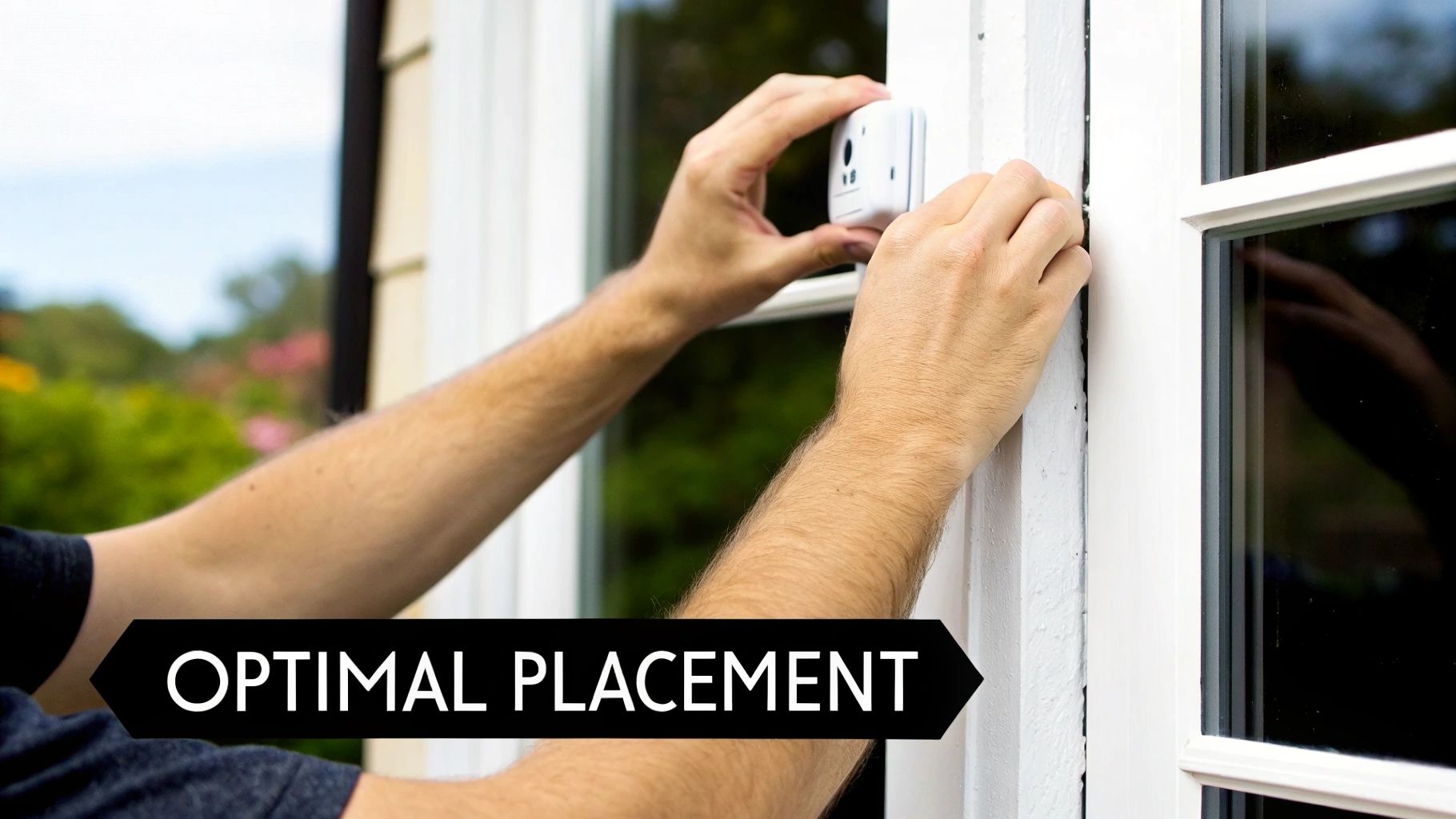
Here's the bottom line: even the most sophisticated breaking glass alarm is completely useless if it can't hear or feel the break. Proper placement is everything. You wouldn't stick a smoke detector in a broom closet and expect it to cover the whole house, right? The same logic applies here.
An acoustic sensor, for example, absolutely needs a clear, unobstructed path to "hear" the windows it’s meant to be guarding. It has to be positioned where the sound waves from shattering glass can travel straight to its microphone.
Best Practices for Placing Acoustic Sensors
With acoustic sensors, the game is all about maximizing their listening range. These little devices are incredibly good at their job, but only if sound has a clear shot to them.
Follow these simple rules for the best results:
- Find a Central Spot: The best place is usually on the wall directly opposite the windows you're protecting. Mounting it on the ceiling in the middle of the room is another great option.
- Keep a Clear Line of Sight: Make sure there's nothing big and bulky between the sensor and the glass. Think heavy furniture, thick drapes, or tall bookshelves—these can all block the sound.
- Watch Your Distance: Every sensor has a maximum range, which is typically around 25 feet. You need to place your device well within that distance from the furthest window pane.
A critical mistake is hiding an acoustic sensor behind a sofa or bookshelf. These sound-dampening objects can easily muffle the high-frequency thwack of shattering glass, stopping the alarm from ever going off.
How to Install Shock Sensors Correctly
Shock sensors work on a totally different principle. They don't listen; they feel. This makes their installation a lot more specific, but also very straightforward.
There's really only one golden rule for these sensors: they must be in direct contact with the glass. They are usually small, discreet devices that you stick directly onto the corner of a windowpane with a strong adhesive.
Because they detect the physical jolt traveling through the glass, you'll need one sensor for every single pane you want to protect. A common error is sticking them on the window frame or the mullions, which will kill their sensitivity and make them nearly useless.
Finally, after you've installed any breaking glass alarm, you have to test it. Most systems come with a built-in test mode for this very reason. You can often simulate a break by jingling your keys right next to the sensor while lightly tapping on the glass (always check the manufacturer's guide first!). This quick check confirms your placement is solid and gives you real peace of mind that your home's perimeter is secure.
Integrating Your Alarm with a Smart Home System
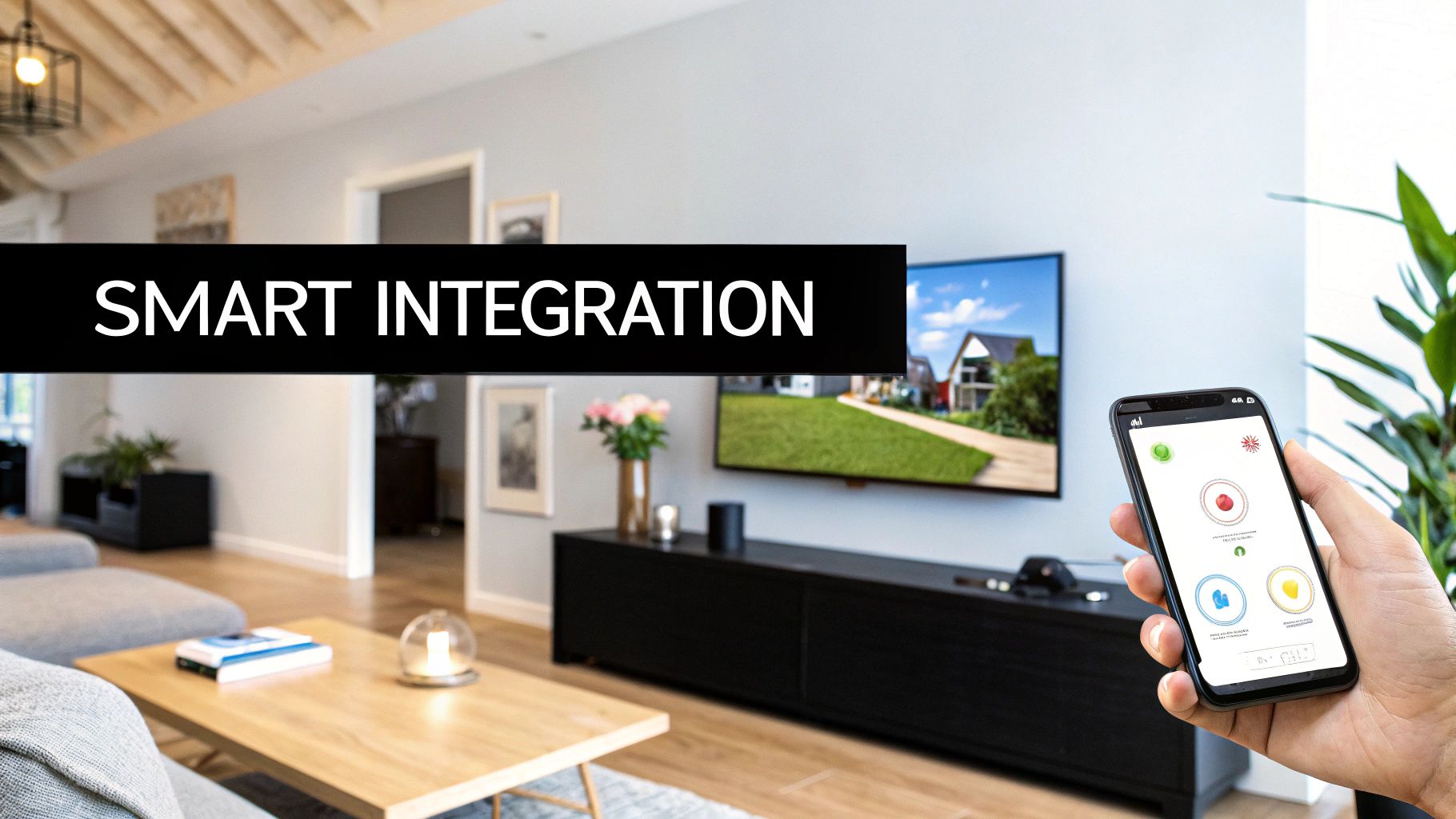
A standalone breaking glass alarm certainly does its job, but the real magic happens when you connect it to a smart home system. It goes from being a simple noisemaker to the first domino in a powerful, automated security response.
Instead of just a piercing siren, imagine the sound of shattering glass triggering a whole chain reaction—one designed to deter intruders and protect your property in an instant.
This is where modern security really flexes its muscles. By linking your sensor to a central hub like Amazon Alexa, Google Home, or a dedicated security platform, you graduate from a basic alert to an intelligent defense network. The sensor stops being an isolated gadget and becomes the nerve ending of a much larger, smarter system.
Creating Automated Security Recipes
Think of it like setting up a recipe for your home's security. The sound of breaking glass is your main ingredient, or "trigger." The actions that follow are the steps you’ve pre-programmed to unfold automatically. The result is a response far more intimidating and effective than a siren on its own could ever be.
For example, you can create an automation—often called a "routine" or "scene"—that fires off a series of commands the second your alarm is tripped. This is what takes your security from a passive alert to an active defense strategy.
The goal of smart home integration is to make your house an active participant in its own defense. When a breaking glass alarm is triggered, the system shouldn't just tell you there's a problem—it should immediately take steps to solve it.
This interconnected approach can completely change the dynamic of a break-in. A sudden blast of light from every bulb in the house, combined with multiple cameras instantly recording, can be enough to disorient and scare off an intruder before they even get a foot inside.
Examples of Smart Home Integration Scenarios
When you start connecting your breaking glass alarm, it helps to think about the bigger picture of your setup. If you need help choosing the best smart home system to build upon, expert comparisons can point you in the right direction. Once it’s all connected, a single trigger can set off an impressive, layered response.
The table below shows just a few examples of how a single event can kick off a coordinated, multi-step defense.
Smart Home Integration Scenarios
| Triggering Event | Automated Action 1 | Automated Action 2 | Automated Action 3 |
|---|---|---|---|
| Glass Break Detected at 2 AM | All interior and exterior smart lights turn on to 100% brightness. | All smart door locks are immediately checked and secured. | Smart cameras start recording and send a live feed to your phone. |
| Sensor Triggered While Away | A loud alert is broadcast through smart speakers like Alexa or Google Home. | The smart thermostat is shut off to prevent smoke circulation in case of fire. | An instant notification is sent to you and a professional monitoring service. |
This kind of automation creates an environment that is actively hostile to an intruder. It secures evidence, illuminates the scene, and ensures help is on the way, transforming a basic sensor into the cornerstone of a truly responsive security network.
Common Questions About Glass Break Alarms
Diving into home security can feel like learning a new language, especially with specialized gear like a breaking glass alarm. It's only natural to have questions about how they work, where they fit in, and what to expect. Let's clear the air and tackle some of the most common questions we get.
We'll cover everything from what might accidentally set them off to how they stack up against other common sensors. The goal here is to give you the confidence to decide if this technology is the right move for protecting your property.
Will a Dog Barking or a Loud TV Set Off My Alarm?
This is easily the number one concern we hear, and it makes perfect sense—nobody wants a security system that's constantly crying wolf. The good news is that quality acoustic sensors are built to be smarter than that. They rely on a clever two-part detection method.
First, the sensor has to hear the low-frequency thud of an impact on the glass. Then, it needs to immediately pick up the high-frequency shatter that follows. A dog's bark, an explosion in an action movie, or a stack of dishes falling simply don't produce that specific acoustic one-two punch. This design dramatically cuts down on false alarms.
How Many Glass Break Sensors Do I Actually Need?
There's no magic number here; it really comes down to the layout of your space and which type of sensor you're using.
Here's a simple way to think about it:
- Acoustic Sensors: These "listen" to an entire area. A single sensor can typically cover a whole room, protecting all the windows within a radius of about 25 feet. Just remember, its hearing can be muffled by walls, bulky furniture, or heavy drapes, so you'll need one for each separate room you want to secure.
- Shock Sensors: These "feel" for vibrations directly on the glass. Because they rely on direct contact, you have to install one on every single window pane you want to protect.
So, you can think of an acoustic sensor as guarding a general zone, while a shock sensor guards a very specific object.
A smart strategy often involves mixing and matching. Use a single acoustic sensor for a large living room with multiple windows, but maybe add a dedicated shock sensor to a small, isolated window in a back bathroom.
Can I Install a Breaking Glass Alarm Myself?
You bet. A lot of the wireless models on the market today are specifically designed for easy DIY installation. They usually run on batteries and stick to the wall or ceiling with strong adhesive tape. Connecting them wirelessly to your main security hub often takes just a few minutes.
Wired systems are a different beast, though. They involve running cables through walls and connecting them to a central panel. While they are rock-solid in terms of reliability, the installation is much more involved. For a wired setup, it's usually best to call in a professional to make sure everything is hooked up correctly and safely.
What's the Difference Between a Glass Break and a Motion Sensor?
This is a fantastic question because they play two very different, but equally important, roles on the same team.
A breaking glass alarm offers perimeter protection. It's designed to alert you the moment an intruder tries to get in, before they've even set foot inside your home.
A motion sensor, on the other hand, provides interior protection. It triggers an alarm when it detects movement after someone is already inside. They work in tandem to create a layered defense. For example, you can keep your glass break sensors armed while you're at home moving around, but you’d want the interior motion sensors off to avoid accidentally setting them off yourself.
At Fortress Security Films, we're big believers in layered security that starts from the outside in. Alarms are critical for knowing when there's a problem, but strengthening the glass itself is the best way to prevent a problem in the first place. Our advanced security films make windows incredibly tough to break through, stopping intruders in their tracks before an alarm even has a chance to sound.
Check out our residential and commercial solutions to see how you can create a truly secure property.
