


When it comes to the best window security film, there isn't one single "best" option. It's all about matching the film's thickness and strength to what you're trying to protect against. For basic safety at home, like preventing injuries from an accidental window break, a 4-mil film is usually enough. But if you're trying to stop a determined intruder, you'll need to step up to an 8-mil film or thicker, and you'll absolutely want a professional attachment system to go with it.
Understanding Window Security Film and Its Role in Protection
At its core, window security film is a simple, cost-effective way to beef up the weakest points on your property. It’s a nearly invisible polyester layer that gets applied right onto the glass, and it completely changes how that glass behaves under stress. When a window with security film is hit, it doesn't explode into a mess of dangerous shards. Instead, the film holds all the broken pieces together, keeping the glass in the frame as a tough, flexible barrier.
This is where the real magic happens. That delay is crucial during a break-in. An intruder expects to smash a window and be inside in seconds. When they’re met with a pane of glass that just won't give way, it creates frustration and noise—and it buys you precious time to react or for help to arrive. More often than not, they’ll just give up and move on.
Core Benefits of Installing Security Film
Security film does more than just stop break-ins; it’s a versatile upgrade that handles a whole range of safety concerns. Think of it as an all-around reinforcement for your glass.
Here's what you get:
- Intrusion Deterrence: It makes forced entry incredibly difficult and time-consuming, which is often enough to send burglars packing.
- Blast and Storm Mitigation: During a hurricane or even an explosion, the film contains the glass fragments, preventing them from becoming deadly projectiles.
- Accident Prevention: It stops everyday accidents—a stray baseball, a fall indoors—from turning into a dangerous situation with shattered glass.
- UV Protection: A huge bonus is that most security films also block up to 99% of harmful UV rays. This protects your skin and stops your furniture, floors, and artwork from fading.
Key Factors Defining Film Effectiveness
Not all films are built the same. Their real-world performance boils down to a few key technical specs that determine just how much of a fight they can put up. Getting familiar with these metrics is the first step in picking the right level of protection.
The most critical takeaway is that true security is a system. A high-quality film is only as strong as its bond to the glass and, for advanced protection, its connection to the window frame itself.
The two things that matter most in a film’s defensive power are its thickness and how it's anchored to the frame.
| Feature | Description | Importance Level |
|---|---|---|
| Mil Thickness | This measures the film's density. The higher the number, the stronger and more impact-resistant it is. | High |
| Tear Resistance | This shows how well the film resists being punctured or torn after the glass behind it has broken. | High |
| Attachment System | A bead of structural silicone that bonds the film and glass directly to the window frame, so the entire pane can't be pushed in. | Critical for High Security |
Ultimately, choosing the right film comes down to a realistic look at your property’s risks. A quiet suburban home might only need basic shatter resistance. But a downtown storefront facing smash-and-grab threats needs a much thicker film anchored with a rock-solid attachment system. This guide will walk you through these comparisons so you can make a smart, informed choice.
Decoding Security Film Performance Metrics
If you want to find the best window security film, you have to learn the language of protection. Every film is graded by a few key performance metrics that tell you exactly what it's designed to do. Getting a handle on these numbers is the only way to cut through the marketing jargon and choose a film that actually meets your security goals.
The first and most common spec you'll see is mil thickness. A "mil" is just a shorthand for one-thousandth of an inch, and it’s a direct indicator of how well the film resists punctures and tears. The rule is simple: the thicker the film (the higher the mil), the tougher it is.
The Critical Role of Mil Thickness
Thickness is really the foundation of a film's strength. For instance, a standard 4-mil film offers a solid baseline of safety. It's great for holding glass shards together during an accident or a storm, but it's not going to stop a determined burglar for long. It might deter a quick smash-and-grab, but that's about it.
When you step up to an 8-mil to 14-mil film, you're entering serious anti-intrusion territory. These thicker films are engineered to absorb a tremendous amount of force, making it incredibly difficult and noisy for someone to break through, even with a tool. For most homes and businesses, this is the sweet spot for real-world security.
The true test of a security film isn't just surviving the first hit. It’s about how long the film can keep a determined intruder out after the glass shatters. That delay is what gives you time and foils the attempt.
Beyond Thickness: Tensile and Break Strength
While mil thickness is a great starting point, two other specs give you a much clearer picture of a film’s real-world toughness: tensile strength and break strength. Both are usually measured in pounds per square inch (PSI).
- Tensile Strength: Think of this as the film’s stretching point. It’s the maximum amount of stress the film can handle before it starts to permanently deform.
- Break Strength: This is the absolute limit—the point where the film finally rips or tears apart under pressure.
Higher PSI numbers for both mean you’re looking at a much more resilient film. This is what keeps the film from tearing as an intruder hammers away at the window. A high-performance 8-mil film can have a break strength over 35,000 PSI, showing just how well it can hold up under a sustained attack.
The Unsung Hero: The Anchoring System
Finally, none of these numbers mean much without the most critical component: the anchoring attachment system. The toughest film in the world is useless if an intruder can just push the entire pane of broken glass out of the frame.
An anchoring system mechanically fastens the film-covered glass to the window frame, usually with a powerful structural silicone sealant.
This essentially fuses the film, glass, and frame into one solid, unified barrier. Instead of the force being concentrated on the glass, it gets distributed across the entire window structure. For any serious security setup using film that’s 8-mil or thicker, an anchoring system isn't just a good idea—it’s absolutely essential.
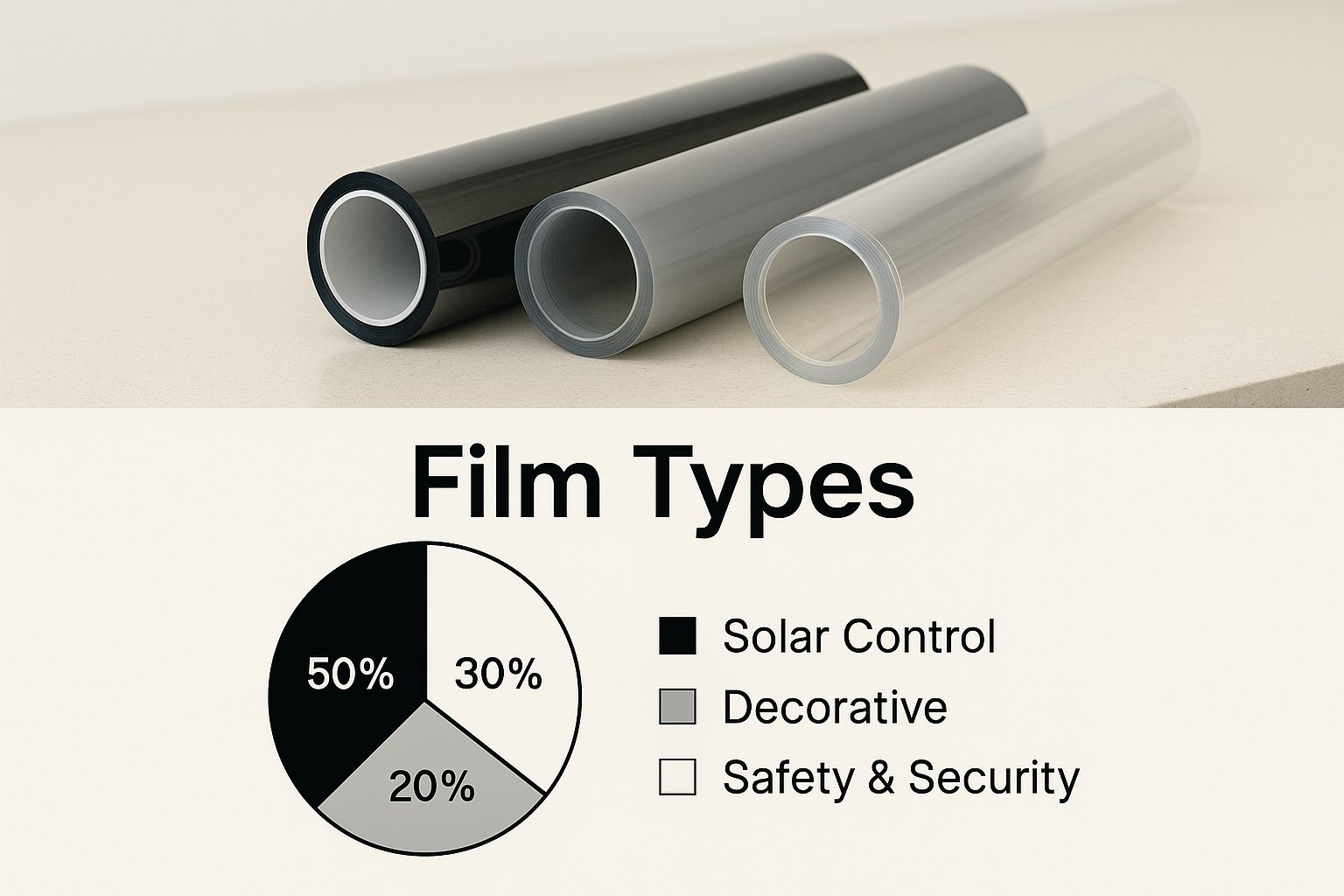
As you can see, what looks like a simple sheet of plastic is often a complex, engineered product built for specific threats. You can read more in-depth articles about security applications and installation insights over at https://fortresssecurityfilms.com/blog/.
Comparing the Top Tiers of Security Film
When you start looking into window security film, the sheer number of options can feel like a lot to take in. But there's a simpler way to cut through the noise. Instead of getting hung up on brand names, it's far more practical to compare films based on their thickness and what they're actually designed to do in the real world.
By grouping them into tiers, you can match your specific security needs to a product that’s truly engineered for that level of threat. We can break it down into three main categories: Standard Safety Film, Anti-Intrusion Film, and Blast Mitigation Film. Each one represents a serious jump in protection, cost, and how it needs to be installed. Getting a handle on what makes each tier different is the first step to making the right choice for your property.
Standard Safety Film: The Everyday Defender (4-7 Mil)
Think of this first tier as your baseline for glass safety. Standard Safety Film, which is typically between 4 and 7 mil thick, is the go-to for most homes. Its main job isn't to stop a determined burglar in their tracks, but to manage the danger that comes from shattered glass.
It's really a safety net. A stray baseball might hit a sliding glass door, or a toddler could stumble into a window. In those moments, a 4-mil film keeps the sharp, dangerous shards of glass held together. This simple feature can prevent serious cuts and keeps the window sealed until it can be replaced.
- Primary Use Case: Accident prevention and basic shatter resistance.
- Ideal Application: Homes with young children, large sliding glass doors, and ground-floor windows in relatively safe areas.
- Security Level: Minimal. It might slow down an unprepared thief for a second, but it won’t stop a motivated one.
This film is a fantastic, budget-friendly upgrade for general home safety. Just be realistic about what it can do—it’s about preventing accidents, not fortifying your home.
Anti-Intrusion Film: The Serious Deterrent (8-14 Mil)
When you’re more worried about a break-in than a stray baseball, you need to step up to Anti-Intrusion Film. These films are much tougher, ranging from 8 to 14 mil thick, and they're built to take a beating from tools like hammers, pry bars, or rocks.
This is where the idea of "intrusion delay" really comes into play. An 8-mil film doesn’t just hold broken glass together; it absorbs the force of repeated hits, making it incredibly loud and difficult for someone to actually create an opening. That delay—and the noise—is often all it takes to convince an intruder to give up and run.
The real game-changer with anti-intrusion films isn't just the thickness; it's the mandatory attachment system that bonds the film to the window frame. Without it, even a 14-mil film is useless—a burglar could just push the entire broken pane out. The film and frame have to work together as a single, unified barrier.
For most homeowners and business owners looking for serious security, the 8-14 mil range hits the sweet spot between powerful protection and reasonable cost. It creates a formidable obstacle against the vast majority of forced entry attempts.
Blast Mitigation Film: The Ultimate Protection (15+ Mil)
At the very top of the protection ladder is Blast Mitigation Film. Starting at 15 mil and going up from there, this is a highly specialized product for places where the threat level is extreme. We're talking about risks like explosions, bomb blasts, or the kind of violent weather you see in major hurricanes.
These films are engineered with incredible tensile and break strength to withstand the massive, sudden pressure waves from a blast. Their purpose is to keep the glass from turning into deadly projectiles, which is one of the main causes of injury and death during an explosion.
- Primary Use Case: Protecting people from flying glass caused by explosions or catastrophic natural disasters.
- Ideal Application: Government buildings, high-profile corporate offices, embassies, and buildings in hurricane-prone coastal areas.
- Installation: Always requires a heavy-duty anchoring system and must be installed by highly trained, certified professionals.
Because it's so thick, this level of film can sometimes affect the optical clarity of the glass, and the installation is significantly more involved and expensive. This is an industrial-grade solution for very specific, high-stakes situations.
Security Film Performance Matrix by Application
To make things even clearer, this table breaks down how each film thickness lines up with its intended purpose and technical specifications. It's a quick way to see which film is the right fit for your security goals.
| Film Thickness (Mil) | Primary Use Case | Break Strength (PSI) | Recommended Application | Attachment System Required? |
|---|---|---|---|---|
| 4–7 Mil | Basic safety, shatter resistance, accidental impact | ~100-175 lbs/in | Residential homes (especially with kids), low-risk storefronts, interior glass partitions | No (but recommended for 7 mil) |
| 8–14 Mil | Forced entry delay, smash-and-grab prevention | ~250-375 lbs/in | High-value homes, commercial storefronts, schools, government buildings | Yes (Critical for performance) |
| 15+ Mil | Blast mitigation, extreme weather, anti-spall | 450+ lbs/in | High-risk government facilities, embassies, critical infrastructure, hurricane zones | Yes (Robust anchoring is mandatory) |
As you can see, the need for an attachment system becomes critical as the film's thickness and intended use become more serious. This isn't just an add-on; it's a core part of the security system.
The demand for these solutions is on the rise. The global security window film market is projected to hit around USD 1.5 billion in 2025 and is on track to grow to nearly USD 2.8 billion by 2033. This growth is largely fueled by heightened security concerns in cities around the world. You can explore more data on this expanding market to see where the industry is headed.
Matching the Right Film to Your Property
Choosing the right window security film isn't about finding the single "best" product on the market. It's about taking a hard look at your property's real-world risks and matching the film's capabilities to them. A quiet suburban home, a busy downtown storefront, and your personal car face entirely different threats, so they naturally need different levels of protection.
When you apply the technical specs we've discussed—like film thickness and tear strength—to these practical scenarios, you can invest with confidence. This practical approach ensures you're not overspending on overkill protection or, far worse, underestimating what it takes to keep your property and family safe. The aim is a balanced, effective barrier that fits your environment perfectly.
Securing Your Home with Residential Window Film
For most homeowners, the sweet spot is where security meets everyday living. You want to deter intruders without making your home feel like a bunker. This is where mid-range security films, typically from 8 to 12 mil, really shine. An 8-mil film is a massive step up from standard glass. It’s tough enough to withstand repeated whacks from a heavy object, creating a loud, time-consuming obstacle that most burglars will simply give up on.
But the benefits for your home go beyond just stopping a break-in. Nearly all quality security films also block up to 99% of damaging UV radiation. This isn't just about protecting your family from harmful rays; it’s about preserving your home's interior. Your hardwood floors, furniture, and artwork will be shielded from the fading that happens over time, making it a smart investment in both safety and home preservation.
Let's be practical: A sliding glass door is often a burglar's favorite way in. Because it’s so large and sits at ground level, it's the single most important piece of glass to secure with at least an 8-mil film and a proper attachment system.
Fortifying Commercial Properties Against Threats
Commercial properties, especially ground-floor retailers and offices, are on the front lines. They face a much more aggressive set of risks, from smash-and-grab thefts and vandalism to the potential for civil unrest. Here, you need a truly formidable defense, which is why films in the 12 to 15 mil range are the professional standard. This level of thickness is engineered to take a sustained, violent beating, holding shattered glass together to stop a quick breach and protect your inventory.
The broader window film market, valued at USD 16.3 billion in 2024, is expected to climb to USD 17.57 billion by 2025. A huge driver of this growth is the adoption in commercial projects, where business owners are catching on to the dual benefits of security and energy savings. You can get more insights on this growing market and its key drivers by reviewing the comprehensive data.
For a business, the visual deterrent is almost as crucial as the physical barrier. When a vandal tries and fails to smash a window, it sends a powerful message that the property is protected. For an even more robust solution, you can combine security film with an anti-graffiti sacrificial layer. This creates a multi-layered defense that keeps your storefront looking pristine while being thoroughly secured. In these high-risk scenarios, an anchoring system isn't optional—it's essential to keep the entire window unit from being pushed out of its frame.
Enhancing Automotive Safety and Security
Car windows are a completely different animal. They're made from tempered glass, which is designed to crumble into thousands of tiny, dull pieces in an accident to protect you. While great for safety, this makes your car incredibly vulnerable to a smash-and-grab. Automotive security film, usually in the 4 to 8 mil range, is made specifically to solve this problem.
When applied to the inside of your side windows, the film prevents the glass from disintegrating on impact. This accomplishes two very important things:
- Theft Deterrence: A thief can smash the window, but the film holds all the pieces together. They can't just reach in and grab your laptop or purse; they're met with a frustrating, flexible barrier.
- Accident Safety: In a side-impact crash, the film contains the broken glass, which can help prevent occupants from being ejected or cut by flying shards.
This makes automotive film a must-have upgrade if you regularly carry valuables or just want an extra layer of protection for your passengers. It turns your car's weakest points into a strengthened barrier, giving you both peace of mind and real-world safety benefits.
Professional Installation Versus a DIY Approach
Even the highest-quality security film is only as good as its installation. A perfect application means the film will perform exactly as designed when you need it most. A bad one? It can lead to total failure. This leaves every property owner with a crucial decision: hire a pro or try to do it yourself?
The right answer really comes down to the thickness of the film and what you’re trying to achieve. While there are a few very specific, limited cases where a DIY approach might look appealing, the risks of a botched job are huge. Knowing the difference between what a pro delivers and what an amateur can accomplish is the key to making sure your investment actually protects you.
When a DIY Approach Might Be Feasible
You should only even think about a DIY installation under very strict conditions. If you're using a basic, thinner film—something like a 4-mil safety film—on a small, flat, and easy-to-reach window, you might pull it off. The goal in this scenario is usually just basic shatter resistance for safety, not serious intrusion prevention.
But even in this best-case scenario, the challenges are very real. The most common DIY mistakes are tough to avoid:
- Contamination: One tiny speck of dust, a single pet hair, or a fingerprint caught under the film creates a permanent weak spot and an ugly blemish.
- Bubbling and Creasing: Getting that perfectly smooth, crystal-clear finish is an art. It requires specific tools and a technique that most weekend warriors simply don't have.
- Improper Edge Seals: If you don't trim the film with absolute precision and seal the edges correctly, it will start to peel over time. Once that happens, it's basically useless.
These aren't just cosmetic problems; they completely undermine the film's strength. A film with bubbles or poor adhesion can't distribute the force from an impact correctly, which dramatically weakens its ability to protect the glass.
Why Professional Installation Is Non-Negotiable for True Security
The second your goal shifts from simple accident-proofing to actual security, professional installation is the only way to go. For any film that's 8-mil or thicker, and for any job that requires an anchoring system, DIY is off the table. The stakes are just too high.
A certified installer isn't just sticking a sheet of plastic to your window. They are installing a complete security system, making sure the film, glass, and frame work together as one cohesive barrier. You can't achieve that synergy without expert training and tools.
A professional brings years of experience and specialized equipment to your property. They work methodically to ensure a sterile, clean application, which is absolutely critical for the film's adhesive to cure perfectly and form a permanent bond with the glass. This flawless finish guarantees maximum optical clarity and, more importantly, peak performance when it’s under attack. You can get a better sense of what a top-tier window security film installation involves and what to expect from certified experts.
Beyond the application itself, a pro knows how to properly install the anchoring attachment system. This is a meticulous process where the film is bonded directly to the window frame with a high-strength structural adhesive. An improperly applied anchor is just as bad as having no anchor at all.
Finally, and this is a big one, hiring a pro protects your manufacturer's warranty. Almost all warranties become void if the film isn't installed by a certified professional. If the product fails, you're on your own. At the end of the day, professional installation isn't just an added expense—it's a critical component of the security solution itself.
Finalizing Your Security Film Choice
Choosing the right window security film really comes down to one thing: being honest about what you're trying to protect against. Start by thinking about your real-world risks. Are you a parent worried about a stray baseball shattering a patio door, or are you a business owner trying to stop a smash-and-grab thief in their tracks? Your answer is the key to figuring out how thick your film needs to be.
Let the performance specs be your guide here. A 4-mil film is a great starting point for basic safety, but if you're serious about delaying an intruder, you need to start at 8-mil. For high-value homes or commercial properties facing significant threats, stepping up to a 12-mil film (or even thicker) and pairing it with an attachment system is what creates a truly tough barrier.
Your Final Selection Checklist
Before you pull the trigger, run through this quick checklist. It's a simple way to make sure you've thought through all the critical details and are making a smart choice that will actually deliver the security and peace of mind you're after.
- Threat Level: What's your number one concern? Accidental breaks, a determined burglar, or severe weather?
- Property Type: A home has different weak points than a storefront or a vehicle. Match the film's capabilities to your specific property.
- Film Thickness: Choose a mil thickness that directly answers the threat level you just identified.
- Attachment System: Does the film you need require a professional anchoring system to work as intended? (Hint: Thicker films almost always do.)
- Professional Installation: Plan for a certified installer in your budget. For anything 8-mil or thicker, it's non-negotiable if you want the film to perform correctly and keep your warranty intact.
Remember, the best security film is more than just the product itself; it's a complete system. The film, the installation quality, and the anchoring method all have to work together perfectly. Spending good money on a premium film but skimping on the installation is just wasting an opportunity for real protection.
By taking a moment to consider each of these points, you can feel confident that you're making a solid investment—one that will provide real, tangible protection for your property and the people inside.
Common Questions About Window Security Film
Even after digging into the specifics, you probably still have a few practical questions about how these films perform in the real world. Let's clear up some of the most common ones so you can feel confident in your decision.
Will Security Film Make My Windows Unbreakable?
No, and this is a really important distinction to understand. Security film is designed to make glass shatter-resistant, not shatter-proof or unbreakable. Think of its job as holding all the pieces together when the glass breaks from a major impact.
This creates a tough, flexible membrane that keeps the glass in the frame, which is a massive deterrent for an intruder. It buys you precious time and stops dangerous glass shards from exploding into a room. The goal is delay and deterrence, not to create an impenetrable force field.
How Long Does Window Security Film Typically Last?
When you get a high-quality film installed by a pro, you're making a long-term investment in your property's safety. You can realistically expect it to last for 15 to 20 years, sometimes even longer, depending on the conditions.
Top manufacturers stand behind their products with serious warranties, often covering 10 years or even offering a lifetime guarantee for residential installs. The film's lifespan really comes down to its quality, the climate you're in, how much direct sun it gets, and—most importantly—how well it was installed in the first place.
The warranty is a key indicator of quality. A lifetime residential warranty shows the manufacturer's confidence in the film's durability against peeling, bubbling, or discoloration over decades of use.
Does Security Film Affect the View Through My Windows?
Not at all. The good stuff is engineered to be optically clear, making it virtually invisible once it's on the glass. The whole point is to add a layer of protection without you even knowing it's there. Your view won't be distorted, and you won't lose any noticeable amount of natural light.
In fact, many films come with great side benefits, like blocking up to 99% of harmful UV rays and cutting down on annoying glare. You get all that protection without sacrificing the look of your home or business.
Can I Install Security Film on Any Type of Window?
For the most part, yes. Security film works great on most standard glass, whether it's single-pane, double-pane, tempered, or even laminated. That said, there can be a few exceptions. Certain low-e coatings or very old, brittle windows might not be suitable.
This is why getting a professional consultation is so critical. An expert can check out your specific windows, confirm they're compatible, and point you to the right film for the job. This is especially true for complex projects, like when you need to learn more about security window film for schools where performance is non-negotiable. A pro assessment ensures the system works exactly as intended.
Ready to secure your property with a solution that is both powerful and discreet? The experts at Fortress Security Films provide comprehensive consultations and professional installations to protect your home, business, or vehicle. Contact us today to get a free estimate and discover the peace of mind that comes with superior window protection.
