


Figuring out the best window film really comes down to what you're trying to protect against. For most folks at home, an 8-mil security film is more than enough to stop a would-be burglar looking for a quick smash-and-grab or to keep glass from flying during an accident. If you're securing a business or a property in a higher-risk area, you'll want to step up to a much beefier 14-mil film to discourage more persistent threats.
Choosing the Right Security Film for Your Needs
Picking the right film is a balancing act. You have to weigh the level of protection you need against your budget and the specific risks your property faces. It's tempting to think "thicker is always better," but that isn't always the most practical or affordable route. The key is to first get a real handle on the differences between the films out there.
At their core, security films are designed to do one job extremely well: hold broken glass together. That one feature is what buys you precious time during a break-in, minimizes the danger from flying shards in a storm, and makes a vandal's life much harder. How well it does that job depends on two things: the film’s thickness, measured in mils, and the strength of the adhesive holding it to the glass.
Understanding Film Thickness and Application
It's pretty straightforward—the thicker the film, the tougher it is to tear or puncture. A thin film might stop an errant baseball, but it won't do much against a determined intruder with a crowbar. This is exactly why it's so critical to match the film's specs to the real-world threats you're concerned about.
You're not alone in looking for this kind of protection. The window film market is booming, valued at around USD 17.57 billion in 2025 and projected to hit USD 24.09 billion by 2029. Security films are a huge part of that growth, which just goes to show how many people are realizing this is an effective way to protect homes, businesses, and even vehicles. If you want to dive deeper into the numbers, you can read the full window film market report.
To help you get started, I've put together a simple table that breaks down the most common film types and where they work best.
Quick Guide to Security Film Types
This table gives you a quick snapshot of the main types of security window film, their common thickness, typical applications, and the security benefits they offer.
| Film Type | Thickness (Mils) | Primary Use Case | Key Security Benefit |
|---|---|---|---|
| Standard Defense | 4-7 Mil | Basic safety, accident prevention, deterring casual vandalism | Prevents glass from shattering into dangerous shards upon impact. |
| Enhanced Security | 8-12 Mil | Residential burglary deterrence, retail storefront protection | Significantly delays forced entry, requiring sustained effort and noise to breach. |
| Maximum Fortification | 14+ Mil | High-risk commercial sites, government buildings, storm-prone areas | Offers robust resistance against determined attacks, severe weather, and blast mitigation. |
Think of this as your starting point. It helps frame the conversation so you can quickly identify which category of film aligns with your security goals.
How Security Window Films Actually Work
To find the right security film, you first need to get a handle on what makes it so effective. It might look like a simple sheet of clear plastic, but its real power is in its sophisticated, multi-layered construction. This isn't just one layer; it's a carefully engineered composite built for one thing: resilience.
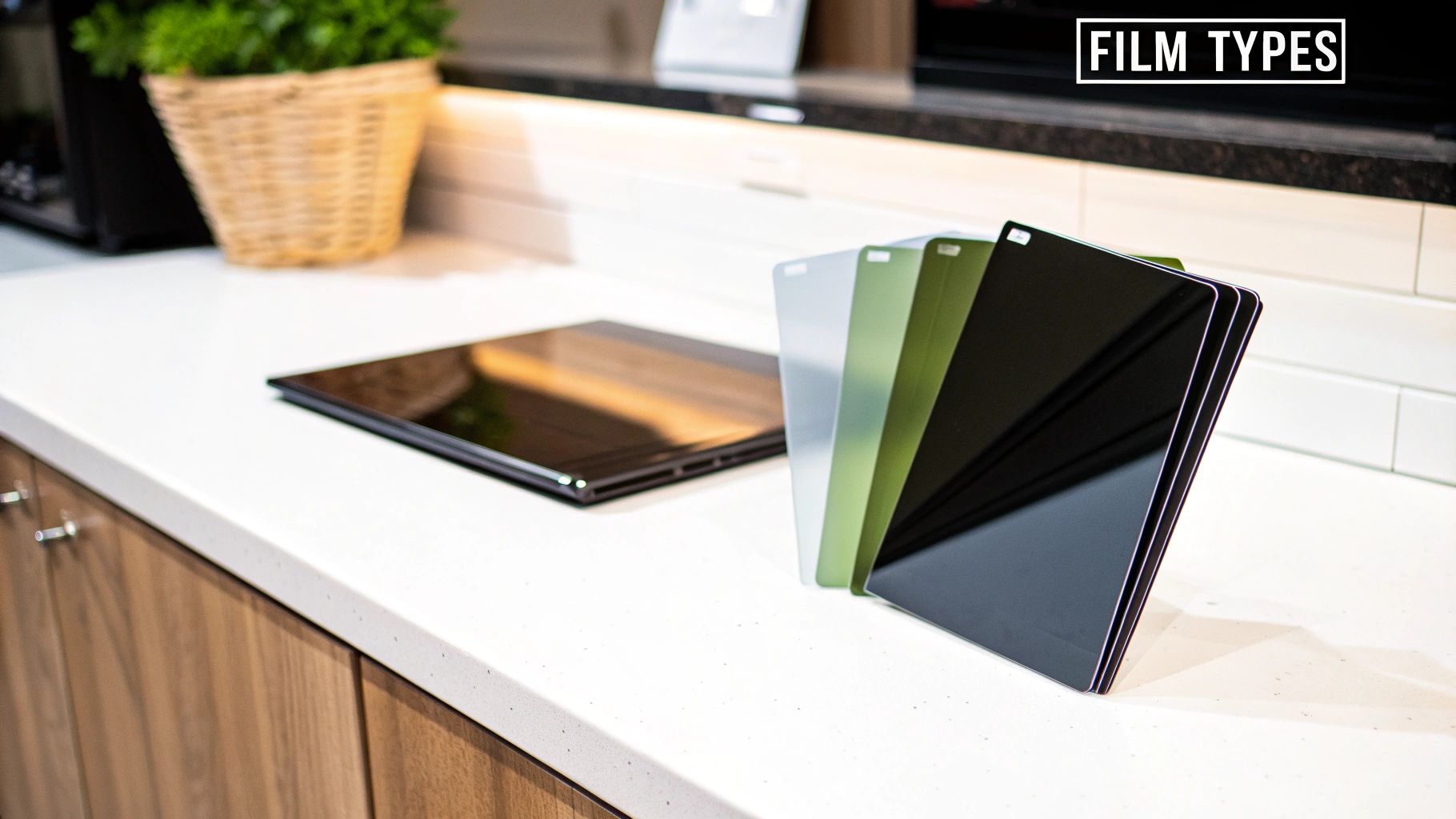
The film is made from heavy-duty polyester, with each layer bonded together to create a surprisingly tough barrier. When something hits the glass, the film’s job is to absorb and spread that impact across the entire window. So, instead of shattering into a million dangerous pieces, the glass might crack, but it stays held together in one flexible sheet by the film’s powerful adhesive.
This is the entire principle behind its protective power. It takes a fragile entry point and turns it into a durable shield that can seriously delay, or even stop, an intruder from getting inside.
The Role of Adhesives and Film Thickness
The real magic happens in the partnership between the polyester film and its specialized adhesive. We're talking about a high-performance, pressure-sensitive adhesive that forms a molecular bond with the glass, making the film a true part of the window. This bond is what keeps the fractured glass contained, preventing it from flying through the air during a storm or being used as a weapon by a burglar.
The film's thickness, measured in mils (one-thousandth of an inch), is directly tied to its strength. A standard 4-mil film offers a good baseline of safety, but stepping up to an 8-mil or 14-mil film provides far greater resistance to tearing and punctures. Thicker films simply require more force—and more time—to get through. That delay is often all it takes for a would-be intruder to give up and look for an easier target. You can find a lot more information about different film types and their best uses over at the Fortress Security Films blog.
The key thing to remember is that security film doesn't make glass unbreakable. It makes it incredibly difficult and noisy to break through. The goal is to create a time barrier that frustrates criminals and protects people from the hazard of flying glass.
Translating Technical Specs into Real-World Protection
When you start comparing different security films, you'll run into some technical terms that measure performance. Getting a grip on these metrics is the best way to make a choice based on facts, not just marketing hype.
Here are the critical performance specs you need to know:
- Tensile Strength: This tells you how much stress the film can take while being stretched or pulled before it finally breaks. Higher tensile strength means a tougher film that’s harder to tear during an attack.
- Puncture Resistance: This measures how well the film stands up to being pierced by a sharp object. It’s a huge factor in stopping someone from using a tool to gain entry.
- Break Strength: This is a direct measure of the force needed to actually break the film itself. It shows how much impact the film can handle, whether it's from a rock or a direct hit from a hammer.
By understanding these numbers, you can compare products with real data. A film with a high tensile and break strength will offer a much more robust defense, turning your most vulnerable entry points into fortified barriers.
Comparing Security Films by Threat Level
Not all security threats are the same, and neither are the films designed to stop them. Choosing the right security window film starts with a realistic look at your specific risks. A film that's perfect for preventing accidental breakage in a suburban home just won't cut it for a downtown storefront facing potential riots or smash-and-grab attempts.
To make this easier, I'll break down the options into three distinct tiers of protection. This will help you match a film's capabilities directly to the security challenges you're up against, ensuring you get the right level of defense without overpaying for protection you don't need.
Standard Defense: The 4-8 Mil Range
Films in the 4-8 mil thickness range are the foundation of window security. Think of this as your first line of defense against common, low-force threats. It's a fundamental upgrade from raw, unprotected glass, primarily designed for everyday safety and to discourage casual, opportunistic criminals.
A 4-mil film is fantastic for preventing injuries if the glass accidentally breaks. When a stray baseball or a child's toy hits the window, the film holds the dangerous shards together. It also provides a small buffer against vandalism, as the glass won't shatter on the first hit.
Stepping up to an 8-mil film gives you a real, noticeable boost in protection. This thickness is often the sweet spot for residential security. It's tough enough to significantly delay a burglar trying to get in with a hammer or a brick. The amount of noise and sustained effort required to break through an 8-mil film is usually enough to make them give up and look for an easier target.
- Ideal Scenarios: Ground-floor home windows, interior glass partitions, and properties in lower-risk areas.
- Primary Threats: Accidental impacts, minor vandalism, and quick smash-and-grab attempts.
- Key Advantage: A cost-effective way to add a serious layer of safety and basic security to standard windows.
Enhanced Security: The 8-14 Mil Range
When your worries go beyond accidental impacts to more determined, intentional threats, the 8-14 mil range provides a truly formidable barrier. This is where security film goes from being a safety product to a genuine anti-intrusion solution, making it a go-to choice for high-end homes and commercial businesses alike.
A 12-mil or 14-mil film is substantially harder to get through than its thinner cousins. It can take repeated, heavy hits from tools like crowbars or bats for a surprisingly long time. That delay is crucial—it buys you precious minutes for people inside to react and for police to get there.
For commercial storefronts, this level of protection is invaluable. It can stop a thief from smashing a display window and running off with merchandise in seconds. In busy urban areas, it also provides a solid defense against civil unrest or rioting, keeping your building secure even if the glass itself is broken.
An 8-mil film is a strong deterrent, requiring sustained noise and effort to breach. But a 14-mil film takes that protection to a professional-grade level, capable of resisting aggressive, prolonged attacks.
This visual guide breaks down the key performance metrics for popular security films, helping you see the trade-offs between thickness, strength, and what you'll invest.
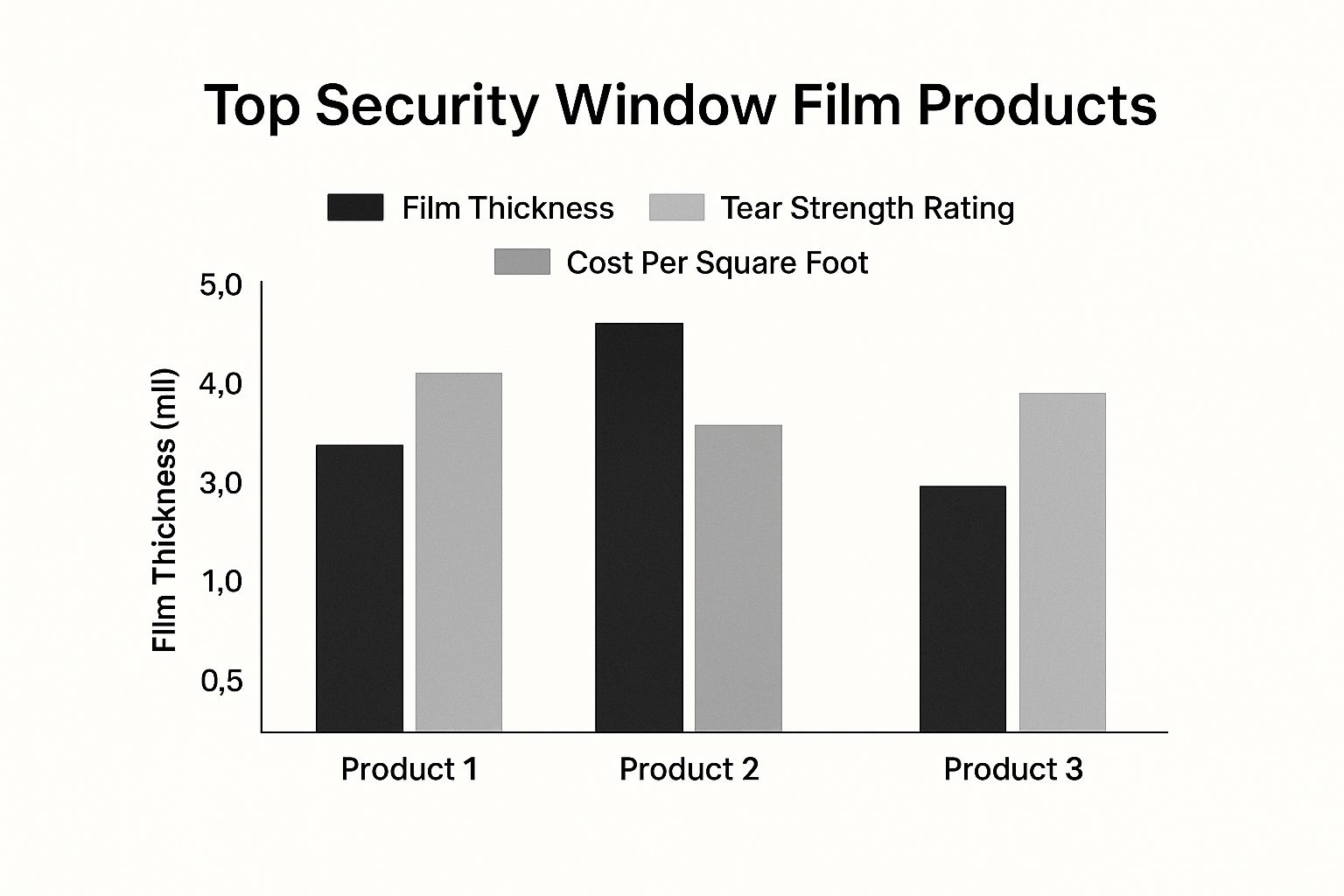
As the chart shows, a thicker film directly correlates with higher tear strength, but it also comes with a higher cost. It's a clear illustration of how investing more directly enhances your protection.
Security Film Thickness Performance Comparison
To help you pinpoint the exact right film for your needs, this table breaks down how different thicknesses perform against specific threats.
| Film Thickness (Mils) | Primary Threat Protection | Breach Delay Time (Approx.) | Ideal Application | Relative Cost |
|---|---|---|---|---|
| 4-Mil | Accidental breakage, safety, light vandalism | < 15 seconds | Residential safety, interior glass partitions | $ |
| 8-Mil | Forced entry (blunt objects), smash-and-grab | 30-60 seconds | Residential security, ground-floor commercial windows | $$ |
| 12-Mil | Determined forced entry (tools), severe weather | 1-2 minutes | High-value homes, retail storefronts, government offices | $$$ |
| 14-Mil | Sustained attacks, rioting, basic blast mitigation | 2+ minutes | High-risk commercial, schools, critical infrastructure, hurricane zones | $$$$ |
| 15+ Mil | Bomb blasts, extreme weather, highest security threats | 3+ minutes | Embassies, data centers, federal buildings, high-security installations | $$$$$ |
This comparison makes it clear: a thicker film doesn't just offer more protection, it buys you more time, which is often the most critical factor in a security event.
Maximum Fortification: The 15+ Mil Range
For high-risk environments where security is the absolute top priority, films that are 15 mils and thicker offer the highest level of protection you can get. This category is engineered for the most extreme situations, including withstanding determined, prolonged attacks, severe weather events like hurricanes, and even blast mitigation.
You'll find these ultra-thick films on government buildings, embassies, critical infrastructure, and high-value commercial properties like jewelry stores. Their incredible tear strength and puncture resistance mean that even after the glass is completely shattered, the film itself remains a resilient barrier that is almost impossible to get through without specialized tools and a lot of time.
In regions prone to hurricanes or tornadoes, these films are lifesavers. They stop wind and debris from blowing out windows and compromising the entire building structure. The application of security window film for schools has also become a critical conversation, where thicker films provide a vital delay during an active threat. Reinforcing vulnerable glass entry points can truly make a life-or-death difference.
Hybrid Films: Combining Security With Other Benefits
One of the best things about modern window films is that you don't have to choose between security and other enhancements. Many of the top security films are available in hybrid versions that combine protection with other valuable features.
Security + Solar Control: These films can block a huge percentage of solar heat and damaging UV rays while reinforcing the glass. This is perfect for properties in sunny climates, as it can lower your energy bills and stop your furniture from fading, all without compromising on safety.
Security + Privacy: You can also find security films with a frosted, mirrored, or decorative finish. This works great for ground-floor offices, bathrooms, or any space where you need to block the view while simultaneously protecting the glass from impact. A hybrid film lets you solve multiple problems with a single installation.
Matching the Right Film to Your Property
Knowing the technical specs of a security film is a great start, but it’s only half the story. The real skill is translating that data into the right choice for your building. The best window film for security isn't a one-size-fits-all product; it's the one that directly addresses your property's unique risks.
Let’s move beyond abstract numbers and walk through a few common scenarios. By breaking down the specific threats in each situation, we can see exactly which film makes the most sense. This is the kind of practical thinking you can apply to your own home or business.
Securing a Suburban Home
Picture a classic suburban house. It’s got large, ground-floor windows and maybe a sliding glass door out back. These are the weak spots burglars love because they promise a quick, quiet entry. The primary threat isn't a sustained, heavy-duty assault—it’s the smash-and-grab.
For this kind of residential setting, an 8-mil security film is really the sweet spot. It provides a serious defense against blunt force from a hammer, a brick, or a pry bar. While the glass isn't suddenly unbreakable, trying to get through it becomes loud, difficult, and time-consuming. Those are three things a burglar absolutely hates.
- Risk Profile: Low to moderate, focused on opportunistic theft.
- Primary Goal: Delay entry, make a lot of noise, and convince the intruder to leave.
- Optimal Choice: An 8-mil film strikes a perfect balance between formidable protection and cost-effectiveness for home security.
This layer of protection turns a vulnerable window into a genuine obstacle, often encouraging a would-be intruder to just move on.
Protecting a High-Traffic Urban Storefront
Now, let's shift to a retail store on a busy city street. The risks here are entirely different. This business faces smash-and-grab thieves after high-value goods, but also potential damage from vandalism or even civil unrest. That glass isn't just an entry point; it's a display case that needs to be fortified.
This is where you step up to a much thicker 12-mil or 14-mil security film. This beefier film is engineered to take a beating—absorbing repeated, heavy impacts from tools. It buys precious minutes for law enforcement to arrive and stops thieves from clearing out your inventory in seconds.
For any commercial property, the delay created by a thick security film is about more than just stopping theft. It's about business continuity. A 14-mil film can be the difference between a single shattered window and a completely ransacked store.
For any business in a high-risk urban area, this upgrade is a critical investment. The cost of a break-in, both in lost goods and operational downtime, is just too high to ignore.
Reinforcing an Office's Interior Glass
Finally, think about a modern office filled with interior glass walls and partitions. The main concern here usually isn't an external break-in, but internal safety and privacy. You're worried about accidental impacts in a busy hallway, protecting sensitive information, or creating a safer space during an emergency.
For these interior applications, a 4-mil to 7-mil film is typically all you need. It gives you excellent protection against accidental shattering, ensuring that if a partition breaks, the glass fragments are held safely together. These films can also be combined with frosted or decorative finishes to add privacy to conference rooms without blocking natural light.
The growing demand for these solutions is clear. The global security window film market was valued at around USD 1.5 billion in 2025 and is expected to climb to USD 2.8 billion by 2033. This growth is fueled by a wider understanding of the benefits in both commercial and residential buildings, as detailed in this security window film market analysis.
The Critical Role of Attachment Systems
No matter which film you choose, its performance gets a massive boost from a professional attachment system. This is an absolutely essential component, especially for high-risk applications.
An attachment system uses a powerful structural adhesive, usually a specialized silicone, to bond the edges of the film directly to the window frame. This creates a strong, flexible anchor that holds the entire sheet of glass in the frame, even after it’s been completely shattered.
Without one, a determined attacker could eventually just push the whole filmed pane of glass out of its frame. The attachment system stops that from happening, maximizing the delay and making sure your window stays a barrier for as long as possible. It's a non-negotiable part of any serious security film installation.
Final Checks Before You Buy
You’ve sorted through the different thicknesses and have a good idea of what you need. That’s a huge step. But before you pull the trigger, there are a few other critical details that separate a successful security upgrade from a wasted investment.
Think of this as the final pre-flight checklist. The best security film in the world is only as good as its installation, and the warranty that backs it up tells you a lot about the company's confidence in its product.
It’s tempting to think of security film as just a fancy sticker, but the application is a precise craft. A single trapped piece of dust or a tiny air bubble isn't just a cosmetic flaw—it's a weak point. An intruder's blow will find that weak point and exploit it, compromising the entire pane of glass.
Why Professional Installation Isn't Optional
I can't stress this enough: professional installation is the only way to go. This isn't a weekend DIY project. Certified installers have the right tools and, more importantly, the experience to create a perfect, seamless bond between the film and the glass. They know how to prep the surface meticulously and apply the film so it’s virtually invisible.
This process is what ensures the film performs under pressure. A sloppy install with peeling edges or bubbles won’t just look bad; it will fail when you need it most. If you're curious about what goes into a proper application, it’s worth looking into the professional window security film installation process to see why the pros are essential for true security.
Understanding Warranties and Performance Data
Don't just glance at the warranty—read the fine print. A reputable manufacturer will offer a robust warranty covering defects like peeling, bubbling, cracking, or turning purple. For residential applications, lifetime warranties are common and a good sign of quality.
But the real question is, what isn't covered? Most warranties won't cover damage from using the wrong cleaning products (like ammonia-based cleaners or abrasive sponges) or glass breakage that goes beyond the film's specified strength. Get clarity on these exclusions from your installer before you sign anything.
Expert Insight: A solid warranty package has two parts: the manufacturer’s warranty on the film itself and the installer's guarantee on their labor. A trustworthy installation company will always stand by their work, ensuring you're covered from every angle.
Beyond the warranty, here are the last few specs to confirm:
- Visible Light Transmission (VLT): This is simply how much light the film lets through. Higher VLT means more clarity. Most clear security films have a very high VLT, so you won't even notice they're there.
- UV Rejection: This is a fantastic secondary benefit. Almost all quality security films block 99% or more of the sun's damaging UV rays. This helps protect your furniture, floors, and artwork from fading and adds a layer of skin protection, too.
- Glass Compatibility: Make sure the film is approved for your specific window type. While issues are rare with modern films and expert installation, putting the wrong product on certain double-pane or treated windows can create thermal stress. Your installer should confirm compatibility from the start.
By taking the time to vet the installation plan, warranty coverage, and these final specifications, you're making sure your investment delivers real, reliable protection for years to come.
Understanding Your Security Film Options
When you're looking into the best window film for security, a few key questions always seem to pop up. Getting straight answers is the only way to feel confident in your choice and really understand what you're buying. Let's tackle some of the most common concerns head-on.
Can Security Film Stop a Bullet?
This is easily the most frequent—and critical—question we get. The answer is a clear and simple no. Standard security films, even the thickest ones, are not designed to be bulletproof.
What they are designed to do is be "bullet-resistant." That means after an impact, the film’s powerful adhesive holds the shattered glass together, which drastically reduces the immediate danger from flying shards. True ballistic protection requires a much more complex, multi-layered system that combines heavy-duty film with laminated glass or polycarbonate. These are highly specialized systems, often rated by the National Institute of Justice (NIJ), and they are in a completely different category from standard security film.
Key Takeaway: It's crucial not to confuse forced-entry resistance with ballistic protection. Security film is a fantastic upgrade against intruders and impacts, but it is not a replacement for certified bullet-resistant glass in environments where firearms are a primary threat.
How Long Will My Security Film Last?
Think of high-quality, professionally installed security film as a long-term upgrade to your property. The top manufacturers stand behind their products with impressive warranties. For residential projects, you'll often see lifetime coverage. For commercial buildings, warranties typically fall in the 10 to 15-year range.
Of course, the film's lifespan is influenced by things like direct sun exposure, the local climate, and how you care for it. But with proper maintenance—sticking to gentle, ammonia-free cleaners—your film will stay clear and perform effectively for years to come.
Will Security Film Void My Window Warranty?
This is a perfectly valid concern. Years ago, it was common for window manufacturers to void a warranty if any aftermarket film was applied. Thankfully, the industry has evolved. Most reputable film manufacturers now work closely with window companies.
Many of them even offer their own warranty that either matches or completely takes over the original glass manufacturer's warranty. Before any work begins, your installer should be able to confirm the film’s compatibility with your windows and walk you through all the warranty specifics.
Can I Install Security Film Myself?
You might see DIY kits out there, but for a security application, professional installation is the only way to go. I can't stress this enough. The film’s performance is completely tied to a perfect, flawless application.
A tiny speck of dust, an air bubble, or an edge that isn't perfectly sealed creates a weak point. Under impact, that's exactly where the film will fail. Certified installers have the right tools and, more importantly, the experience to create a seamless, edge-to-edge bond that ensures the film performs exactly as designed when you need it most.
Ready to secure your property with a professionally installed, high-performance solution? Contact Fortress Security Films today for a personalized consultation and discover the best window film for your security needs.
