


Picking the right coating for your car’s glass really comes down to what you need it for. Are you trying to survive daily downpours, or just make cleaning off bugs and grime a little less of a chore? Your answer will point you toward one of two main paths: a simple hydrophobic spray for a quick fix, or a tough ceramic coating for serious, long-lasting protection.
Your Ultimate Guide to Car Glass Coatings
Think of a glass coating like a high-tech raincoat for your windshield and windows. Some are like those packable jackets you can quickly throw on for a light shower, while others are more like a heavy-duty GORE-TEX shell designed to withstand a monsoon. This guide will help you see past the hype and understand the real differences between the main players: hydrophobic, ceramic, and silicone-based coatings.
We'll break down how each one works, what you can expect to pay, and who they’re really for. The goal is to give you the confidence to invest smartly in your car's safety and looks.
Why Is Everyone Talking About Glass Coatings?
The buzz around these products isn't just a fleeting trend; it's a real shift in how people care for their cars. The global glass coatings market, with automotive use leading the charge, was already valued at a staggering USD 2,861.25 million in 2024. Projections show it rocketing to USD 8,283.75 million by 2031.
What’s fueling this? It's the promise of coatings that deliver scratch resistance, block UV rays, and can even extend the life of your glass by up to 50% in tough environments. For a deeper dive into the numbers, you can check out a full industry analysis of the automotive glass market on mordorintelligence.com.
This boom is happening because drivers are seeing real, tangible benefits every day:
- Drastically Better Safety: When rain hits, water beads up and flies right off the glass, giving you a much clearer view of the road.
- Effortless Cleaning: The slick surface makes it incredibly easy to wipe away bugs, dirt, and even ice.
- Less Wiper Wear and Tear: You'll find yourself using your wipers far less often, which means they last longer.
- Reduced Glare: Some of the more advanced formulas can cut down on annoying glare from oncoming headlights and the sun.
If you want to see what top-tier products can do for clarity and durability, it's worth checking out a guide on the best ceramic coating for windshield options out there.
To get started, here’s a quick breakdown of the most common coating types and what they do best.
Quick Guide to Car Glass Coating Types
| Coating Type | Primary Benefit | Best For |
|---|---|---|
| Hydrophobic Sprays | Easy application and instant water-beading. | DIY enthusiasts and those wanting a quick, affordable improvement. |
| Ceramic/Quartz (SiO2) | Extreme durability, chemical resistance, and long-lasting performance. | Drivers seeking the highest level of protection and longevity. |
| Silicone-Based | Good durability and strong water repellency at a mid-range price. | A solid middle-ground for performance and cost. |
This table gives you a starting point, but we'll dive deeper into what makes each of these technologies unique and how to choose the one that fits your car, your climate, and your budget.
Comparing the Different Types of Glass Coatings
Trying to pick the right car glass coating can feel a bit like choosing armor for your vehicle. Each type offers a different level of protection and performance, and knowing the key differences is the first step to getting that crystal-clear, rain-shedding finish you're after.
At the end of the day, you’re looking at three main families of products: simple hydrophobic sprays, easy-to-use silicone sealants, and the more advanced ceramic (SiO₂) coatings. They all aim to do the same thing—make the glass so slick that water has no choice but to bead up and roll right off, which is a game-changer for visibility in a downpour.
Hydrophobic and Silicone Coatings: The Accessible Choices
For most DIY-ers, hydrophobic sprays and silicone-based coatings are the starting point. They're budget-friendly and incredibly simple to apply; if you can clean a window, you can apply these products in just a few minutes. They work by creating a physical barrier right on top of the glass.
Think of it like waxing a floor. The wax sits on the surface, making it slick. These coatings do the same thing, forming a non-porous layer that water can't stick to. They work great for a few months, but since they're just a surface layer, they're more vulnerable to being worn down by your wiper blades and harsh car wash soaps.
To help you figure out what's best for your car, check out this decision tree. It breaks down the right choice based on what you value most.
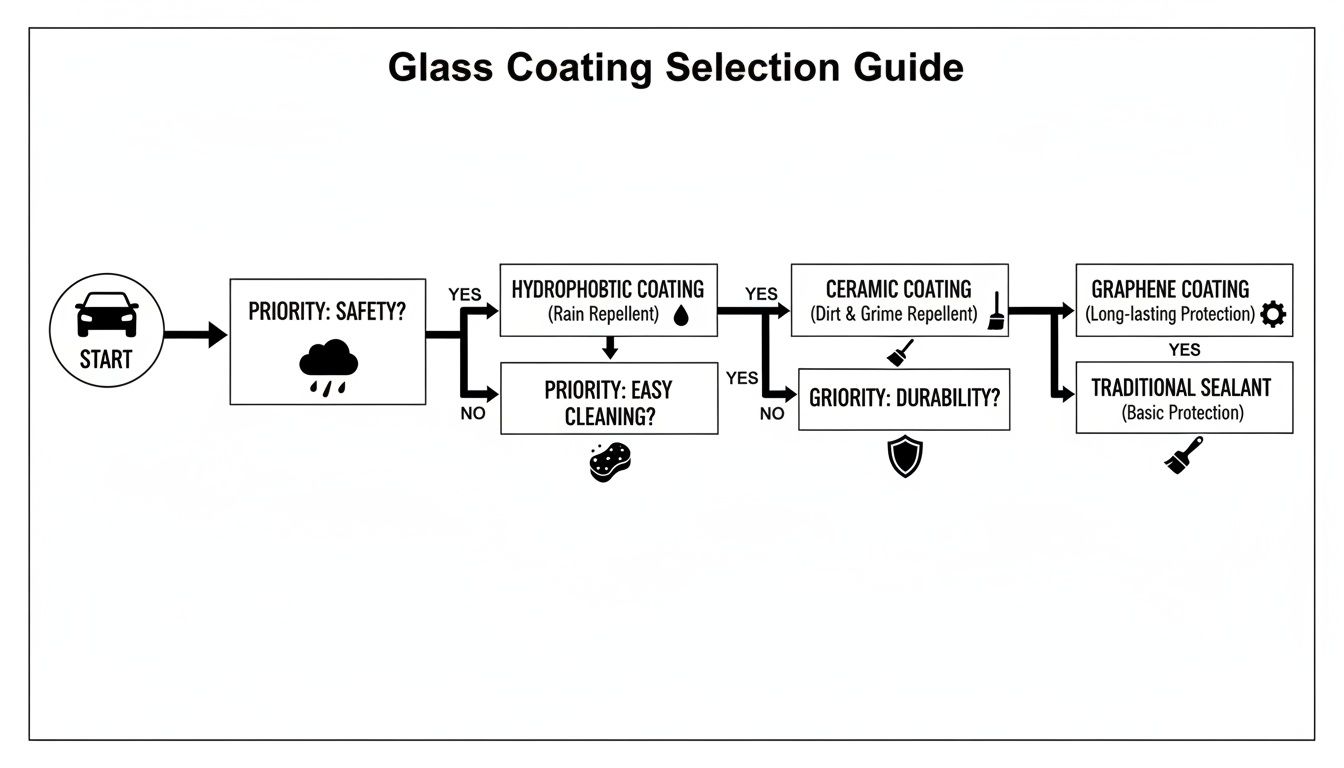
As you can see, if you're playing the long game and want maximum durability, a ceramic coating is the clear winner. It simply outperforms the others over time.
Ceramic Coatings: The Durable Defender
Ceramic coatings, sometimes called SiO₂ or quartz coatings, are a whole different beast. Instead of just sitting on top of the glass, these liquid formulas chemically bond with the surface. This process, known as covalent bonding, creates a semi-permanent, hardened shield of microscopic crystals that's incredibly tough.
What you get is a shield that’s exceptionally resistant to abrasion from wipers, road salt, and whatever else the environment throws at it. It’s not a temporary fix; it becomes an integrated part of your glass.
This isn't just about making water roll off, either. These coatings add some serious protection against other elements. For instance, coated glass can block up to 99% of UV rays, which goes a long way in preventing your car's interior from fading. Some industry reports even estimate this protection can save a driver over $500 a year in potential damage.
As you weigh your options, don't forget to look into advanced films, too. Understanding the benefits of ceramic window tint can help you compare its advantages against a simple coating. You can also dive deeper into how different films work in our guide on car window tinting benefits.
Understanding the Performance Metrics That Matter
When you're looking at glass coatings, it’s easy to get lost in marketing fluff. What you're really buying isn't a bottle of liquid; it's a specific set of performance benefits. The real question is, how do you measure that performance and know you're getting your money's worth?
It all boils down to a few key characteristics that make a real difference in how you see the road, how safe you are, and how long your investment lasts. Let's cut through the noise and talk about what actually matters.
H3: The Magic of Water-Beading
The most famous—and frankly, the most satisfying—benefit of any good glass coating is hydrophobicity. This is just a technical term for its ability to make water run for its life.
Picture this: on untreated glass, rain splatters and smears, forcing you to crank up your wipers. A coated windshield is different. It creates an incredibly slick, low-energy surface that forces water to form tight, perfect little beads.
Once you hit about 30-40 MPH, the wind just whisks those beads right off the glass. It's a game-changer in a downpour, giving you a crystal-clear view and letting your wipers take a much-needed break.
H3: Optical Clarity Is Non-Negotiable
Here’s the thing about a great glass coating: you shouldn't even know it's there. Optical clarity is absolutely crucial. A cheap or poorly applied product can leave behind a hazy film, create a rainbow effect under certain light, or—worst of all—amplify glare from oncoming headlights at night.
A premium coating bonds so seamlessly with the glass that it becomes part of it. It should be perfectly invisible, sharpening your view of the road instead of adding any visual distortion.
This isn't just about looks; it's a major safety feature. Some studies have found that a high-quality coating can slash glare by up to 30%. Less glare means fewer distractions and a safer drive, a trend noted in the broader automotive glazing market forecast at researchandmarkets.com.
H3: Durability and Real-World Longevity
Finally, a coating is only as good as its ability to stick around. Durability is its power to stand up to the daily grind of driving—the constant friction from wiper blades, harsh car wash chemicals, road salt in the winter, and even acidic bug guts.
Longevity is the direct result of that toughness.
- Abrasion Resistance: How well does it hold up against thousands of swipes from your wiper blades?
- Chemical Resistance: Can it survive repeated exposure to soaps and de-icing fluids without breaking down?
A basic silicone spray might give you a few months of performance if you're lucky. A professionally installed ceramic coating, on the other hand, can easily last for years. The climate you live in, how much you drive, and your car wash habits all play a part, but a better product will always deliver a longer service life.
H3: Performance Metrics Compared Across Coating Tiers
Not all coatings are created equal. Here’s a quick breakdown of what you can realistically expect from different product tiers.
| Performance Metric | Entry-Level (Silicone) | Mid-Grade (Hybrid) | Professional (Ceramic) |
|---|---|---|---|
| Hydrophobicity | Good initial beading, fades quickly | Excellent beading and sheeting | Extreme, highly uniform beading |
| Optical Clarity | Generally good, risk of slight haze | Excellent, no distortion | Flawless, invisible finish |
| Abrasion Resistance | Low, wears off from wipers | Good, withstands moderate use | Excellent, highly resistant to wipers |
| Chemical Resistance | Minimal, strips easily | Moderate, holds up to most soaps | High, resists harsh chemicals |
| Longevity | 1-3 months | 6-12 months | 1-2+ years |
As you can see, investing in a higher-tier product generally gets you a big jump in durability and longevity, ensuring those impressive water-beading effects stick around for the long haul.
Choosing Your Path: DIY vs. Professional Application
So, you've picked out a coating. Now for the big question: do you roll up your sleeves and do it yourself, or do you hand the keys over to a pro? This is a major crossroads in the process, and the right answer really depends on your budget, how much you enjoy detailed work, and which coating you’re using.
Both routes can get you fantastic results. But the journey—and the guarantees—are completely different.
For the enthusiast who loves being hands-on, the DIY path is not only cheaper but also incredibly rewarding. There's a real satisfaction in knowing you protected your ride yourself. Just know that the final result rests entirely on how well you prep the glass.
The DIY Approach: What to Expect
If you're going the DIY route, you're essentially becoming a detailer for a day. Applying the coating is the easy part; the real work is creating a perfectly sterile surface for it to bond to. This isn't something you can knock out in 20 minutes before heading out.
You have to be meticulous.
- Intensive Cleaning: This is way more than a quick spray-and-wipe. You'll need a quality glass cleaner to get every last bit of surface grime off.
- Decontamination: Here's where most people slip up. You need to use a clay bar or a chemical decontaminant to pull out all the tiny, embedded particles from the glass. You're aiming for a surface that's as smooth as, well, glass.
- Final Prep: One last wipe-down with isopropyl alcohol (IPA) is crucial. It removes any lingering oils from your fingers or other residues, leaving the surface ready for bonding.
The biggest hurdles for DIYers are the simple mistakes that have big consequences. Try applying a coating in direct sunlight, and you'll find it flashes almost instantly, leaving you with a streaky mess that's a nightmare to fix. Rushing the prep work is the other classic blunder—it guarantees the coating won't stick properly and will fail way sooner than it should.
A professional detailer’s greatest advantage isn’t just their skill—it’s their controlled environment. Applying a coating in a clean, temperature-stable garage prevents dust, pollen, and humidity from compromising the bond, a luxury most DIYers don’t have.
Why Go with a Professional Installer
Choosing a professional installer is an investment in perfection and, honestly, peace of mind. These guys live and breathe this stuff. They have the right tools, like infrared lamps to properly cure the coating, and the experience to guarantee a flawless finish. This is especially true for the more advanced, long-lasting ceramic coatings.
A pro handles all that painstaking prep work with practiced precision, ensuring you get the absolute best car glass coating performance and durability. Yes, the upfront cost is higher, but you're paying for a guaranteed result. You're also avoiding the very real risk of a botched job that could force you to strip everything off and start from square one.
For those considering even more robust protection, it's worth looking into the installation process for something like a car window security film to really appreciate the difference an expert application can make.
Keeping Your Glass Coating in Top Shape
You've done the work and applied a great glass coating. Fantastic! But the job isn't quite finished. To get the most out of it—and to keep that water beading off like crazy—you need to give it a little TLC. Proper maintenance is what separates a coating that lasts a few months from one that performs beautifully for a year or more.
Think of it this way: you wouldn't buy a great suit and then never dry-clean it. A little upkeep goes a long way in protecting your investment.
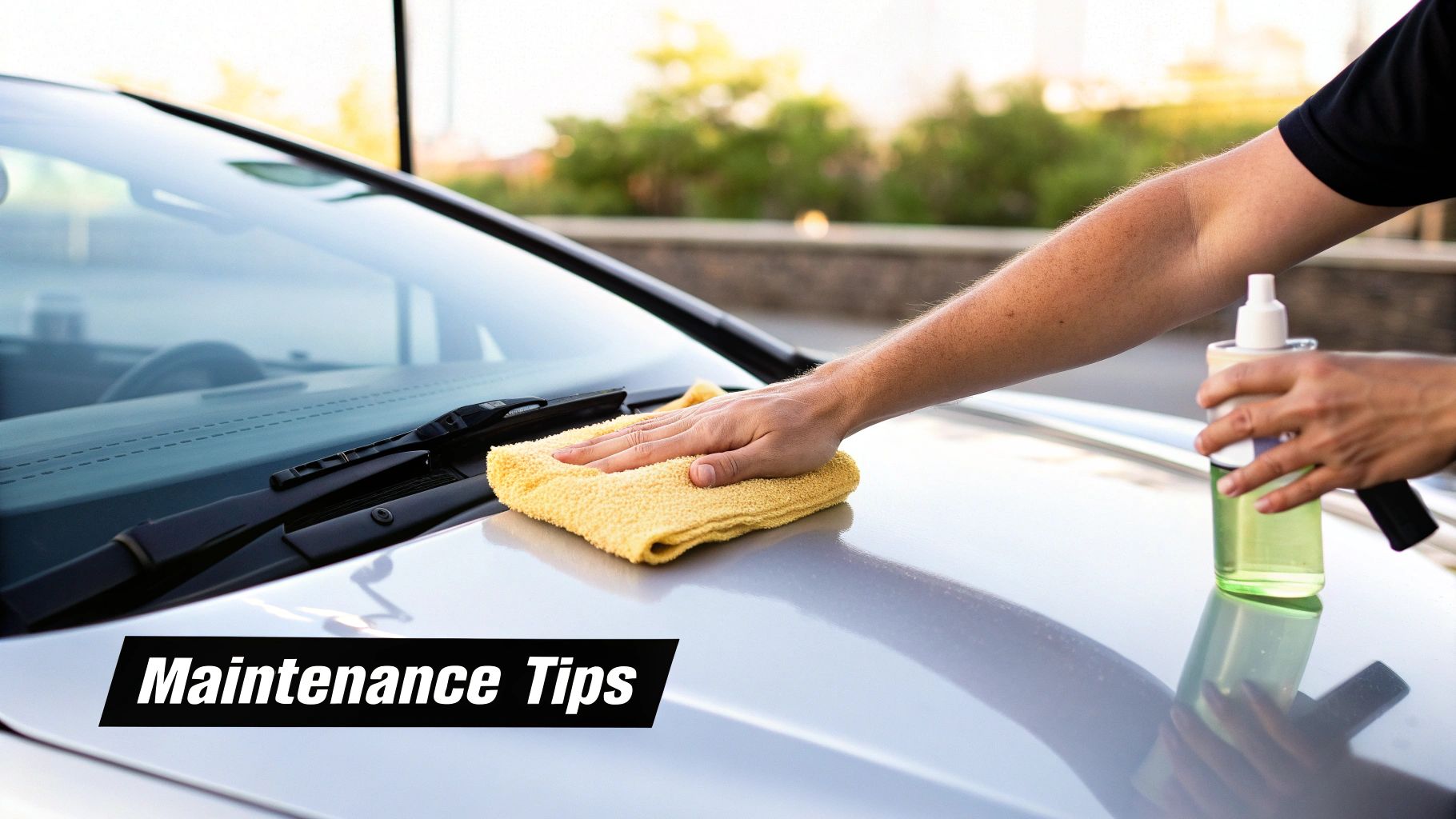
The number one rule is to be gentle. Those harsh, high-alkaline soaps used in many automated car washes are the enemy of your coating; they can chemically strip it right off the glass. Instead, always reach for pH-neutral car wash soaps and use a fresh, soft microfiber towel. This simple habit prevents you from accidentally grinding dirt into the surface and degrading the coating's performance.
Simple Steps for Long-Lasting Protection
You don't need a complicated routine to keep your coating working perfectly. Just a few smart habits will make all the difference in its durability and clarity.
Wash the Right Way: Stick to dedicated automotive soaps that are pH-neutral. They’re designed to lift dirt and grime without being aggressive enough to harm the coating's chemical bonds. Whatever you do, keep the dish soap in the kitchen.
Boost It with Toppers: Most coating manufacturers sell a "maintenance spray" or "topper." Think of these as a quick refresh for your coating's hydrophobic power. A quick spray-and-wipe after a wash every few months can really extend the life of the main layer.
Check Your Wipers: Old, gritty wiper blades are a coating’s worst nightmare. Every time they swipe, they can drag tiny particles of dirt across the glass, causing abrasion and micro-scratches. Swap out your blades as soon as they show signs of wear.
A well-maintained coating is more than just a cosmetic upgrade. It’s a safety feature. Keeping it in good condition ensures water clears from your windshield effectively during a downpour, and that’s something you can’t put a price on.
Ultimately, a little consistent care is all it takes to shield your coating from the daily grind of UV exposure, road salt, and other grime. While these coatings provide an excellent barrier, if you're looking for serious physical protection against smashes or impacts, it's worth exploring dedicated solutions like our automotive security film.
By following these simple tips, you can be sure your glass stays crystal clear and protected for the long haul.
Got Questions About Car Glass Coatings? We've Got Answers.
Even after you've done your homework, a few questions always pop up before you're ready to pull the trigger on a glass coating. Let's tackle some of the most common ones we hear from drivers just like you.
Can I Put a Glass Coating on Top of My Window Tint?
Absolutely. This is a common question, but there's no conflict between the two. Your window tint is always applied to the inside of the glass, while a hydrophobic or ceramic coating is applied to the outside.
Since they live on opposite sides of the glass, they'll never interfere with each other. You get all the rain-shedding, easy-cleaning benefits of the coating on the exterior, plus the privacy and UV-blocking of your tint on the interior.
How Long Does a Good Glass Coating Actually Last?
This is the big one, and the honest answer is: it depends. The longevity of any coating hinges on the product itself, the climate you live in, and how much you drive.
Here’s a realistic breakdown:
- Silicone Sprays: Think of these as a temporary boost. You'll get 1-3 months of performance before you need to reapply. They're quick and easy, but not a long-term fix.
- Consumer-Grade Ceramic Coatings: If you apply a quality DIY ceramic kit and take care of it, you can reasonably expect it to last one to two years.
- Professional-Grade Coatings: This is the top tier. Thanks to more potent formulas and a pro's meticulous prep work, these coatings can easily last two years or even longer.
Will a Glass Coating Stop Rock Chips or Cracks?
No, and this is a crucial point to understand. It's a very common myth. While a ceramic coating creates an incredibly hard and slick surface, it's also microscopically thin. It’s simply not thick enough to absorb the force of a pebble hitting your windshield at highway speeds.
Its main job is to protect against the elements and make cleaning easier, not to defend against physical impacts.
If you're looking for real protection from rock chips, cracks, or even "smash-and-grab" break-ins, you need to look at a dedicated windshield protection film. These are much thicker, impact-absorbing layers built specifically for that kind of physical defense.
Is It Worth Paying a Pro to Apply It?
This really comes down to what you're trying to achieve and which product you're using. For a high-end, long-lasting ceramic coating, professional installation is almost always worth the money. A pro detailer has a clean, controlled space and knows all the tricks to prep the glass perfectly—which is the secret to getting that coating to bond properly and last for years.
On the other hand, if you're just using a simple hydrophobic spray or an entry-level sealant, a careful DIY job will get you fantastic results without the added cost.
At Fortress Security Films, we take glass protection to a whole new level. While coatings are fantastic for visibility, our advanced security films create a powerful, invisible shield against physical threats. See how we can fortify your vehicle's glass by visiting us at https://fortresssecurityfilms.com.
