


First things first, let's get one major misconception out of the way. Ballistic window film is not "bulletproof." Slapping a film on a piece of glass won't magically stop a bullet in its tracks. Instead, it's more accurate to think of it as a bullet-resistant system—a high-tech safety net for your windows and glass doors.
What Ballistic Window Film Actually Does
The real job of this film is to manage the incredible amount of energy that gets transferred during an impact. That could be a bullet, a sledgehammer, or even the shockwave from a nearby explosion.
It’s made from multiple, micro-thin layers of high-tensile polyester, all laminated together and bonded to your existing glass with an incredibly aggressive adhesive. When a bullet hits a treated window, the glass itself will still shatter. But here's where the magic happens: the film holds all those dangerous, razor-sharp shards together.
This simple function delivers two huge security benefits:
- It stops deadly glass shrapnel. By holding the broken glass in place, the film prevents the window from exploding inward. In many active threat situations, it's the flying glass, not the bullet itself, that causes the most severe injuries.
- It soaks up the bullet's energy. The film and the now-flexible pane of broken glass act like a catcher's mitt, absorbing a massive amount of the projectile's kinetic energy. This can dramatically slow the bullet down or, depending on the firearm and film thickness, even stop it from getting through at all.
More Than Just Bullets
While its name screams "ballistic," the film’s core job—keeping glass intact under extreme force—makes it a fantastic all-around security upgrade. It’s incredibly versatile.
For instance, the same strength that resists a bullet works wonders against forced entry. A burglar trying to smash a window with a rock or a crowbar is in for a nasty surprise. They’ll find that while the glass might crack, getting through the film is a loud, difficult, and time-consuming ordeal.
That delay is everything. It buys you precious time—time to react, to find safety, and for help to get on its way. More often than not, a criminal will just give up and move on.
Turning a Weak Point into a Stronghold
Think about it: the standard glass in most homes and businesses is a massive vulnerability. It offers almost no resistance to a determined attacker. It shatters in an instant, giving them immediate access and spraying the room with dangerous debris.
Retrofitting that same glass with ballistic film fundamentally changes how it behaves under attack. It transforms a fragile pane into a resilient, energy-absorbing shield. You get a serious security boost without needing ugly bars, bulky shutters, or the sky-high cost of installing true bullet-resistant glass. It's a smart, practical first line of defense for any modern building.
How Ballistic Film Reinforces Glass
There's no magic behind how ballistic window film works—it's just a smart combination of advanced materials and applied physics. At its core, the film turns a standard piece of glass into a tough, energy-absorbing shield. The film itself is a sophisticated laminate, built from micro-thin layers of high-tensile polyester fused together with incredibly strong, specialized adhesives.
Think of it this way: the glass is your first line of defense, built to take that initial, shattering blow. The ballistic window film is the flexible, resilient safety net right behind it, catching the impact and holding everything together to prevent a breach.
This partnership is what makes the system work. The glass provides the hard, rigid surface, but it's the film that gives it the flexible strength to withstand the incredible force of an impact without failing completely.
The Physics of Energy Absorption
When a bullet or other projectile hits a window treated with ballistic film, the glass does what it's supposed to do—it shatters instantly. Without the film, those sharp fragments would fly inward, becoming dangerous projectiles themselves. But the film's aggressive adhesive grips every last shard, holding the pane together.
This is the moment the real work begins. The sheet of film, now holding a spiderweb of broken glass, flexes and bows outward like a catcher's mitt absorbing a fastball. This stretching action is key. It spreads the projectile's kinetic energy over a much larger surface area, which slows the object down dramatically.
Instead of cleanly punching through a brittle pane, the bullet is forced to push its way through a tough, pliable membrane. This resistance saps its momentum, often stopping it dead in its tracks.
The core principle is all about converting the sharp, focused energy of an impact into widespread tensile stress. The film’s ability to stretch and deform without tearing is what makes it so effective against violent force.
This technology is constantly evolving. For example, thermoplastic polyurethane (TPU) films are quickly becoming a go-to for transparent ballistic protection. The global market for these films hit about $2.5 billion in 2023, and that number is set to grow thanks to their flexibility, light weight, and excellent optical clarity. You can discover more insights about the growing TPU film market and its applications.
Why Anchoring Is Non-Negotiable
A critical piece of the puzzle that many people overlook is the anchoring system. You can have the thickest, strongest film in the world, but it's only as good as its connection to the window frame. Without a proper anchor, a powerful impact could just pop the entire sheet of film and broken glass out of the frame in one piece.
An anchoring system secures the edges of the film directly to the window frame. This is usually done with a structural silicone adhesive (a "wet glaze" system) or a mechanical battening system. The goal is to create a seamless, bonded unit from the film to the frame.
By anchoring the film, you ensure that the impact's force is transferred not just across the glass, but also into the building's structure itself. This makes the entire window assembly—glass, film, and frame—work together as a single, resilient system.
- Prevents Frame Push-Through: It stops an attacker from simply dislodging the whole pane.
- Maximizes Energy Transfer: It lets the building's own structure help absorb the blow.
- Essential for NIJ Certification: No ballistic glazing system can achieve a true NIJ rating without being properly anchored.
Ultimately, the science behind reinforcing glass is a three-part formula: advanced materials, the physics of energy dissipation, and a professional installation that fully integrates the film with the window frame.
Understanding NIJ Levels for Window Film
When you start looking into security upgrades, the technical jargon can feel a bit like alphabet soup. For ballistic window film, the most important term you'll hear is the National Institute of Justice (NIJ) 0108.01 standard. This isn't just a random code; it's the official U.S. government benchmark for how well materials like body armor and security glazing can stop a bullet.
Think of it as a universal language for ballistic protection. It translates a product's technical specs into a clear, real-world promise of what it can defend against. When a product has an NIJ rating, you know it’s been through hell and back in standardized tests, facing specific types of ammunition fired at precise speeds.
But here’s the single most important thing to get right from the start: ballistic window film by itself does not have an NIJ rating. The rating is for the entire system—the film, the glass it’s applied to, and crucially, the anchoring system holding it all to the window frame.
A dangerous myth I hear all the time is that you can just buy a roll of "bulletproof" film and slap it on any window. True ballistic resistance is a complete system where every single part works together to absorb and manage an incredible amount of force.
The Different Levels of Protection
The NIJ standard is broken down into levels, and as the number goes up, so does the protection. For window film systems, we're almost always talking about handgun threats. Stopping a high-powered rifle round requires much more serious hardware, like thick polycarbonate or multi-layered laminated glass.
Here’s a quick rundown of the NIJ levels you’ll see when it comes to security glazing systems.
- NIJ Level I: This is your baseline. It's designed to stop lower-velocity handgun rounds like a .22 Long Rifle (LR) and a .380 ACP.
- NIJ Level IIA: This level steps up the protection to handle more common handgun calibers, specifically 9mm FMJ (Full Metal Jacket) and .40 S&W rounds.
- NIJ Level II: Here, we're getting into more serious stopping power. This level is tested against higher-velocity 9mm FMJ rounds and the powerful .357 Magnum.
- NIJ Level IIIA: This is often seen as the top tier for handgun defense. It's built to defeat very high-velocity 9mm rounds and even the formidable .44 Magnum. It’s typically the highest rating you can achieve with a film-based retrofit system.
This image shows the direct relationship between the thickness of the film used in a system and the level of protection it can help achieve.
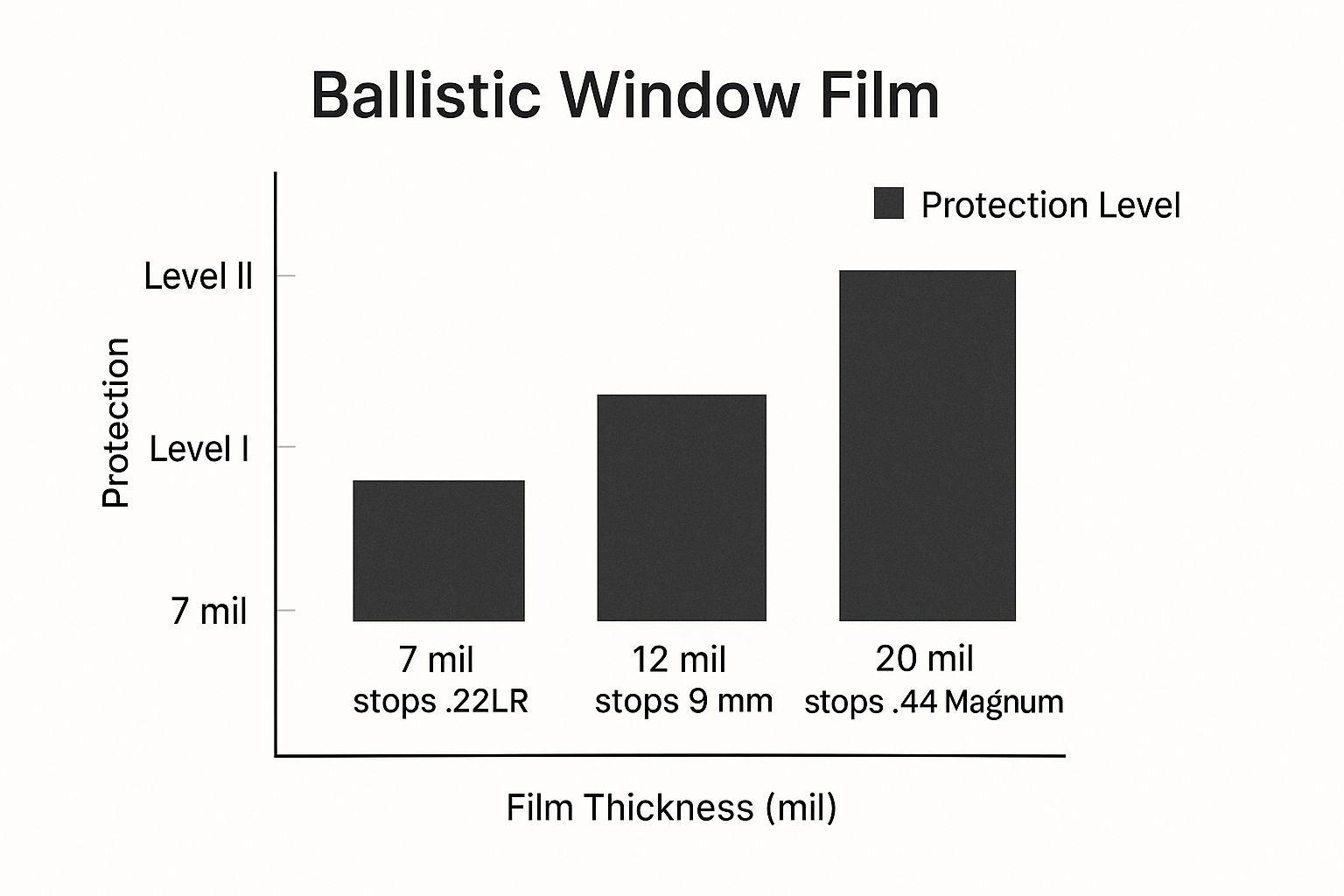
As you can see, thicker films are a key component in systems designed to withstand more powerful ammunition.
A Closer Look at the Ratings
To make this even clearer, let's put the most common NIJ levels for glazing systems into a table. This helps visualize what each level is designed to protect against and where you might see it used.
| NIJ Level | Protects Against (Common Handgun Calibers) | Typical Application |
|---|---|---|
| NIJ Level I | .22 LR, .380 ACP | Basic security for low-risk retail, residential. |
| NIJ Level IIA | 9mm FMJ, .40 S&W | Schools, commercial buildings, corporate offices. |
| NIJ Level II | High-Velocity 9mm FMJ, .357 Magnum | High-risk retail, government facilities. |
| NIJ Level IIIA | High-Velocity 9mm, .44 Magnum | Courthouses, police stations, critical infrastructure. |
This table is a simplified guide, but it quickly shows how the protection scales with the potential threat. The key is to match the system's capability to the real-world risks you face.
Why Certified Protection Is More Important Than Ever
The need for proven, tested security solutions is growing every day. That demand is fueling huge growth in the market. The global bulletproof security glass market, which includes ballistic window film systems, was valued at around USD 11.56 billion and is expected to climb past USD 30 billion by 2032. This isn't just a trend; it's a direct response to a world with increasing security concerns. You can read the full research about the bulletproof glass market to see what’s driving this demand.
Choosing the right NIJ level isn't about picking the highest one you can afford. It’s about a careful and honest assessment of your specific risks. A local retail shop worried about smash-and-grabs has very different needs than a government building in a high-threat area. The best path forward is always to consult with a security professional who can help you make an informed decision, ensuring your investment truly delivers protection when it counts.
Where Ballistic Film Makes a Real-World Difference
It's one thing to understand the science behind ballistic window film and its NIJ ratings, but the real test is how it holds up in the field. This isn't just a theoretical concept; it's a practical solution being used every day to protect people and property in all kinds of situations. The applications generally fall into three main categories where vulnerable glass creates a serious risk.
In each scenario, the film’s ability to absorb impacts and hold shattered glass together is the key. It transforms a building's weakest points into a surprisingly strong line of defense, whether it's a busy downtown storefront or a quiet suburban home.
Commercial and Government Buildings
If you run a business with large, street-facing windows, the threat of a break-in is always in the back of your mind. Retail stores, banks, and especially jewelry shops are classic targets for smash-and-grab robberies. The whole strategy depends on speed: break the glass, grab the goods, and be gone in seconds. Ballistic window film completely disrupts that plan.
When a criminal tries to smash a treated window, it doesn't just shatter and fall away. It holds together, creating a frustrating and noisy obstacle. That delay is everything. Most thieves will simply give up and run rather than hang around and risk getting caught. It’s a powerful, nearly invisible deterrent that protects your assets without making your building look like a fortress with ugly bars or shutters.
Government buildings, courthouses, and police stations face even more serious threats, and for them, the film plays two critical roles:
- Forced-Entry Prevention: It hardens entry points against determined attackers, buying precious time for security teams to respond.
- Blast Mitigation: During an explosion, the film is crucial for containing the flying glass shrapnel that causes the most injuries.
It's no surprise the global market for security films is booming. The blast-resistant window film market alone was valued at roughly USD 1.2 billion recently and is projected to hit USD 2.3 billion within the next decade. You can read the full research about the blast-resistant film market to see what's driving this incredible growth.
Residential Security and Home Protection
More and more homeowners are using security film to protect their families. Burglars love big glass doors, patio sliders, and ground-floor windows because they're such easy targets. A standard pane of glass is no match for a determined intruder, but a window treated with ballistic window film is a whole different story.
There’s a real peace of mind that comes from knowing your home's most vulnerable spots are reinforced. It creates a vital buffer, giving your family time to react, find a safe place, and call for help during a home invasion. For this reason, it’s become a go-to solution for high-net-worth individuals and families looking for discreet but highly effective security.
Automotive and Vehicle Protection
The use of ballistic film isn't limited to buildings. It's also a critical safety feature for vehicles, especially for executives, high-profile individuals, and law enforcement. A vehicle’s windows are its weakest points in an ambush or attack.
By applying a multi-layer film system to a car’s windows, you can achieve handgun-level protection and stop projectiles from getting inside. This effectively turns a regular car into a much safer mode of transport, protecting occupants while they are most exposed—on the move. For police and security details, this technology can be the deciding factor between a contained threat and a tragedy.
Making the Right Choice: Selecting and Installing Your Security Film
Picking the right ballistic window film system isn't as simple as choosing the thickest option off a shelf. It's a careful calculation, balancing the specific threats you face with the unique reality of your property. The goal is to create a unified system where the film, the glass, and the window frame all work in concert. This is a job for a professional, from the first conversation to the final inspection.
It all starts with a real-world threat assessment. Are you a homeowner worried about determined burglars, or are you securing a commercial building in an area with a higher risk profile? Your answer points directly to the NIJ protection level you actually need. We also have to look at your existing windows—their size, whether they're single or double-pane, and the sturdiness of the frames are all part of the equation.
Why Professional Installation Is Not Optional
Let me be crystal clear: installing a ballistic window film system is not a DIY project. The entire system's ability to perform under pressure depends completely on a perfect, professional installation. A film that's applied incorrectly or an anchoring system that isn't rock-solid provides a false sense of security and will fail when it matters most.
Think of it like this: you can have all the parts for a world-class race car, but if they aren't assembled with the precision of a master mechanic, you just have an expensive pile of metal. It won't perform. Professional installers bring specialized tools, deep training, and hands-on experience to the job. They ensure the film is flawlessly bonded to the glass, with no bubbles, dust, or tiny flaws that could weaken it.
Even more importantly, they are experts at installing the anchoring system. This is the hardware that physically locks the film and glass into the window frame, turning three separate parts into one solid barrier. It's what keeps the entire window from being blown out of its frame under extreme force.
A professional security consultation is the bedrock of any effective system. It's where an expert identifies your specific risks and designs a solution that gives you the right protection without you paying for overkill.
What the Professional Installation Process Looks Like
When you bring in a certified installer from a company like Fortress Security Films, you're getting a meticulous process designed for one thing: performance. It’s far more involved than just sticking a film to glass.
- In-Depth Consultation and Measurement: First, an expert comes to you. They'll assess your security needs, take precise measurements of every window, and walk you through the best NIJ-rated options that fit your budget and threat level.
- Meticulous Surface Prep: This step is non-negotiable for a lasting bond. The glass is professionally cleaned and decontaminated to get rid of any microscopic dirt, oils, or residues. This allows the film's powerful adhesive to form a permanent, molecular-level connection to the glass.
- Expert Film Application: Technicians use specialized tools and proven techniques to apply the thick, multi-layered film. They carefully squeegee out every drop of moisture, leaving a perfectly flat, optically clear finish that's virtually invisible once it fully cures.
- Installing the Frame Anchoring System: With the film in place, the anchoring system is installed. This is typically done with either a structural silicone known as a "wet glaze" or a mechanical battening system that physically fastens the film's edges to the window frame.
How to Vet Your Installer
Choosing the right installer is just as crucial as choosing the right film. To make sure you’re hiring a genuine professional, you need to ask a few pointed questions:
- Are you certified to install ballistic-grade security films? Don't be afraid to ask for proof of their certification directly from the manufacturer.
- Can you show me examples of your past work? A reputable company will be proud to share its portfolio and provide references from previous clients.
- What kind of anchoring system do you recommend for my windows, and why? Their answer will quickly tell you if they understand how to build a complete security system or if they're just a film applicator.
- What exactly does your warranty cover? Get the details on what’s covered for both the film materials and the installation labor.
What Does Ballistic Film Cost & How Do You Take Care of It?
Deciding to install ballistic window film is a serious security upgrade, so it’s natural to wonder about the bottom line and what it takes to keep it in top shape. There isn't a simple price tag; the final cost really depends on the level of protection you need and the unique details of your space.
The biggest factor influencing the price is the film's thickness and its NIJ rating. A system engineered to stop a handgun round (like an NIJ Level IIIA film) is far more substantial and requires a more complex anchoring system than one designed just to slow down an intruder. Naturally, higher protection means a higher price point.
Breaking Down the Investment
The film itself is just one part of the equation. When you get a quote, it will be a comprehensive figure that takes a few other key things into account.
- Total Glass Area: The more square footage you need to cover, the more the project will cost. It's a straightforward calculation of materials and time.
- Installation Difficulty: Do you have custom arched windows, hard-to-reach skylights, or complex framing? Tricky installations require more time and skill, which adds to the labor cost.
- Window and Frame Condition: If your existing glass or frames need prep work before the film can be applied, that will be factored in as well.
As a ballpark figure, you can expect professionally installed ballistic window film systems to run anywhere from $25 to over $100 per square foot. The lower end of that range typically covers robust forced-entry protection, while the higher end is for certified, NIJ-rated ballistic systems designed to stop projectiles.
Protecting Your Investment for the Long Haul
The good news is that once your film is installed, taking care of it is incredibly simple. A little bit of proper maintenance is all it takes to keep it looking and performing its best for years. In fact, a quality installation can easily last 15 years or more, and it's usually backed by a manufacturer's warranty that protects against things like peeling, bubbling, or turning purple.
To clean your windows, just stick to the basics: a soft microfiber cloth and a gentle cleaning solution made from water and a few drops of mild dish soap. Stay away from ammonia-based cleaners (like Windex), abrasive pads, or razor blades, as they can scratch and permanently damage the film's surface.
That’s all there is to it. This simple routine will keep your windows perfectly clear and ensure your security film remains ready to perform for decades.
Frequently Asked Questions
Even after covering the basics, a few key questions always seem to pop up. Let's tackle some of the most common ones to clear up any lingering doubts you might have about this powerful security upgrade.
Will Ballistic Window Film Make My Windows Dark or Reflective?
Not at all. This is one of the biggest misconceptions out there. High-quality ballistic window film is engineered for optical clarity, meaning it's virtually invisible once a professional installs it.
You get to add a serious layer of security without altering your property's appearance one bit. Natural light still streams in, and your view remains crystal clear. While you can get versions that combine security with solar control, the core ballistic product is designed to be completely transparent.
Your windows will look exactly the same as they did before, but they will perform on an entirely different level. This discreet protection is ideal for maintaining the architectural integrity and aesthetic of any building.
Is Ballistic Window Film Legal for Homes and Vehicles?
Absolutely. For homes and commercial buildings, installing ballistic film is perfectly legal. In fact, it's often a recommended security measure for properties with higher risk profiles. Generally, there are no restrictions on applying clear security films to buildings.
Vehicles are a slightly different story, as regulations can vary by state or country, mostly around tint levels. The good news is that because most ballistic window film is optically clear, it usually doesn't run into those legal issues. Still, it's always a smart move to double-check with your installer. They'll know the local laws inside and out and will make sure your installation is 100% compliant.
How Does Ballistic Film Compare to Bulletproof Glass?
This is a really important distinction to understand. Ballistic film is a retrofit solution—an upgrade applied to your existing glass. Bulletproof glass, on the other hand, is a complete replacement product that involves swapping out the entire window pane and, often, the frame as well.
Here's a quick breakdown of the key differences:
- Protection Level: Bulletproof glass is the heavy-hitter, capable of stopping high-powered rifle rounds. Ballistic film systems are designed to defeat handgun threats, typically up to a NIJ Level IIIA rating.
- Cost & Installation: Bulletproof glass is a major investment. It's incredibly heavy, thick, and expensive, and installing it often requires structural changes to the building. Ballistic film is a much more affordable and less disruptive way to achieve a significant security boost.
Think of it this way: ballistic film is a powerful upgrade for your current infrastructure, while bulletproof glass is a complete overhaul designed for the most extreme threat scenarios.
Ready to transform your property's most vulnerable points into a source of strength? The experts at Fortress Security Films can provide a comprehensive security assessment and a professionally installed system tailored to your exact needs. Fortify your windows and protect what matters most by visiting us today.
For project-specific ballistic applications, explore Fortress’s ballistic security solutions.
