


When you're searching online for "ballistic glass for sale," it's important to know what you're actually looking for. The industry standard term is bullet-resistant, and that distinction matters. These systems are designed to delay and deter an attacker, not to be some indestructible shield from a superhero movie.
Your choice really boils down to two main paths: go with traditional laminated ballistic glass, or upgrade your existing windows with a modern, retrofit security film.
Making Sense Of Ballistic Glass Protection
Getting started with securing your property can feel like you’re learning a new language. You're hit with technical jargon and a dizzying array of ratings. The very first thing to get straight is the difference between "bulletproof" and "bullet-resistant."
Frankly, nothing is truly bulletproof. Instead, these specialized glass systems are engineered to stop specific types of ammunition for a certain number of shots. Their real job is to buy you time. They delay an attacker, giving people inside a chance to get to safety and for law enforcement to show up.
This concept of strategic delay is the whole game in modern physical security. It turns a weak spot, like a glass storefront or a lobby door, into a serious obstacle. Once you grasp that, you stop looking for an imaginary, invincible barrier and start thinking about a practical solution built for the real world.
Two Paths to Fortification
So, how do you get this level of protection? You’ve got two solid options, and the right one for you depends on your building, your budget, and the kinds of threats you're worried about.
-
Laminated Ballistic Glass: This is the classic, heavy-duty choice. Think of it as a sandwich made of multiple layers of glass with a tough, clear polymer in between. It creates a thick, heavy panel that can stop some serious firepower. It's usually the go-to for new construction projects or major renovations where the building's frame can handle the extra weight.
-
Ballistic Security Films: This is the nimble, modern approach. Advanced security films, like the kind certified by the National Institute of Justice (NIJ), are applied directly over your existing glass. These are not your average window tints; they are multi-layered polymer films engineered to absorb and spread out the force of an impact. Even if the glass shatters, the film holds it all together, preventing a breach.
The demand for discreet, effective security solutions is exploding. The global market for what people call bulletproof glass was valued at $9.3 billion in 2023 and is expected to hit $29.5 billion by 2033. This isn't just for banks and government buildings anymore; we're seeing huge growth in retail, schools, and even private homes. People want security that works without making their property look like a fortress. You can read the full research about ballistic material market trends to see the data for yourself.
The real objective of bullet-resistant glass is not just to stop a bullet, but to buy time. Whether it's 30 seconds or five minutes, that interval is often the difference between safety and tragedy. It is an investment in response time.
At the end of the day, finding the right ballistic glass for sale is about matching the solution to your unique situation. Whether you're protecting a jewelry store from a smash-and-grab crew or securing your home against a break-in, this guide will give you the knowledge to make a smart, confident decision.
Decoding NIJ Ratings for Real-World Threats
Choosing the right ballistic protection can feel overwhelming, but it really boils down to one simple question: what do you need it to stop? This is where the National Institute of Justice (NIJ) ratings become your most important tool. These aren't just technical jargon; they're a clear, standardized language that tells you exactly how a product will perform under fire.
Think of NIJ ratings like the SPF on sunscreen. A lower number protects against common, everyday threats, while a higher number is built for more intense scenarios. For example, an NIJ Level 1 rating is designed to stop rounds from smaller handguns—the kind of threat you might face in a smash-and-grab robbery.
As you go up the scale, the protective power increases. This system helps you match a product to your actual security needs, so you don’t overspend on protection you don’t need or, worse, underspend and remain vulnerable. It’s all about finding that sweet spot between safety and practicality.
Understanding The Threat Levels
Each NIJ level is tied to a specific type of ammunition it can reliably stop. But instead of getting bogged down in the ballistic data, it’s much more helpful to think in terms of real-world situations. A street-level retail store faces very different threats than a secure government building, and their protection should reflect that.
For instance, most businesses and homes are primarily concerned with common handguns. Solutions rated for NIJ Levels 1, 2, or 3A are specifically tested to withstand multiple impacts from these firearms, giving you a solid defense against the most likely dangers.
When you start looking at ballistic glass for sale, checking these ratings is the absolute first step toward making a smart decision.
This diagram shows how different solutions, like traditional laminated glass and modern security films, fit into an overall protection strategy.
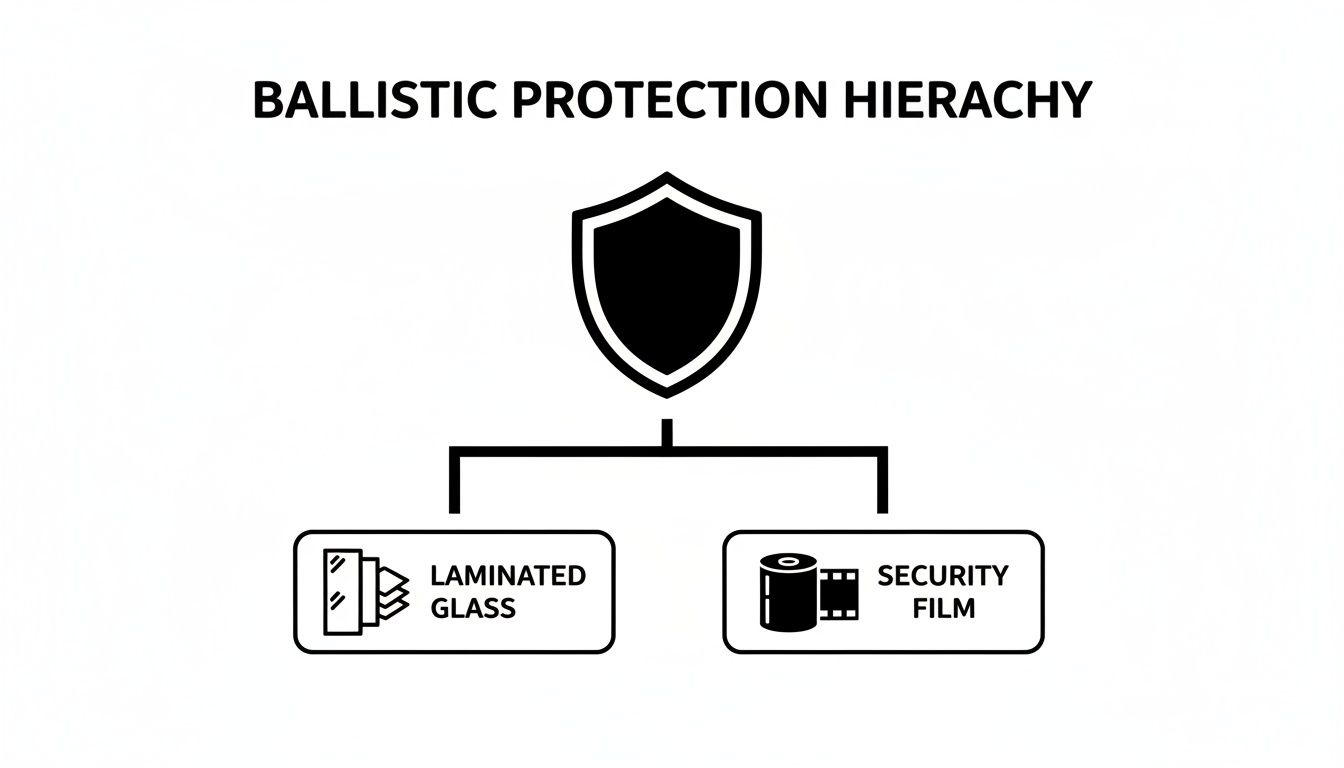
As you can see, both laminated glass and security films are powerful tools in a comprehensive security plan, each with its own set of advantages.
Matching Ratings to Your Needs
To make things easier, we’ve put together a simple breakdown of the most common NIJ levels. This table translates the technical specs into practical applications, helping you see at a glance which level is the right fit for your security goals.
NIJ Ballistic Resistance Levels Explained
A simplified breakdown of NIJ protection levels and the common threats they are designed to withstand, helping you choose the right level for your needs.
| NIJ Level | Protects Against (Common Handguns/Rifles) | Typical Use Case (Home, Retail, High-Security) | Security Film Equivalent |
|---|---|---|---|
| Level 1 | Small-caliber handguns (.22 LR, .380 ACP). Stops a minimum of 3 shots. | Homes, small businesses, low-risk retail. | Excellent. NIJ-rated films often meet or exceed this level. |
| Level 2 | More powerful handguns (9mm, .357 Magnum). Stops a minimum of 5 shots. | Banks, pharmacies, higher-risk retail stores. | Available. Requires specific multi-layer film systems. |
| Level 3A | High-velocity handgun rounds (.44 Magnum). Stops a minimum of 5 shots. | Police stations, government facilities, schools. | Yes. Top-tier NIJ-certified films can achieve this rating. |
| Level 3 | High-powered rifle rounds (7.62mm FMJ). Stops multiple rifle shots. | High-security government buildings, military bases. | Film alone is insufficient; requires laminated glass. |
| Level 4+ | Armor-piercing rifle ammunition. Highest level of protection available. | Critical infrastructure, embassies, military checkpoints. | Requires specialized, thick laminated glass composites. |
This table highlights something important: for the handgun-level threats that most homes and businesses face, advanced security films are a fantastic solution. In fact, they are often the ideal one. Modern systems, especially when installed by a certified pro, can achieve serious NIJ ratings without the cost and disruption of a full window replacement.
An NIJ rating is more than a technical spec; it's a promise of performance. It certifies that a product has been independently tested and proven to withstand a specific, defined threat, giving you verifiable peace of mind.
For many property owners, the ability to retrofit existing windows with a high-performance film is a complete game-changer. You can learn more about how NIJ-certified ballistic window film provides this level of defense discreetly and effectively. It’s a powerful barrier against both forced entry and ballistic threats, all while preserving the original look of your building.
Ultimately, choosing the right rated product means you’re investing in proven, reliable security tailored precisely to the dangers you aim to prevent.
Security Film Versus Laminated Glass
When you start looking into ballistic glass for sale, you'll quickly find yourself at a crossroads. Should you go with traditional, heavy-duty laminated glass, or retrofit your existing windows with an advanced security film?
Think of it like deciding whether to build a brand-new engine for your car or upgrade the one you have with a high-performance turbocharger. Both get you incredible power, but they take very different roads to get there.
Laminated glass has been the heavyweight champion of ballistic protection for a long time. It’s built like a tank, constructed by layering multiple sheets of glass with a tough polymer interlayer, usually polyvinyl butyral (PVB). The whole sandwich is then fused together with intense heat and pressure. What comes out is a thick, rigid panel that can stop some serious threats.
But that strength comes with major baggage. Laminated glass is incredibly heavy, which often means you need to structurally modify your window frames and sometimes even the building itself. The installation is a full-blown construction project—think demolition, replacement, and a lot of disruption. This makes it a much better fit for new construction where its weight and bulk can be planned for from day one.
The Modern Alternative: Security Film
Ballistic security film offers a smarter, more nimble way to fortify your windows. Instead of ripping out the entire window, these multi-layered polymer films are professionally applied right onto your existing glass. This simple upgrade transforms a standard pane of glass into a formidable, bullet-resistant barrier, all without changing how it looks.
It’s like adding a layer of invisible armor. The film is engineered to absorb and spread the energy of an impact across the entire window. So, even if the glass shatters, the film tenaciously holds all the shards together, preventing anything—or anyone—from getting through. This is a massive advantage in both ballistic and forced-entry situations.
For most property owners—especially in retail, schools, and even homes—this retrofit approach is a game-changer. The latest market data shows a strong shift toward these modern solutions. NIJ-certified films allow for cost-effective upgrades that can slash replacement needs by up to 70% compared to a full laminated glass installation. Better yet, these ballistic upgrades have been shown to reduce forced-entry success by 85% in commercial buildings. You can dig deeper into these trends and their effect on the bullet-proof glass market.
A Head-to-Head Comparison
To really see the difference, let’s put these two solutions side-by-side and compare what matters most: cost, installation, and aesthetics.
| Feature | Laminated Ballistic Glass | Ballistic Security Film |
|---|---|---|
| Installation | Highly disruptive; requires full window and frame replacement. | Minimally disruptive; applied directly to existing glass. |
| Timeline | Weeks to months, including manufacturing and construction. | Typically completed within a few days, sometimes even one. |
| Cost | Significantly higher due to materials, labor, and potential structural work. | Far more cost-effective; leverages existing infrastructure. |
| Aesthetics | Can alter the building's look; frames may need to be thicker. | Virtually invisible; preserves the original architectural design. |
| Weight | Extremely heavy, often requiring frame and building reinforcement. | Adds negligible weight, compatible with almost any window. |
This breakdown makes it pretty clear why security film is the go-to choice for upgrading existing buildings.
The core value of security film lies in its ability to deliver robust, NIJ-rated protection without forcing a compromise on budget, time, or the architectural integrity of your property.
Practical Application Scenarios
Let's walk through a few real-world examples where this decision is critical:
- The Historic Building Owner: Imagine you own a landmark property with beautiful, ornate window frames. You need better security, but laminated glass would mean destroying that historic architecture. Ballistic security film is the perfect solution, giving you modern protection while remaining completely invisible and preserving the building’s character.
- The Luxury Retailer: A high-end boutique needs to secure its storefront immediately after a nearby smash-and-grab. A full window replacement isn't an option—it would mean closing the store for weeks. Security film can be installed quickly, often overnight, providing an instant defense with zero business interruption.
- The New School Construction: A school is being built from the ground up, and security for the main entrance is a top priority. In this case, the architects can design the structure to handle the weight of laminated glass, integrating it into the new build for permanent, maximum protection right from the start.
Ultimately, the choice between film and laminated glass comes down to your unique situation. Laminated glass offers immense strength when you can plan for it, but for the vast majority of security upgrades, security film provides a powerful, practical, and accessible solution.
How Ballistic Glass Is Used In The Real World
Theory is one thing, but seeing how this technology performs in the real world is where its value truly clicks. Ballistic-rated glass and films solve very real problems for people every day, often in ways you'd never notice just by looking. Let’s walk through a few scenarios where these security upgrades made a critical difference.
These examples show just how flexible and effective modern security can be when it moves off the spec sheet and into a practical, life-saving role. Each case tackles a specific threat, showing how the right solution offers a powerful, yet discreet, defense.
The Luxury Boutique And The Smash-And-Grab Threat
Picture a high-end jewelry store on a busy city street. Its most valuable assets—gleaming watches and diamond necklaces—are also its biggest weakness, showcased behind large panes of glass to entice shoppers. The owner knew all too well about the alarming rise in smash-and-grab robberies, where a crew can shatter a window and vanish with tens of thousands of dollars in merchandise in less than a minute.
Tearing out the entire storefront to install thick, laminated ballistic glass just wasn’t practical. The cost would have been astronomical, the store would be closed for weeks, and the heavy-duty glass might have spoiled the boutique’s airy, inviting feel.
The smarter move? A retrofit. The owner chose a professionally installed, NIJ-rated ballistic security film. Applied directly to the existing glass, the installation happened with zero disruption to the business. The film is optically clear, so the jewelry still sparkles, but that once-fragile storefront is now a hardened barrier. A would-be thief would find the glass stubbornly holds together, denying them the quick score they were counting on and buying precious time for police to arrive.
Securing A School Entrance For Critical Response Time
A private school was facing a different, but no less serious, challenge. Its main entrance was a bright, welcoming glass vestibule—a feature that a security audit flagged as a major vulnerability. An intruder could shatter the glass and be inside the school in a matter of seconds.
The school's objective was to fortify this entry point to delay any potential threat, giving them enough time to trigger a lockdown. A complete ballistic glass replacement was considered, but it would have eaten up a massive chunk of their security budget.
Instead, they retrofitted the vestibule's existing glass with a multi-layer security film system. This upgrade brought the entrance up to an NIJ rating capable of stopping rounds from common handguns, effectively hardening the entire access point. Now, that vestibule acts as a critical buffer zone in an emergency. It buys the minutes needed for staff to secure classrooms and for first responders to get on site, transforming a weak point into a strategic defensive line.
The most effective security solutions are often the ones you don't see. They work silently in the background, preserving a building's intended atmosphere while providing a formidable layer of protection against unexpected threats.
To get a sense of how different threats are managed in commercial settings, it's helpful to look at the full spectrum of protective options, including specialized products like fire shutter window solutions. Each solution is engineered to counter a specific risk, from fire containment to forced entry.
Protecting A Modern Home Without Sacrificing The View
Finally, let’s look at a modern home with gorgeous floor-to-ceiling windows and sweeping panoramic views. The homeowners cherished the natural light and open design, but they were also worried about the possibility of a home invasion. They knew that standard window glass offers almost no resistance to a determined intruder.
They needed to boost their security without resorting to bars or shutters that would destroy their home's aesthetic. The goal was a solution that was incredibly strong but completely invisible—a perfect job for a high-end residential security film.
By having a clear, ballistic-rated film applied to their windows, the homeowners added a powerful, unseen layer of defense. The film doesn't just protect against bullets; it’s a fantastic deterrent against forced entry. Anyone trying to break the glass is met with a frustrating and loud ordeal as the film keeps the shattered pane from collapsing. This gives the family more than enough time to react and call for help, all without compromising the very views that made them fall in love with the home.
What To Expect During The Installation Process
Deciding to upgrade your building’s security with a ballistic-rated system is a big move. For many property owners, the first question is about the installation itself. Will it be a huge, disruptive construction project?
Thankfully, no. Modern systems, especially security films, are designed for a surprisingly clean and efficient installation. It’s a far cry from the mess and noise you might be picturing. A professional job is a precise, well-managed process that respects your property and your time from start to finish.
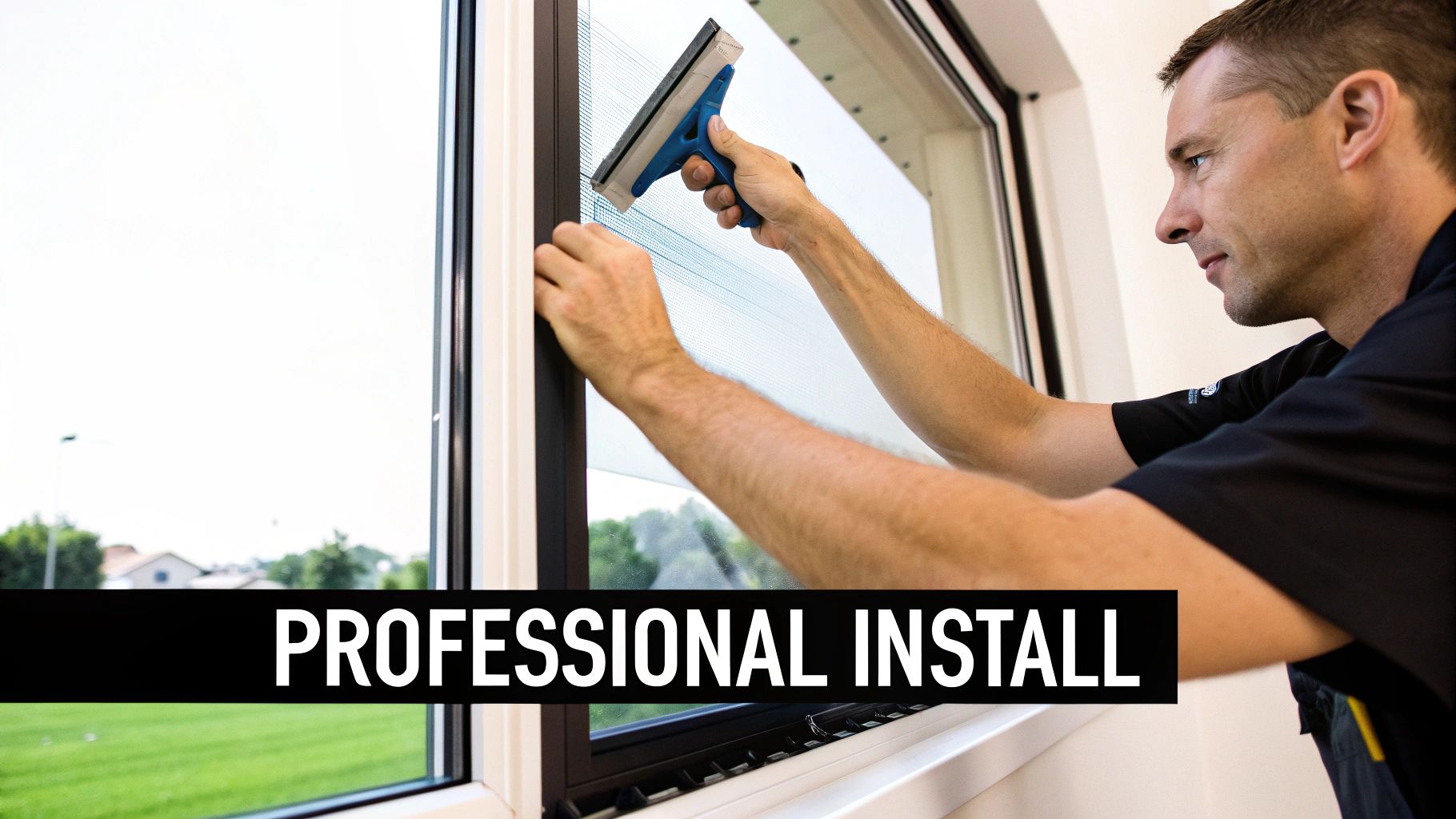
The Security Film Installation Journey
Retrofitting your windows with security film is designed to be as streamlined as possible. Instead of ripping out entire windows—a process that involves demolition and serious downtime—this method works with the glass you already have.
It all starts with a detailed consultation. A certified technician will come to your property to understand your security concerns and assess vulnerabilities. They’ll take exact measurements of every pane of glass to be treated, ensuring the film fits perfectly from edge to edge.
Once the film is custom-cut for your windows, the on-site work begins. Here’s a step-by-step look at what happens:
- Thorough Glass Preparation: First, the technicians deep-clean the interior surface of your windows. This is a critical step; any speck of dust or residue could compromise the bond and create imperfections.
- Precise Film Application: The film is then carefully applied using a special solution that allows the installer to slide it into the perfect position. Using professional-grade squeegees, they methodically work out every drop of moisture and every air pocket, leaving behind an optically clear finish.
- Anchoring System Integration: For higher NIJ ratings, an anchoring system is almost always part of the install. This system mechanically fastens the film directly to the window frame. It creates an incredibly strong bond that helps the entire window unit—glass, film, and frame—absorb and distribute impact force.
- Final Inspection and Curing: After the application is complete, the technician does a final quality check. The film then needs to cure, a process that can take several days. During this time, any remaining microscopic water particles evaporate through the film, leaving a crystal-clear, fully bonded protective layer.
The quality of the installation is just as important as the quality of the film itself. A certified technician ensures the system performs exactly as it was tested and rated, giving you genuine, reliable protection.
Film Versus Laminated Glass Installation
The difference between installing film and replacing a window with laminated ballistic glass is night and day.
Swapping out a window for heavy, multi-layered ballistic glass is a full-blown construction project. It typically involves removing the old window and frame, sometimes even modifying the wall to handle the extra weight, and then installing the new, cumbersome unit. This kind of job can take weeks and brings all the noise, dust, and disruption you'd expect from a renovation.
Security film installation, on the other hand, is a clean, quiet process that’s often done in just a day or two, depending on the size of the job. This makes it a fantastic solution for active businesses, schools, and homes where you simply can't afford to shut down operations. You can learn more about the specifics of a professional security window film installation and how the process is adapted to minimize any interruption to your daily routine.
Ultimately, choosing a modern retrofit solution means your property gets secured quickly and professionally, without the massive headache of a major construction project.
Why A Certified Installer Is Non-Negotiable
Buying a top-rated ballistic film or glass system is only half the job. Even the most advanced materials in the world are useless if they aren’t installed with absolute precision. That’s why your choice of installer is every bit as critical as the product itself—the installation is what truly activates the system's protective power.
Think of it like this: you could buy the best high-performance engine on the market, but if a shoddy mechanic installs it with loose bolts or misaligned parts, it won't just underperform. It will fail spectacularly right when you floor it. The same exact principle applies to your security.
The Anatomy Of A Professional Installation
A certified installation is so much more than just sticking a film to a window. It’s a meticulous process that ensures every component—the glass, the film, the frame—works together as a single, unified barrier to stop a threat. This is especially true for systems that use an anchoring mechanism, which mechanically fastens the filmed glass directly to the window frame.
This anchoring step is what allows the incredible force of an impact to spread across the entire structure, keeping the whole window from just being blasted out of the wall. An uncertified installer might cut corners here, or skip it entirely, creating a hidden and catastrophic weak point.
A certified installation isn't just another line item on a quote. It's the final, critical manufacturing step that happens on-site, turning a box of high-tech materials into a real, functional security barrier.
Your Vetting Checklist
When you're looking for ballistic glass for sale, you have to vet the installer with the same intensity you use to vet the product. A truly professional provider will be transparent, confident, and ready to answer every single one of your questions.
Here’s a practical checklist to help you make the right call:
- Certifications and Licensing: Ask for proof. Can they show you current NIJ and ASTM certifications for the products they install? Are they fully licensed and insured to work in your state and city?
- Relevant Experience: Have they done this before? Ask to see a portfolio of projects similar to yours, whether it's for a business, a school, or a home.
- Product and Labor Warranties: What happens if something goes wrong? A good company offers a warranty on the installation itself, completely separate from the manufacturer’s product warranty.
- Technical Expertise: Do their people actually know what they’re doing? Find out if their technicians have specific, formal training on the complex anchoring systems required for ballistic installations.
Taking shortcuts on installation is a direct compromise on safety. This holds true for other critical home services, where understanding the value of hiring a restoration professional after a disaster can mean the difference between a real recovery and a lingering problem.
Choosing a certified provider like Fortress Security Films means your investment will perform exactly as it's supposed to when it counts. Professional installation of our NIJ-certified ballistic solutions delivers genuine peace of mind, transforming a simple purchase into a reliable security asset that protects what matters most.
Answering Your Questions About Ballistic Protection
When you start looking into ballistic glass, a few questions always bubble to the surface. It's completely normal. Getting straight answers is the best way to feel confident you're making the right investment for your property's safety. Let's tackle the most common ones we hear from property owners.
What’s the Price Tag on Ballistic Protection?
The cost really comes down to three things: the NIJ protection level you’re aiming for, how much glass you need to cover, and whether you go with new laminated glass or a retrofit film.
Laminated glass is the premium option, but it's also the most disruptive and expensive. It means tearing out your existing windows and frames for a full replacement. On the other hand, ballistic security films are significantly more budget-friendly. They work with the glass you already have, turning it into a powerful defensive barrier without the headache and cost of a major construction job. The best way to get a hard number is with a professional consultation tailored to your building.
Will Security Film Make My Windows Dark?
Not at all. This is one of the biggest misconceptions out there. High-quality security films are designed for exceptional optical clarity—they’re virtually invisible once installed.
You won't have to sacrifice natural light or sacrifice your view. The entire point is to add a formidable layer of protection that doesn't change how your building looks or feels. Security shouldn't get in the way of your aesthetic.
How Long Does This Stuff Actually Last?
When installed by a pro, ballistic security films are built to endure. These aren't temporary solutions. They come with robust manufacturer warranties, often covering ten years or more for commercial buildings. For homes, you might even see a lifetime warranty.
Upkeep is a breeze, too. You can clean your windows normally, just stick to non-abrasive cleaners. Your installer will give you all the care instructions you need to make sure the film lasts.
Remember, ballistic security film is more than just a one-trick pony. It’s a multi-hazard solution that excels at preventing forced entry, reducing blast damage, and keeping glass intact during severe weather. It boosts your safety against a whole spectrum of threats.
Ready to secure your property with a solution trusted by homeowners, businesses, and schools? Contact Fortress Security Films today for a professional security assessment and explore our NIJ-certified window film systems. Get your free consultation now.
