


When you hear the term ballistic film for windows, you might picture a sci-fi force field. The reality is a bit more down-to-earth, but no less impressive. This isn't your average window tint; it's a multi-layered security product designed to dramatically reinforce existing glass against impacts.
The core job of this thick, durable film is to hold shattered glass together. By doing this, it can seriously delay intruders and reduce the deadly hazard of flying glass from blasts or projectiles. Think of it as a crucial safety net, not a replacement for true bulletproof glass.
What Is Ballistic Film for Windows
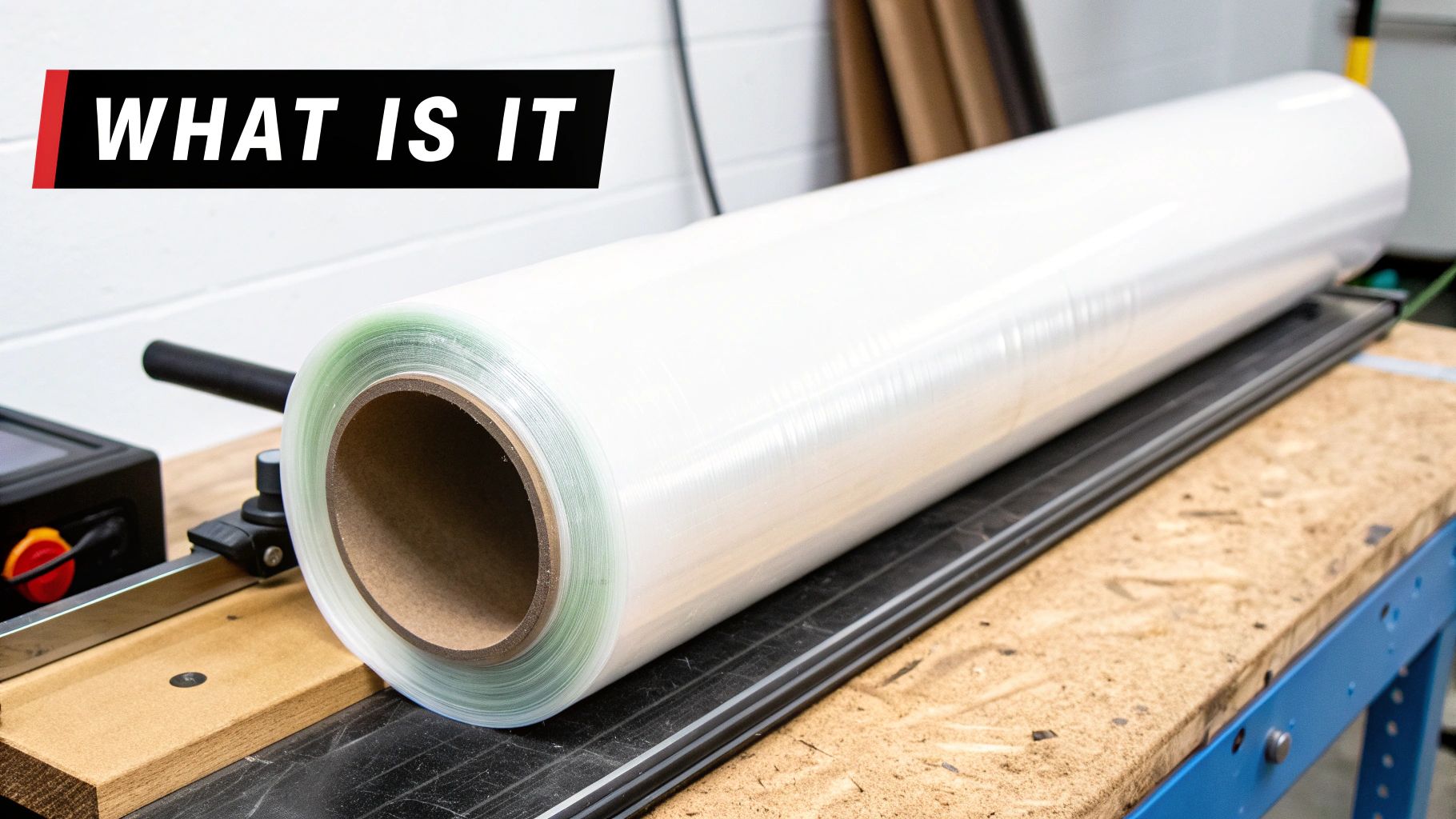
So, let's break down what this powerful security tool actually is. Instead of thinking of it as invisible armor, picture it as a high-tech reinforcement for your building's weakest points: its windows. The film's primary function is to absorb and spread out the energy from an impact, which is what stops the glass from shattering into a million dangerous pieces.
This isn't just a single sheet of plastic. It's a highly engineered product made of multiple layers of heavy-duty polyester, all bonded together with powerful adhesives. This construction creates a tough, resilient membrane—often 15 mils or thicker—that holds fast to the glass. When something hits the window, the glass will likely crack, but the film’s grip keeps all those broken pieces locked tightly within the frame.
Setting Realistic Expectations
It’s really important to get the terminology right here. The name "ballistic film" can be a bit of a misnomer, making people think it renders glass completely bulletproof. That’s not the case. It’s far more accurate to call it "bullet-resistant" or, in industry terms, "anti-spall."
The whole point is to delay, deny, and protect. The film denies an attacker instant access, protects people inside from shattered glass, and most importantly, buys precious time for everyone to react and for help to arrive.
This delay is where the film truly shines. For a retail store, that extra time can stop a smash-and-grab robbery in its tracks. For a school or government building facing a worst-case scenario, those few seconds or minutes are absolutely invaluable. You can get a much deeper look into how these systems are tested and perform by exploring professional ballistic solutions.
How It Differs from Standard Security Film
While all security films make glass stronger, films rated for ballistic resistance are on a whole other level. The difference comes down to their construction, how they're installed, and what they're built to do.
- Thickness and Composition: Your standard security films usually fall in the 4 to 8 mil range. Films engineered for ballistic resistance are substantially thicker and are built with more complex polymer layers designed to handle extreme force.
- Anchoring Systems: This is a non-negotiable part of the system. For a film to provide any real resistance, it must be mechanically anchored to the window frame. This attachment physically bonds the filmed glass to the structure of the building, which keeps the entire pane from being knocked out of its frame.
- Threat Mitigation: A basic security film is great for stopping blunt force—think a hammer or a brick. Ballistic film for windows, on the other hand, is engineered to manage far greater energy levels, like the force from projectiles and even the shockwaves from an explosion.
How Ballistic Film Turns Your Windows Into a Shield
To get a real feel for how ballistic film for windows works, you have to stop thinking about the glass itself and start thinking about energy. The film’s real power isn't just its thickness; it’s in its ability to take a concentrated, violent impact and spread that force out over the entire window. It effectively turns a fragile pane of glass into a flexible, resilient barrier.
Think about what happens when a projectile hits a normal window. All that energy hits one tiny spot, and the glass has nowhere to send it. The result is an instant, catastrophic failure—an explosion of razor-sharp shards flying inward at high speed. This flying glass, called spall, is often what causes the most severe injuries.
Now, imagine that same impact on a window with a properly installed ballistic film system. The story changes completely.
The Science of Spreading the Blow
The secret is in the film's construction—multiple layers of a tough, high-tensile polymer. These layers are engineered to stretch and give under pressure, acting like a massive shock absorber. When a bullet or other object strikes the glass, the film catches it and immediately starts to dissipate the kinetic energy across the entire surface.
It’s a bit like a trampoline. If you drop a bowling ball in the center, the whole surface stretches to absorb the impact. The energy doesn’t stay in one spot; it spreads out through the flexible material. Ballistic film does the same thing for your window, absorbing the blow instead of letting it punch right through.
This energy dispersion is the key. It stops the glass from disintegrating on impact. The window might crack or even look like a spiderweb, but the film's incredibly strong adhesive holds all those dangerous fragments locked in place. The window remains a solid barrier.
This containment feature is huge. It keeps people inside safe from flying glass and, just as importantly, keeps the window sealed. An intruder can't just shatter the glass and walk in; the barrier holds, buying you precious time.
It's a System, Not Just a Sticker
While the film gets all the attention, it's actually just one part of a three-part system. On its own, even the best film can't deliver true ballistic-level protection. For that, you need two other critical components: a specialized adhesive and a robust anchoring system.
Think of it as a team. The film, adhesive, and anchor have to work together perfectly to create a unified shield that’s far stronger than any one part.
Let's look at why you can't skip any of these pieces.
- The Aggressive Adhesive: This isn't your average peel-and-stick glue. We're talking about a specialized, permanent bonding agent that fuses the film to the glass. It creates a single laminated unit, ensuring the film can't be ripped away from the glass during an impact.
- The Frame Anchoring System: This is arguably the most important element for high-level security. The anchor is a mechanical system that fastens the film-and-glass unit directly to the window frame. This creates a physical bond that transfers the impact's force from the glass, through the film, and into the solid structure of the building itself.
Without an anchor, a powerful enough blow could just pop the entire sheet of glass out of its frame, film and all. The anchor ensures the whole system stays put, no matter what hits it.
From a Weak Point to a Stronghold
At the end of the day, a ballistic film system is all about managing failure. It accepts that glass will eventually break under enough force, but it changes how it breaks to keep people safe and a building secure.
The result is pretty remarkable. A window goes from being the most vulnerable point in a building to an active part of its security. It becomes a silent guardian, ready to absorb a threat, contain the danger, and give you the time you need to react when seconds are everything. That's the real value of a complete ballistic film system.
Decoding Ballistic Resistance Ratings and Levels
When you start looking into ballistic film for windows, it’s easy to get buried in technical jargon and bold claims. But to make a smart choice, you have to look past the marketing and understand the official standards that measure what these products can actually do. The term "ballistic film" gets thrown around a lot, but real performance isn't about the film alone—it's about the entire window system meeting specific, tested ratings.
This is where independent organizations like UL (Underwriters Laboratories) and the NIJ (National Institute of Justice) come in. They provide the critical benchmarks that separate proven protection from mere promises. Instead of taking a manufacturer's word for it, these ratings give you a clear, objective yardstick to measure how well a security system will hold up under fire.
Getting a handle on these levels is vital. Why? Because they tell you exactly what kind of threat a product is built to stop. A system designed to handle a small handgun is a world away from one made to stop something more powerful. This knowledge helps you set realistic expectations and find a solution that truly fits your security needs.
Making Sense of UL 752 Ratings
In the United States, the go-to standard for ballistic-resistant materials is UL 752. This isn't just a simple pass/fail test. It breaks down protection into different levels, where each level corresponds to a specific type of firearm, ammunition, and the number of shots the material must stop cold without being penetrated.
Here’s the most important thing to remember: ballistic film by itself doesn't achieve a UL rating. The film is just one piece of the puzzle. It has to be part of a complete system that includes a strong mechanical anchoring system, which fastens the filmed glass directly to the window frame.
The real goal of a rated system isn't just to stop a bullet. It's to stop the bullet and prevent dangerous spall—razor-sharp fragments of glass—from flying into the room. UL 752 tests for this specifically, making sure the "safe side" actually stays safe for anyone inside.
This is a non-negotiable distinction. A window that stops a projectile but sprays the room with glass shards has ultimately failed to protect people. True security lies in containing both the threat and the glass. It’s no surprise that the demand for these advanced systems is on the rise. The global bulletproof glass market, where ballistic films are a major component, was valued at USD 6.74 billion in 2021 and is expected to hit nearly USD 14.90 billion by 2029. You can discover more insights about this growing market on Fortune Business Insights.
Comparing Film Thickness to Performance
While the official UL rating is the ultimate measure of performance, the thickness of the film itself—measured in mils—gives you a good general idea of its strength. The thicker the film, the more energy it can absorb and dissipate.
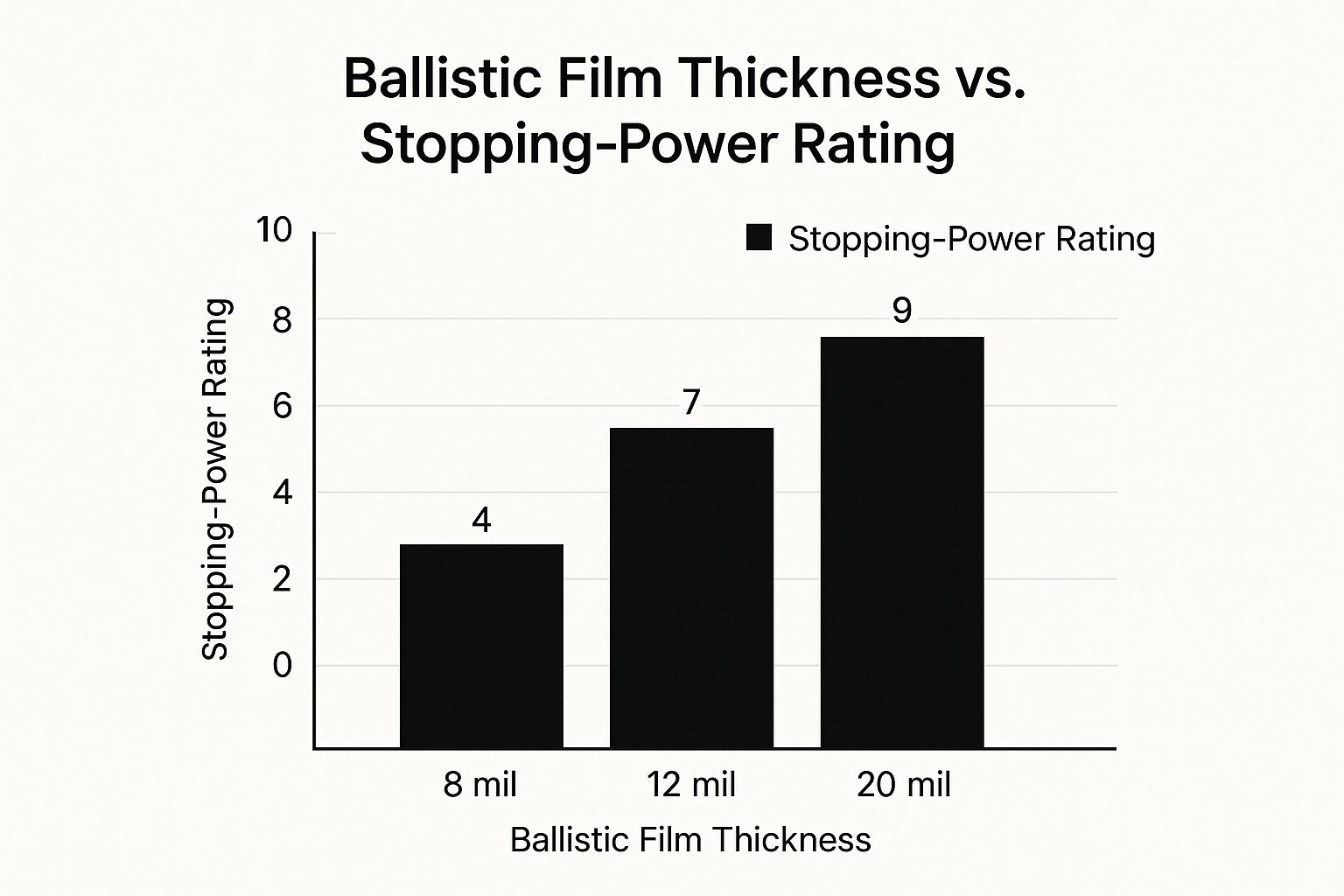
This visual really drives the point home. As you move from an 8-mil film up to a 20-mil film, the potential to contribute to ballistic resistance grows significantly. But remember, that potential is only unlocked when it's installed as part of a complete, professionally anchored system.
A Practical Look at Common UL 752 Levels
To bring these ratings out of the lab and into the real world, it helps to see what they actually mean. This table breaks down the UL 752 standard, showing the handgun caliber and number of shots each level is rated to withstand, helping you match a film's rating to your security needs.
Comparison of Common Ballistic Resistance Levels (UL 752)
| UL 752 Level | Rated to Withstand (Handgun Type) | Number of Shots | Common Application |
|---|---|---|---|
| Level 1 | 9mm Full Metal Jacket (FMJ) | 3 shots | Ideal for retail storefronts and offices at risk of smash-and-grab or lower-level threats. |
| Level 2 | .357 Magnum Jacketed Soft Point (JSP) | 3 shots | A step up for facilities requiring enhanced protection, like banks or high-value retail. |
| Level 3 | .44 Magnum Super-Penetrating Lead | 3 shots | Suited for high-risk locations like government buildings, police stations, and schools. |
Always keep in mind that these ratings apply to the entire system, not just a roll of film. The ballistic film for windows, the glass it's applied to, and the anchoring mechanism all have to work in perfect concert to achieve these levels of protection. Armed with this knowledge, you can ask installers the right questions and feel confident that the solution you choose is genuinely tested and certified for the threats you need to mitigate.
Real-World Applications of Ballistic Window Film
It’s one thing to talk about specs and materials, but where does ballistic film for windows actually make a difference? This is where the theory meets the pavement. In countless environments, this technology acts as a silent, invisible guardian, providing real protection for people where they live, work, and learn.
The goal isn't just about stopping a bullet; it’s about turning a building's most vulnerable entry points—its glass—into a formidable line of defense. From busy city storefronts to quiet suburban homes, the need to reinforce glass is universal. Ballistic film's ability to delay entry and contain dangerous glass shards makes it a surprisingly versatile fix for many modern security threats.
Protecting Commercial and Retail Spaces
Any business with street-facing glass is a potential target. Smash-and-grab robberies are all about speed; a criminal shatters a window, grabs what they can, and is gone in seconds. This is precisely the scenario where a ballistic-rated film system completely changes the game.
Even after repeated blows, the film holds the glass together. That quick, easy entry the intruder was counting on is gone. The delay is frustrating, noisy, and attracts attention—three things a criminal wants to avoid. More often than not, they’ll just give up and move on.
- Deters Theft: It foils criminals who rely on speed and surprise.
- Keeps Employees Safer: It protects staff from shattered glass and gives them a barrier against intruders.
- Guards Your Assets: By keeping the window intact, it prevents thieves from reaching high-value merchandise.
This is why demand is surging. The market for bullet-resistant glass and films, which includes ballistic films for window protection, was valued at USD 5.02 billion in 2024 and is expected to more than double by 2032. It’s a clear sign that businesses are getting serious about hardening their weakest points.
Securing Schools and Government Buildings
When it comes to schools, courthouses, and government offices, the stakes are much higher. Here, the priority is protecting people from targeted violence. In an active shooter situation, every single second is critical. Ballistic window film systems are an essential layer in a security strategy designed to buy precious time.
If an attacker tries to shoot through a window to get inside, a properly rated and installed film system can stop the projectile and keep the glass from collapsing. That delay is everything. It allows for lockdown procedures to be triggered and gives law enforcement the time they need to arrive and neutralize the threat.
The film’s job in these high-risk places isn’t to create an unbreakable fortress. It’s to slow an attacker down, contain the immediate danger, and save lives by creating a window of opportunity for everyone to respond.
This life-saving delay is why so many institutions are retrofitting their existing glass with these systems. You can see real-world examples of how these systems are put into place by looking at a portfolio of professional ballistic solutions.
Enhancing Residential Safety and Peace of Mind
Homeowners are also realizing the benefits that come with this level of protection. The same features that stop a smash-and-grab at a retail store are just as effective at preventing a home invasion.
Think about it: a burglar expects to break a glass door or window and be inside in a flash. Instead, they’re met with stubborn, unyielding resistance. The noise and effort required to get through not only thwarts the attempt but also alerts anyone inside, as well as the neighbors.
And the protection doesn't stop with intruders. In a hurricane or severe storm, the film can keep windows from shattering from high winds or flying debris. This prevents catastrophic damage to your home's interior and protects your family from injury. This dual-purpose benefit makes it a genuinely smart investment for anyone serious about home security.
How to Choose the Right Ballistic Film
Picking the right ballistic film for windows isn’t as simple as grabbing the thickest roll off the shelf. It’s a process that demands a hard look at your actual security needs. After all, the ideal setup for a downtown storefront is likely overkill for a quiet suburban home, and that same home’s system would be completely inadequate for a high-risk government building.
The absolute first step? A threat assessment. You have to get real about what you're trying to protect against. Answering that question honestly is the key that unlocks every other decision you'll make.
Start With Your Threat Assessment
Before you even glance at a product brochure, you need to map out your primary security concerns. Think of this as laying the foundation for your entire security upgrade.
- Forced Entry and Burglary: Is your biggest worry a criminal with a brick, hammer, or crowbar trying to smash their way in? This is the most common threat for most homes and businesses.
- Smash-and-Grab Robberies: For retailers, the game is speed. Criminals want to be in and out in seconds. Your goal here is to create a delay that makes the attempt not worth their while.
- Civil Unrest or Vandalism: Is your property in an area where protests, riots, or general vandalism could lead to intentional or accidental window damage?
- Active Threats: For schools, government offices, and corporate headquarters, the grim reality is that the main concern might be delaying an active shooter, buying precious time for people to react and for first responders to arrive.
Once you’ve identified your primary threat, you can start matching it to the capabilities of different film systems.
Key Factors to Evaluate in a Film System
With your threat level defined, you can now dig into the technical specs that actually matter. The goal is to find the sweet spot between performance, clarity, and long-term durability.
Film Thickness and Composition
Thickness is the most common starting point, and it’s measured in mils (one-thousandth of an inch). Your average security film runs 4-8 mils thick, but for true ballistic resistance, you’re looking at systems that are 15 mils or thicker. But don't get hung up on thickness alone. The quality of the multi-layered polymer construction and the adhesives used are just as important. A well-made 15 mil film can easily outperform a poorly constructed 20 mil one.
Remember, the film is just one component. True ballistic performance is only achieved when the film is part of a complete, professionally installed system.
The Necessity of an Anchoring System
I can't stress this enough: ballistic film without a mechanical anchoring system is just a strong sticker on your window. The anchor is what physically bonds the film-and-glass unit to the window frame. It’s the critical link that transfers the brutal force of an impact away from the glass and into the building's much stronger structure. Without it, the entire pane—film and all—will just get pushed in.
Optical Clarity
One of the best things about ballistic film for windows is that it offers incredible protection while being almost completely invisible. A high-quality film shouldn't distort your view, turn yellow over the years, or make your rooms feel dim. Always, always ask for samples to see exactly how the film looks on your specific type of glass before you commit.
Don't Overlook Secondary Benefits
Many of the best films on the market come with some fantastic extra perks. These can add a ton of value to your investment by making your space more comfortable and protecting your interior.
- UV Filtering: A good security film can block up to 99% of damaging UV rays. This is huge for preventing your furniture, floors, and artwork from fading over time.
- Solar Heat Rejection: Some films are also designed to reduce solar heat gain. This can make a noticeable difference in your cooling bills during the summer and keep the space more comfortable year-round.
It's no surprise that the market for these multi-functional films is booming. It's projected to grow from about USD 1.2 billion in 2024 to nearly USD 2.5 billion by 2033. This surge shows a clear demand for solutions that offer both serious protection and real-world daily benefits. You can read more about this market trend in this Verified Market Reports analysis.
Why Professional Installation Is Non-Negotiable
When you invest in ballistic film for windows, you're making a serious commitment to safety. But the film itself is only half the story. A high-performance product like this is only as good as its installation, which is exactly why a DIY approach is a critical—and potentially dangerous—mistake.
Think of it this way: with a simple decorative tint, a small bubble is just an eyesore. But with security film, a single imperfection becomes a catastrophic weakness. One speck of dust, a tiny air pocket, or an uneven edge creates a failure point that can compromise the entire system under impact.
The Precision of a Certified Installer
Certified professionals don’t just "install" film; they treat it like a surgical procedure because they know what's at stake. Their process is all about meticulous preparation and flawless execution, ensuring the system performs precisely as it was engineered to when it matters most.
Here’s what a professional brings to the table:
- Surgical Glass Preparation: The glass surface has to be absolutely perfect. Installers use specialized tools and cleaning agents to strip away every contaminant, creating the ideal surface for an unbreakable molecular bond between the adhesive and the glass.
- Contamination-Free Environment: Pros know how to control the environment to minimize airborne dust and debris during application. This is a crucial detail that’s nearly impossible to manage in a typical DIY setting.
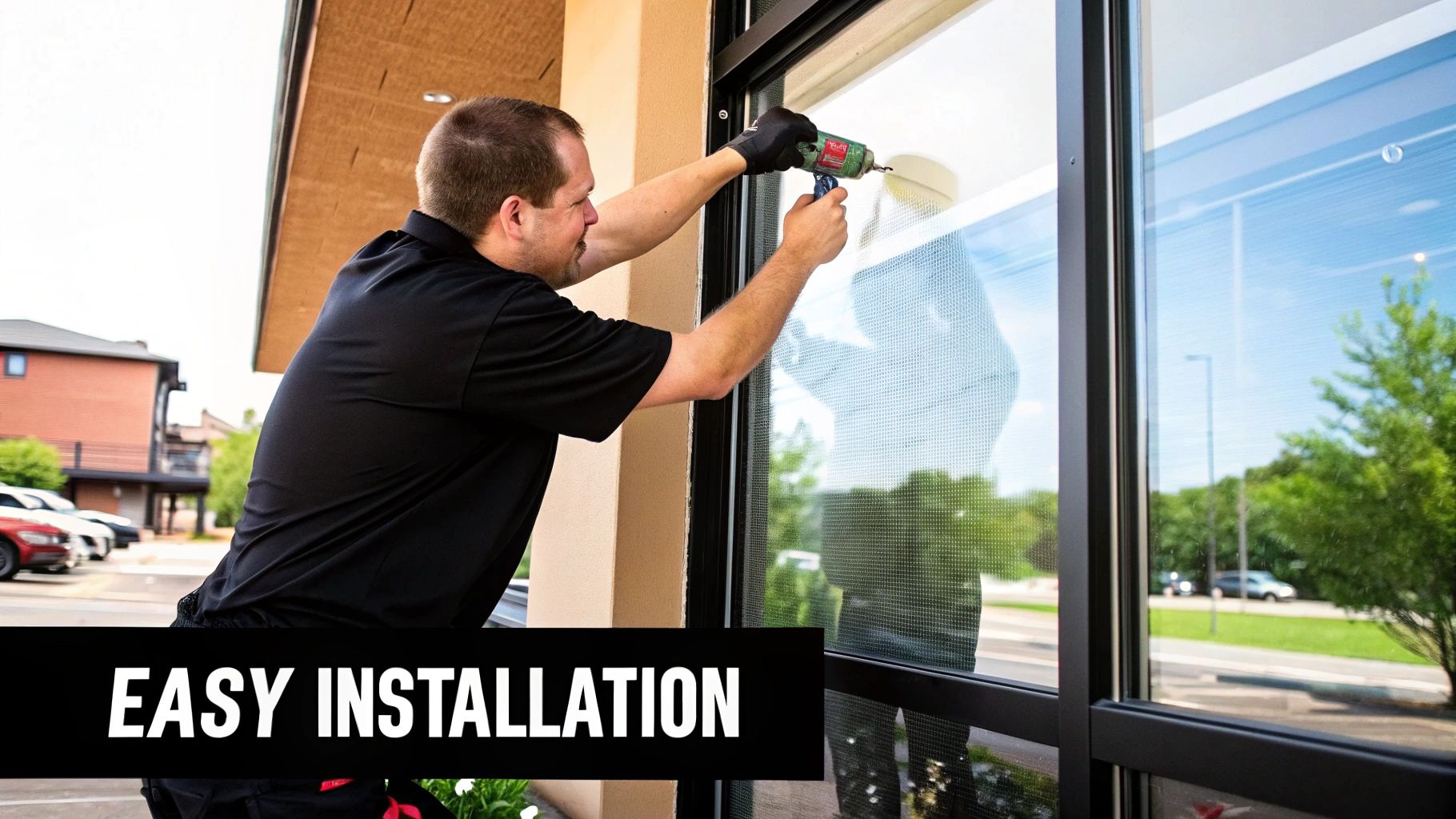
- Expert Anchoring: This is the most important step of all. A certified installer knows how to properly fit and secure the mechanical anchoring system, which fastens the film and glass directly into the window frame itself. This is what allows impact force to be transferred safely into the building’s structure.
A ballistic film system without a professional anchoring installation will not provide its rated level of protection. The film might hold the glass together, but the entire pane can be knocked out of the frame by a significant impact, defeating the purpose of the security upgrade.
Protecting Your Investment with Proper Care
Once a professional has installed your system, keeping it in prime condition is pretty straightforward. You just need to follow a few simple guidelines to protect its integrity for years to come. For a deeper dive, you can find more information on the professional window security film installation process.
To keep your ballistic film for windows performing at its best, follow these tips:
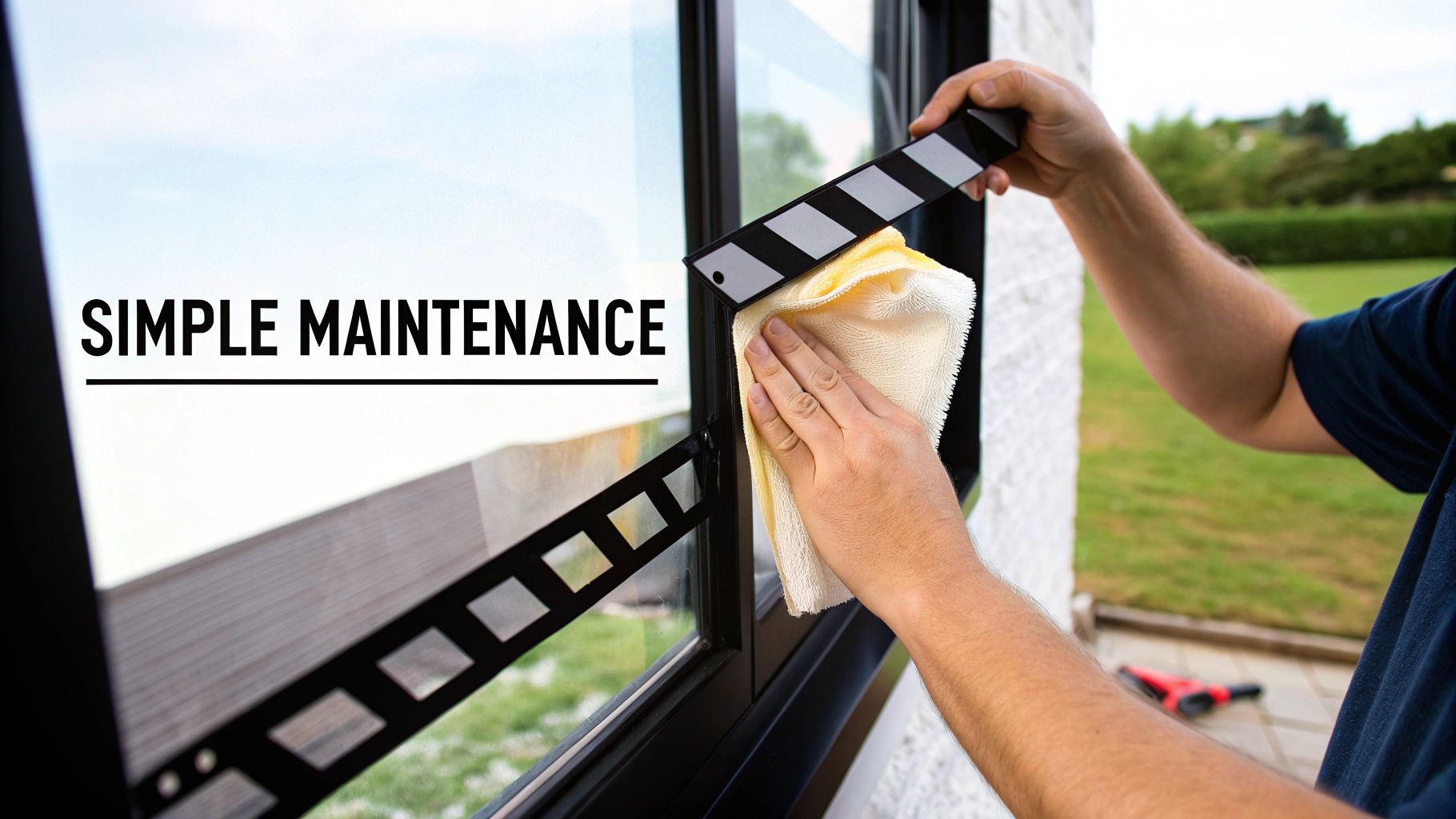
- Wait Before Cleaning: Let the film fully cure first. Your installer will give you a specific timeframe, but it's usually around 30 days. Cleaning too soon can interfere with the bonding process.
- Use Soft Materials: Always clean with a soft microfiber cloth or a clean synthetic sponge. Stay away from anything abrasive like paper towels or scouring pads, which can easily scratch the film's surface.
- Choose the Right Cleaner: A simple mix of mild dish soap and water is all you need. NEVER use ammonia-based cleaners. Ammonia can break down the film and its adhesive over time, ruining your investment.
By putting the installation in the hands of certified experts and following these basic care instructions, you can be confident your ballistic film system will deliver the full protection you paid for.
Got Questions About Ballistic Film? We've Got Answers.
When you're looking into a serious security upgrade like ballistic film for windows, you're bound to have questions. It’s a big decision, and you deserve straightforward answers to make sure you're getting the protection you expect. Let's tackle some of the most common questions we hear from clients.
We’ll cut through the confusion and give you a realistic look at how these systems work in the real world. Getting these key points straight is the first step toward choosing a solution that genuinely meets your security goals.
Is Ballistic Film Actually Bulletproof?
No, it isn't, and this is probably the most important thing to understand. The word "bulletproof" suggests nothing can get through, which simply isn't the case for any transparent material, including this film. A much more accurate term is "bullet-resistant."
So what does it do? The film's main job is to catch the glass and hold it together when it shatters from an impact. This prevents deadly shards of glass from spraying into the room and, just as importantly, makes it incredibly difficult for an attacker to get inside. It's all about delay.
Think of it less like a solid wall and more like a high-tech safety net. It absorbs the initial shock and denies an intruder the immediate entry they were counting on. That delay buys you precious, life-saving seconds for people to find cover, lock down, or escape while help is on the way.
It’s not an invincible shield, but it’s a powerful tool that can change the entire outcome of a violent event by giving you the time you need to react.
Does a Thicker Film Automatically Mean More Protection?
It’s a factor, for sure, but it’s not the whole story. While true ballistic-rated films are typically 15 mils or thicker, the real strength comes from the entire system working together. You can have the thickest film in the world, but it won't do much on its own.
A film's performance depends just as much on its chemical makeup, the quality of its adhesive, and—critically—the mechanical anchoring system that fastens it to the window frame. That anchor is what transfers the force of an impact from the glass into the building itself.
- Film Composition: The unique layers of polymers are designed to stretch and absorb massive amounts of energy without tearing.
- Adhesive Quality: A high-performance adhesive creates a permanent bond with the glass, ensuring the film and glass act as one.
- Anchoring System: This is the essential part that stops the entire sheet of filmed glass from being blown out of the frame.
A thick film without a proper anchor is a system designed to fail. It’s the combination of all three—film, adhesive, and anchor—that provides tested and reliable protection.
Can I Just Install Ballistic Window Film Myself?
With a product so directly linked to your safety, this is one area where professional installation is non-negotiable. Trying to DIY this to save a few dollars is a huge mistake.
Unlike a simple privacy film where a bubble is just an eyesore, any small flaw in a ballistic film installation is a critical weak point. A tiny piece of trapped dust or an air pocket can compromise the film’s bond to the glass, causing it to fail under attack. On top of that, a DIY job instantly voids the manufacturer’s warranty.
Most importantly, only a certified installer has the training and equipment to correctly install the anchoring system into the window frame. They know how to ensure the ballistic film for windows will perform exactly as engineered when it matters most, giving you the confidence that your property and the people inside are properly protected.
Ready to turn your windows into a resilient line of defense? The experts at Fortress Security Films can design a system tailored to your specific security needs. Contact us today for a professional security assessment.
