


Think of automotive security window film as invisible armor for your car's most vulnerable points: the glass. It's a remarkably tough, clear polyester film that gets applied directly to the inside of your windows. Its one and only job is to be incredibly strong and resistant to impact. This isn't your average window tint; this film is engineered to hold shattered glass together, turning a weak link into a formidable barrier.
Understanding Your Vehicle's First Line of Defense
It’s easy to confuse security film with the standard tint most people have seen, but they are worlds apart in their construction and purpose. While both can block UV rays and add privacy, security film is built from multiple, micro-thin layers of high-tensile polyester bonded with a seriously aggressive adhesive. This layered construction is the secret to its incredible tear and puncture resistance.
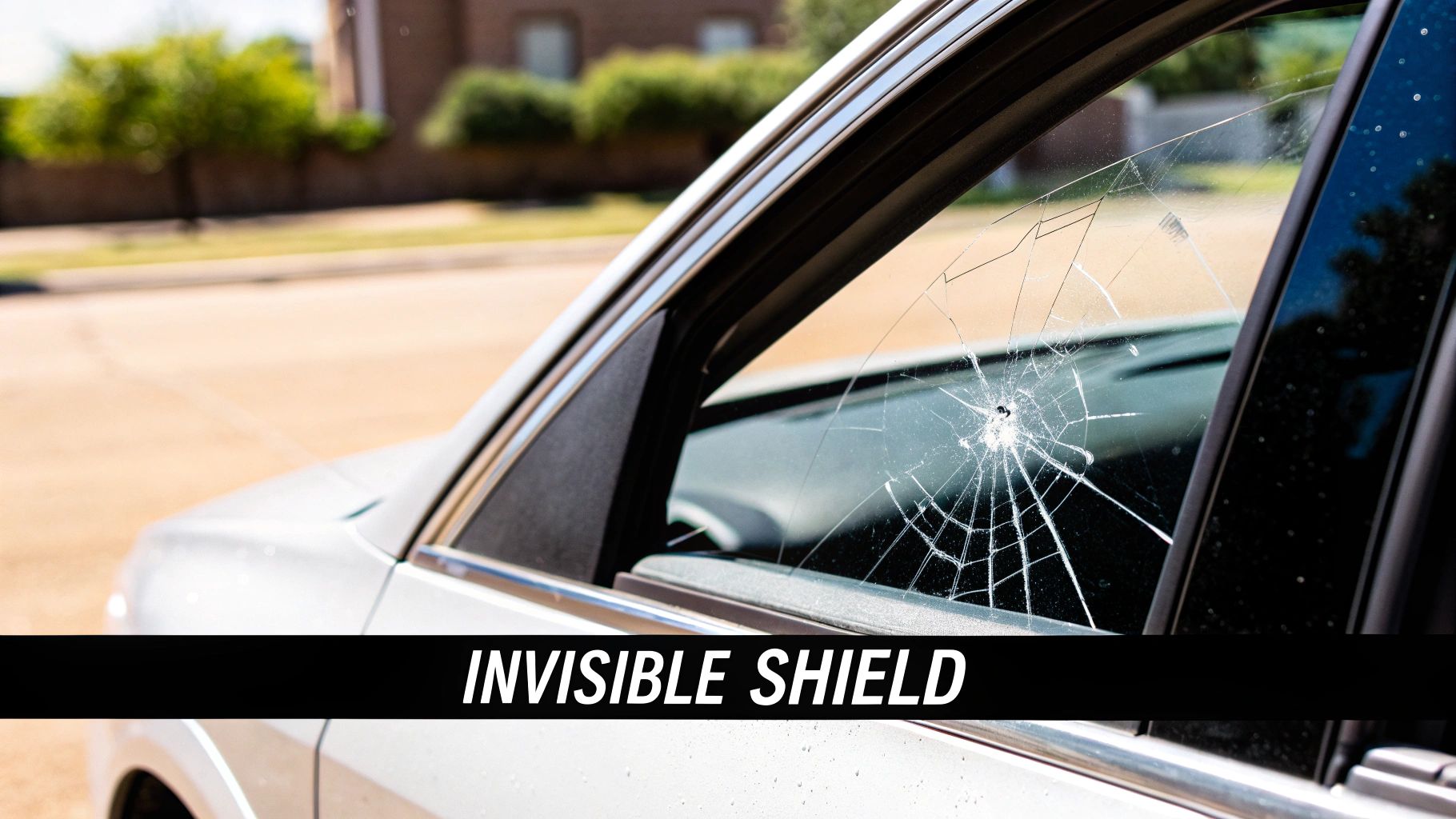
Here's a simple way to picture it: try tearing a single sheet of paper. Easy, right? Now, imagine trying to tear a stack of ten sheets that have been laminated together. It’s a whole different story. Security film operates on that same principle, using its laminated structure to absorb and spread the force of an impact across the entire pane of glass.
The "Spiderweb Effect" In Action
A fantastic way to visualize how this technology works is to think about what happens when a rock hits your windshield. With an untreated side window, a similar impact would cause the glass to explode into a mess of dangerous shards, leaving a wide-open invitation for a thief.
Now, picture that same window reinforced with security film. When it gets hit, the glass might still crack, but the film’s powerful adhesive clings to every last piece. The result is a contained, spiderweb-like pattern across the glass.
The window remains a solid barrier. It denies a thief the quick entry they need and protects you and your passengers from flying glass in a collision. That delay—even just a few seconds—is often all it takes for a criminal to give up and look for an easier target.
This "spiderweb effect" is the key to how the film works. It’s not about making the glass invincible; it’s about managing how the glass breaks to keep you safe and your car secure.
Key Characteristics That Make a Difference
This specialized film has a few defining features that separate it from purely cosmetic tints. Knowing what they are makes its value crystal clear:
- Serious Thickness: Security films are much thicker than standard tints, often measured in mils (a thousandth of an inch). More thickness equals more strength.
- Powerful Adhesive: The glue used is no joke. It's designed to create a permanent bond, effectively fusing the film to the glass.
- Impact Absorption: Its multi-layered design is made to flex and soak up energy from a blow, preventing the window from just blowing out.
At the end of the day, installing security film is a fundamental upgrade that transforms your car’s most fragile surfaces into a robust shield.
How Security Film Turns Your Window Into a Shield
Ever wonder how a thin film can make glass so tough? It's not magic, but some pretty clever engineering. Security window film is built from multiple layers of heavy-duty polyester, all bonded together with a seriously aggressive adhesive. This isn't like a sticker; the adhesive creates a powerful molecular bond, essentially fusing the film to the glass itself.
The best analogy is plywood. A single, thin piece of wood veneer is easy to snap. But when you laminate several layers together, crisscrossing the grain and bonding them with strong glue, you create something incredibly durable. Security film does the same thing for your windows, turning a fragile pane into a unified, shatter-resistant barrier.
Thicker Film, Tougher Glass
The real measure of a security film's strength is its thickness, which we measure in mils. One mil is just one-thousandth of an inch. To put that in perspective, a standard window tint is usually only 1-2 mils thick. A true security film starts at 4 mils and can go all the way up to 14 mils or more for maximum protection.
A thicker film has more mass and greater tensile strength, which allows it to absorb and spread out the force of an impact. This makes it a whole lot harder for a thief to smash their way through. It takes them more time and a lot more effort to get through a window with a thick film, and that's usually all it takes to make them give up.
A car thief wants a fast, silent target. The extra time and noise involved in breaking through a security-filmed window is a huge deterrent, often sending them looking for an easier mark.
This growing awareness among drivers is a big reason why the global automotive window film market is expected to hit $5.447 billion by 2025. People want solutions that protect their property and their families. This comprehensive market analysis dives deeper into those trends.
It's Not Just About Brute Force
Today's best security films don't just stop at impact resistance. The technology has evolved to bundle multiple benefits into one product, so you're getting a complete window upgrade, not just a security layer. Two of the most popular technologies you'll see are carbon and ceramic films.
Here's how they add even more value:
-
Carbon Film: This film is infused with tiny carbon particles. They're fantastic at blocking infrared light—the kind that makes your car feel like an oven—but they won't mess with your cell phone, GPS, or radio signals.
-
Nano-Ceramic Film: This is the top-tier stuff. It uses microscopic ceramic particles that don't conduct heat or interfere with electronics. The result is incredible heat rejection, crystal-clear visibility, and the best UV protection you can get, all in a film that will never fade.
So, when you install a quality security film, you're not just making your glass tougher. You're also making your cabin cooler, protecting your interior from sun damage, and blocking out harmful UV rays. It's a single upgrade that improves your vehicle's safety, security, and comfort all at once.
Real-World Benefits for Everyday Drivers
So, what does all this tech talk about automotive security window film actually mean for you behind the wheel? This is where the true value really shines through—in the moments you hope never happen, and in the small comforts you'll appreciate every single day.
Think about a classic smash-and-grab. You've parked your car to pop into a store, and a thief spots your laptop bag on the passenger seat. Without security film, it’s a matter of seconds: one sharp blow, the glass shatters, and they're gone with your stuff.
But with the film installed? That quick strike just makes a dull thud. The glass might crack into a spiderweb, but it stays locked in place, held together by the film. That thief doesn’t get instant access. The delay and the noise are exactly what they don’t want, and more often than not, it's enough to make them give up and run.
More Than Just Theft Prevention
The protective power of security film goes way beyond stopping criminals. Let's talk about car accidents. In a side-impact collision, an unprotected window can instantly explode inward, spraying tiny, razor-sharp shards of glass all over you and your passengers.
Security film changes that dangerous equation entirely. It acts like a safety net, catching and holding the broken glass together.
This one feature turns a major hazard into a much more manageable situation. By containing the glass, the film helps prevent serious cuts and eye injuries while also keeping the window frame intact, which is a small but important part of your car's overall structural safety during an accident.
This is what that protection looks like in action.

As you can see, the reinforced glass holds up against the impact, stopping a would-be thief dead in their tracks and preventing the window from shattering.
Everyday Comfort and Health Perks
The benefits don't just kick in during an emergency. A quality security film makes every drive better. Here’s how:
- UV Ray Blockage: Good films block up to 99% of damaging UV rays. Think of it as sunscreen for your car's interior. It stops your dashboard from cracking and your seats from fading over time.
- Skin and Eye Safety: That UV protection isn't just for your car; it's for you, too. Constant sun exposure while driving adds up, and this film provides a crucial shield for your skin and is important when you consider how UV rays can affect your eyes.
- Superior Heat Rejection: The film also blocks the infrared rays that make your car feel like an oven on a sunny day. Your cabin stays noticeably cooler, meaning you can ease up on the A/C, save a little fuel, and actually get into a comfortable car from the start.
It's this combination of safety and comfort that has people taking notice. The global automotive film industry, valued at $12.01 billion, is expected to more than double to $26.33 billion by 2030. That's a clear sign that drivers everywhere are seeing the practical, everyday advantages of an upgrade like this.
How to Choose the Right Film for Your Car
Picking the right security film for your car might seem overwhelming with all the technical jargon, but it really just comes down to a few key numbers. Once you know what they mean, you can confidently choose a film that gives you the exact protection and comfort you're after.
The first and most important spec is film thickness, which is measured in mils. For perspective, one mil is just one-thousandth of an inch. A typical cosmetic tint is only 1-2 mils thick and won’t do much against a determined thief. Real security films start at 4 mils, but for serious protection, you can go all the way up to 14 mils or even thicker. The rule is simple: more thickness means more strength.
Decoding the Spec Sheet
Beyond just brute force, the film's daily performance is defined by a few other metrics you’ll see on the spec sheet. Getting familiar with these will help you compare products and understand the different general window tint options out there.
- Visible Light Transmission (VLT): This is just a fancy way of saying how dark the tint is. A lower VLT number means a darker film, giving you more privacy. Just be sure to check your local laws, as they often have limits on how dark your windows can be.
- UV Rejection: This one’s a big deal for your health and your car’s interior. Look for films that block over 99% of UV rays. This protects your skin from sun damage and stops your dashboard and upholstery from fading and cracking over time.
- Total Solar Energy Rejection (TSER): This is the ultimate measure of how well a film keeps your car cool. TSER accounts for all the sun's energy—visible light, UV, and heat-carrying infrared rays. A higher TSER means a cooler cabin, which is a lifesaver on a hot day and even helps your A/C run more efficiently.
A common mistake is thinking darker is always better for heat rejection. That's not the case anymore. Advanced nano-ceramic films can be incredibly light and clear but still block more heat than a much darker, old-school dyed film.
Comparing Standard vs Nano-Ceramic Films
When it comes to security films, your main choice will be between a traditional polyester film and a modern nano-ceramic one. Both add a layer of security, but that’s where the similarities end. Nano-ceramic technology is a huge leap forward, providing benefits that older films just can't match.
To help you decide what’s right for your needs and budget, let’s break down the key differences between these two types of security films.
Security Film Performance Comparison
This table compares the main performance metrics for standard security films and their advanced nano-ceramic counterparts, helping you see where each one shines.
| Feature | Standard Security Film | Nano-Ceramic Security Film |
|---|---|---|
| Primary Goal | Impact resistance & basic UV protection | All-in-one: Impact resistance, elite heat rejection, clarity |
| Heat Rejection | Moderate | Excellent; blocks infrared heat without a dark tint |
| Signal Interference | Possible with metallic films | None; non-metallic construction is signal-friendly |
| Clarity | Good | Exceptional; virtually invisible with no haze |
| Cost | More affordable | Premium price for superior performance |
In the end, it’s all about finding the right balance. Standard films are a great, budget-friendly way to add a solid layer of protection. But if you also want top-tier heat rejection and perfect clarity without any signal interference, investing in a nano-ceramic film is absolutely worth it.
Getting It Installed Right and Staying Legal
When it comes to automotive security window film, the quality of the installation is just as important as the quality of the film itself. This isn't a DIY weekend project. Think of it less like applying a sticker and more like a high-tech bonding process. A sloppy job with bubbles, trapped dirt, or peeling corners completely undermines the film's ability to protect you.
Professional installers have this down to an art. The process starts with an intense, almost microscopic cleaning of the glass to get rid of any speck of dust or oil. This step is non-negotiable because it allows the film's powerful adhesive to form a seamless, molecular-level bond with the window—that’s where the real strength comes from.
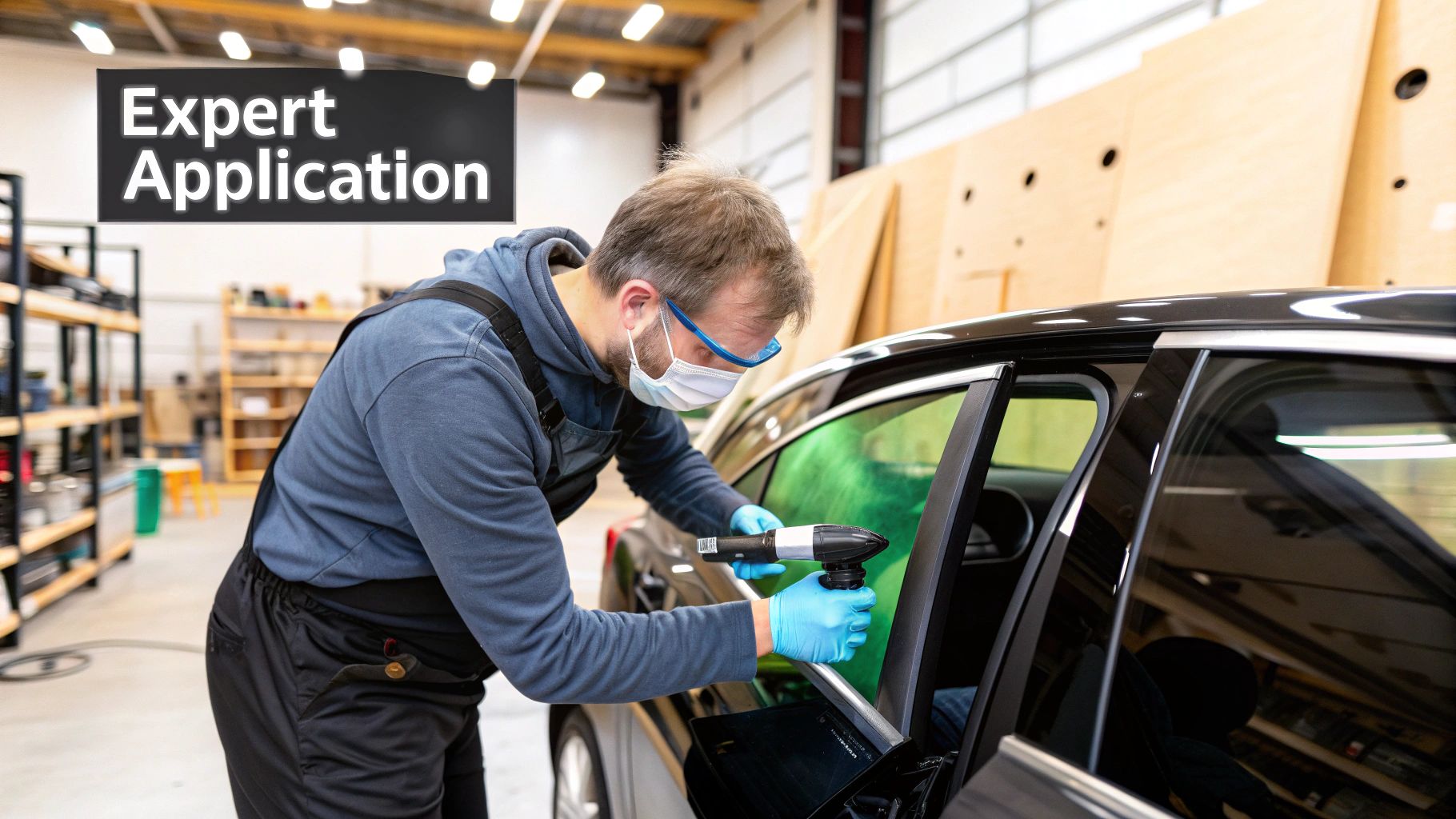
Once the film is on, it needs time to "cure." This can take a few days as the last bits of moisture between the film and the glass evaporate. It's during this curing phase that the adhesive fully sets and the film achieves its maximum protective strength, creating that tough barrier you're counting on.
Navigating Window Tint Laws
Before you even think about which film to buy, you need to know the law. Window tint regulations are a patchwork of local and state rules, and they can vary dramatically from one place to the next. The key term you'll hear is Visible Light Transmission, or VLT.
VLT is just a fancy way of saying how much light the film lets through. A lower VLT number means a darker tint. For instance, a 5% VLT is the super-dark "limo tint," while a 70% VLT is so light you'd barely notice it's there.
Police have VLT meters to check for compliance, and the rules are very specific about which windows can be how dark.
Here's a quick look at how these laws are typically structured:
- Front Side Windows: These almost always have the tightest restrictions. Many states require them to let in 35% VLT or more.
- Rear Side & Back Windows: The rules here are usually much more relaxed, often allowing for significantly darker films.
- Front Windshield: You generally can't tint the whole windshield. Most laws only allow for a non-reflective strip across the top, often down to what's called the "AS-1 line."
Getting this wrong can lead to hefty fines and an order to have the film professionally removed. The best first step is to check your state's specific laws. Any trustworthy installer will know the local regulations inside and out and can help you pick a security film that gives you the protection you want while keeping you on the right side of the law.
Common Questions About Automotive Security Film
So, you've seen what this film can do and how it works. But now we get to the practical stuff—the questions that pop up when you're seriously considering this for your own car. This is where we clear the air on cost, durability, and what this film can (and can't) realistically do.
My goal here is to give you the final pieces of the puzzle. An investment in your vehicle’s protection is a big deal, and you deserve to know exactly what you’re getting into. Let's tackle the questions I hear most often from drivers.
How Much Does Security Window Film Cost?
The honest answer? It varies. The final price tag depends on a few key things: the size of your vehicle, the specific film you choose, and even the labor rates in your area. Covering the glass on a big SUV is naturally going to cost more than a two-door coupe, just based on the square footage alone.
As a ballpark figure, you can expect to pay anywhere from $400 to $800 for a quality, professional installation on a standard sedan.
But if you’re looking at a top-of-the-line nano-ceramic film—the kind that offers incredible heat rejection along with its security features—the price for a larger vehicle could easily push past $1,000. It's definitely more than a standard window tint, but you're paying for a completely different product. This is a thick, multi-layered material engineered for impact resistance, and the installation itself is a meticulous skill.
Is This Film Actually Bulletproof?
This is probably the most common—and most critical—misconception out there. Let's be perfectly clear: automotive security window film is not bulletproof.
It's better described as "bullet-resistant," and even that term really only applies to the thickest, most specialized films. The core job of this film is to stop smash-and-grab thieves, keep glass from shattering all over you in a crash, and stand up to blunt force from things like a bat or a hammer.
While an extremely thick film (we're talking 12 mil and up) might slow a projectile down and reduce the deadly spray of glass fragments—a phenomenon called spalling—it will not stop a direct shot from a firearm. Think of it as an anti-intrusion barrier, not armor.
Its real-world power lies in delay. It buys you precious seconds, making a would-be thief give up and move on to an easier target.
Will It Interfere with My Phone or GPS?
Great question. Whether the film messes with your electronics depends entirely on what it's made of. Older, cheaper films often used tiny metallic particles to reflect heat. The problem is, that metal also blocks radio frequencies, leading to dropped calls, a spinning GPS icon, and a fuzzy satellite radio signal.
Luckily, technology has moved way past that.
High-performance films, especially the carbon and nano-ceramic types we see today, are engineered to be 100% non-metallic. They use advanced, microscopic particles that are fantastic at blocking heat and UV rays but are completely invisible to electronic signals. Just make sure to confirm with your installer that you're getting a modern, "signal-enabling" film, and all your devices will work just as they always have.
How Long Does It Last and How Do I Care for It?
When a certified pro installs a high-quality automotive security window film, it’s designed to last for the life of your vehicle. All the reputable brands back their products with a lifetime manufacturer's warranty covering nasty issues like bubbling, peeling, cracking, or the dreaded purple fade.
Taking care of it is simple, but you have to do it right.
- Give It Time to Cure: This is crucial. Don't roll down your windows for about a week after installation. The adhesive needs that time to fully cure and create a permanent bond with the glass.
- Clean Gently: Use a soft microfiber cloth and a cleaner that's ammonia-free. Honestly, a simple spray bottle with water and a couple of drops of mild dish soap is perfect.
- No Abrasives, Ever: Stay away from anything that could scratch it—scouring pads, razor blades, or any sharp tools. Scratches are permanent.
With just that little bit of care, your film will stay crystal clear and ready to protect you for years to come.
Ready to transform your vehicle's glass into a powerful barrier? At Fortress Security Films, we provide advanced, nearly invisible protection tailored to your needs. Strengthen your defense against modern threats and drive with confidence. Explore our automotive security solutions today.
